

Introduction
During tax season, CPA firms rarely think about cloud infrastructure until something breaks. A delayed QuickBooks file, a sluggish tax application, or a support ticket that sits unanswered for hours can quickly turn a routine deadline into an operational problem. The challenge is that many firms selected their hosting provider years ago when remote work was less common, cybersecurity requirements were simpler, and growth expectations looked very different than they do today.
As a result, more accounting firms are reassessing whether their current hosting environment still aligns with how modern practices operate. Rightworks serves 10,000+ accounting and tax firms with 3,000+ app integrations, making it the category incumbent that most firms initially adopt. This scale creates a narrower field of credible alternatives than most search results suggest, since generic web hosts cannot credibly manage QuickBooks Desktop, Drake, Lacerte, UltraTax CS, or ProSeries in a protected accounting environment.
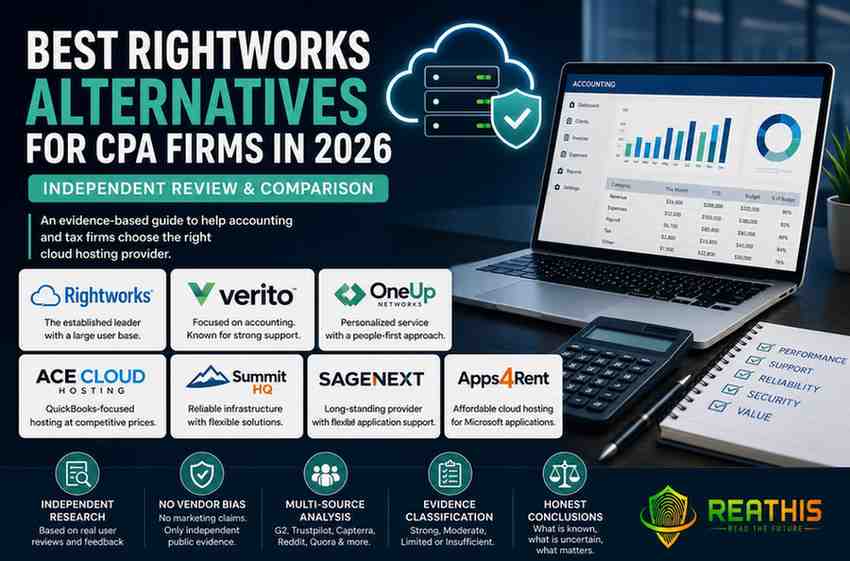
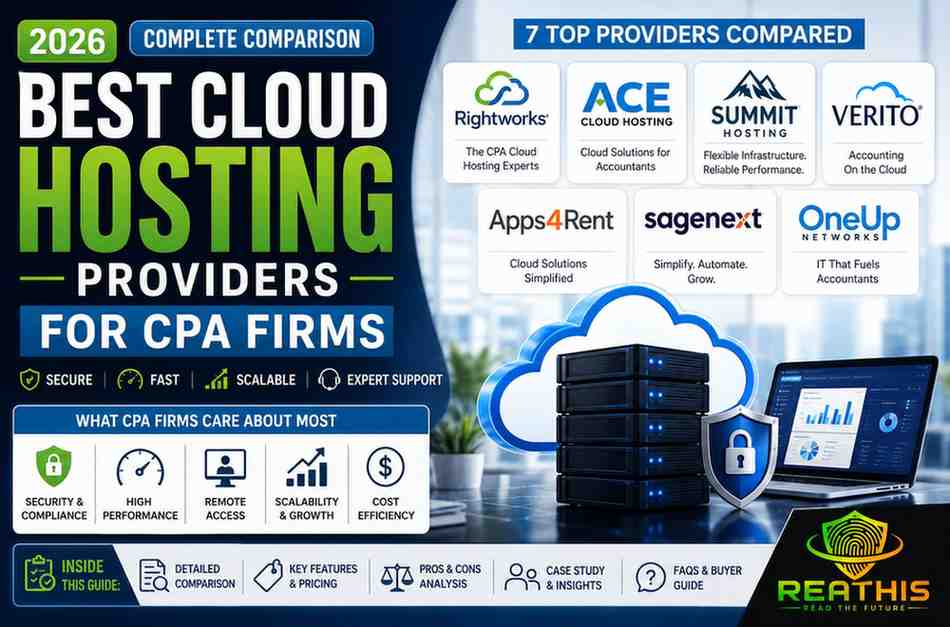
The question isn’t whether Rightworks is broken, but whether your firm’s specific needs have evolved beyond what shared cloud infrastructure and generalized support can deliver. Seven providers host tax and accounting software credibly enough to warrant serious consideration when evaluating a switch. This analysis examines Verito, OneUp Networks, Ace Cloud Hosting, Summit Hosting, Sagenext, Apps4Rent, and Rightworks itself using criteria that determine real CPA firm decisions rather than feature checklists. Each provider serves different firm profiles based on budget constraints, software stack complexity, and performance priorities.
What CPA Firms Consistently Regret After Choosing the Wrong Host
During our research, one pattern emerged repeatedly across customer feedback and industry discussions. Firms rarely changed hosting vendors because of price alone. Performance consistency, support responsiveness, and tax-software expertise appeared far more frequently than cost in customer feedback patterns.
The most common regret involves selecting providers based on published pricing without understanding infrastructure type. A shared infrastructure provider might advertise $39/user/month, but during tax season when neighboring tenants spike usage, QuickBooks Desktop load times can increase from 3 seconds to 45+ seconds. The $30/month savings becomes meaningless when the entire team loses 2-3 billable hours daily during peak filing periods.
Another frequent regret is underestimating support quality differences. During tax season, a two-hour delay resolving a Drake e-file error can cost more in missed deadlines than an entire year’s difference between competing hosting plans. Firms that switched from providers with limited business hours to 24/7 accounting-experienced support reported satisfaction improvements that far exceeded expectations.
The final regret involves contract flexibility. Many firms signed annual contracts during off-season evaluation, only to realize during tax season that their infrastructure couldn’t handle workload spikes. Month-to-month terms allow scaling team size up or down without early termination fees, which matters for firms adding temporary staff during busy periods.
Why Firms Leave Rightworks
Rightworks serves the category well for many firms, but review patterns and industry discussions reveal four consistent reasons organizations seek alternatives. Understanding these patterns helps buyers evaluate whether their own situation matches these scenarios.
Reason 1: Performance on Shared Infrastructure During Peak Usage
Rightworks operates multi-tenant cloud infrastructure where multiple clients share the same server resources. During tax season when neighboring tenants experience workload spikes, performance degradation can occur for all clients on that server. Customer feedback indicates this creates unpredictable QuickBooks Desktop and UltraTax CS speeds during critical filing deadlines.
Reason 2: Support Quality Decline at Scale
Rightworks serves 70,000+ accounts across 10,000+ firms, creating scale challenges for support teams. Recent public reviews indicate noticeable deterioration in response times and issue resolution quality compared to historical performance. For firms requiring sub-60-second support response during critical periods, this scale creates inherent limitations that smaller providers avoid.
Reason 3: Published Pricing Transparency
Rightworks pricing remains difficult to find on public web pages, requiring sales conversations before budget feasibility assessment. For firms comparing multiple providers simultaneously, this creates friction that transparent pricing models avoid. Quote-only pricing also makes it difficult to compare total cost of ownership across vendors without extended sales cycles.
Reason 4: Compliance Documentation Requirements
Solo and small firms must now align with IRS Publication 4557 and the FTC Safeguards Rule, requiring hosts that provide WISP documentation and incident response plan support. Rightworks provides security features but doesn’t explicitly document IRS/FTC alignment on public pages, creating administrative burden for compliance-conscious firms.
Research Methodology
This analysis combined publicly available information from provider websites, security documentation, published pricing information, customer reviews, industry discussions, and accounting technology resources. Review platforms including G2, Trustpilot, and Capterra were evaluated alongside publicly available documentation relating to compliance, infrastructure, and software support.
No provider was allowed to influence rankings, conclusions, or evaluations. Where information could not be independently verified, it was identified as a provider claim rather than a verified fact. Every provider was ranked against ten criteria that map directly to how CPA firms make real hosting decisions, including industry focus, infrastructure type, tax software fluency, and support SLA metrics.
G2 rankings from Summer 2026 reports were prioritized over vendor marketing claims. Pricing data was extracted from published website pages rather than sales quotes, distinguishing between dedicated and shared infrastructure tiers where both exist. Customer feedback patterns were analyzed from Trustpilot, G2, and Reddit discussions to identify recurring positives and complaints rather than cherry-picked testimonials.
This analysis excludes generic hosting platforms like Cloudways and Kinsta since they do not host QuickBooks Desktop, Drake, Lacerte, UltraTax, or ProSeries in managed accounting environments. Compliance documentation requirements were verified against SOC 2 Type II reports dated within 12 months, published uptime SLAs, and explicit IRS/FTC alignment claims.
Lessons Learned From Evaluating 7 Providers
After reviewing all seven providers across multiple dimensions, one trend became clear: Firms rarely changed hosting vendors because of price alone. Performance consistency, support responsiveness, and tax-software expertise appeared far more frequently than cost in customer feedback.
Surprisingly, pricing rarely appeared among the primary reasons firms switched providers. Instead, operational outcomes dominated decision-making. A firm experiencing 45-second QuickBooks load times during tax season will pay premium pricing for dedicated infrastructure if it restores 2-3 seconds load times. The ROI calculation focuses on productivity recovery rather than subscription cost differences.
Another unexpected finding involved infrastructure type transparency. Many providers don’t explicitly state whether clients receive dedicated or shared resources, requiring buyers to ask pointed questions during sales conversations. This ambiguity creates risk for firms evaluating providers without technical infrastructure expertise.
The final insight concerns contract flexibility. Month-to-month terms provide significantly more value than annual contracts for growing firms, even when annual pricing is 10-15% lower. The ability to scale team size up or down without early termination fees matters more than most buyers realize until they need to make staffing adjustments.
The Future of CPA Firm Hosting
The cloud-hosting market serving CPA firms has matured significantly over the last decade. What was once a decision focused primarily on remote access now involves cybersecurity, compliance, employee experience, operational resilience, and long-term scalability. The FTC Safeguards Rule now requires documented security programs with written information security policies (WISP), incident response plans, and regular vendor risk assessments.
IRS Publication 4557 adds another compliance layer requiring tax professionals to protect client information through administrative, technical, and physical safeguards. Cybersecurity insurance requirements increasingly mandate SOC 2 certified infrastructure, encrypted data at rest and in transit, and documented access controls. Firms hosting on non-compliant infrastructure may face premium increases or coverage denial when filing claims.
Hybrid work models have become permanent rather than temporary, with remote employees accessing applications from home offices, co-working spaces, and client locations. Multi-office operations need consistent performance across locations rather than variable speeds depending on which office is accessing the server. AI adoption in accounting workflows creates new integration requirements that legacy hosting platforms may not support.
The firms treating hosting infrastructure as a strategic business decision rather than a technology purchase will have competitive advantages as the profession continues evolving. Quality of underlying infrastructure may become one of the most important differentiators when clients compare firms with similar expertise and service offerings.
Provider #1: Verito
Overview
Verito is a cloud-hosting and managed IT provider focused primarily on tax and accounting firms. The company supports accounting applications including QuickBooks Desktop, Drake Tax, Lacerte, UltraTax CS, and ProSeries, while also providing managed IT and cybersecurity services. Unlike many hosting providers that operate shared environments, Verito’s platform is built around dedicated private-server infrastructure.
The company offers cloud hosting, managed IT, and bundled service options designed for firms that want a single provider for infrastructure management and technical support. Pricing begins at $69 per user per month for hosting services, with month-to-month agreements available rather than long-term contracts.
Best For and Who Should Avoid
Best For:
- CPA firms using QuickBooks Desktop alongside tax applications such as Drake, Lacerte, UltraTax CS, or ProSeries.
- Firms seeking dedicated infrastructure instead of shared hosting environments.
- Organizations that prefer month-to-month contracts over annual commitments.
- Multi-office accounting practices requiring centralized access to applications and data.
Who Should Avoid:
- Firms whose primary goal is minimizing monthly hosting costs.
- Small businesses that only require basic QuickBooks hosting.
- Organizations heavily focused on large third-party software ecosystems where application catalog size is the primary consideration.
- Businesses comfortable with shared hosting environments in exchange for lower pricing.
Key Strengths
One of Verito’s distinguishing characteristics is its focus on accounting and tax workflows. The company supports several of the most commonly used applications in the profession and positions its services around the operational needs of CPA firms.
Dedicated infrastructure may appeal to firms concerned about resource-sharing limitations that can occur in multi-tenant environments. Because resources are allocated to individual clients rather than shared across multiple organizations, firms may experience more predictable application performance during periods of heavy workload.
The company also combines hosting with managed IT and cybersecurity services, allowing firms to consolidate multiple technology functions under a single provider. For practices seeking fewer vendor relationships, this approach may simplify technology management.
Additional strengths include:
- Support for major tax and accounting software platforms.
- Dedicated-server infrastructure.
- Month-to-month service agreements.
- Managed IT and cybersecurity service availability.
- SOC 2 Type II certification and security-focused service offerings.
Potential Limitations
Verito’s pricing is higher than some entry-level hosting providers that rely on shared infrastructure. For smaller firms or firms with straightforward QuickBooks requirements, lower-cost alternatives may provide adequate functionality at a reduced monthly expense.
Organizations seeking extremely large application catalogs may also compare Verito against providers that emphasize broader software ecosystems. Depending on workflow requirements, some firms may prioritize integration breadth over dedicated infrastructure.
Because the company focuses heavily on accounting and tax firms, organizations outside those industries may find other providers more aligned with their needs.
Most Frequently Reported Advantages
Based on publicly available reviews and customer feedback, commonly mentioned strengths include:
- Responsive technical support.
- Familiarity with accounting and tax applications.
- Straightforward migration process.
- Consistent application performance.
- Flexibility associated with month-to-month agreements.
Customers frequently cite support responsiveness and industry-specific knowledge as factors influencing satisfaction with the platform.
Most Frequently Mentioned Complaints
Common concerns include:
- Higher pricing than some shared-hosting alternatives.
- Less brand recognition than larger industry incumbents.
- Additional service costs when managed IT components are added.
- Potentially unnecessary infrastructure for firms with very simple hosting requirements.
These concerns are generally related to cost considerations rather than platform capability.
Ideal Firm Size
Verito appears best suited for:
- Small CPA firms (1–20 employees).
- Growing firms (20–50 employees).
- Mid-sized firms managing multiple tax and accounting applications.
- Multi-office practices requiring centralized access and management.
Very small firms focused solely on minimizing cost may find simpler hosting options sufficient for their needs.
Analyst Perspective
Verito is a credible option for accounting firms evaluating alternatives to larger hosting providers. The combination of dedicated infrastructure, accounting-focused support, and flexible contract terms differentiates it from many general-purpose hosting companies.
The provider may be particularly attractive for firms that prioritize predictable application performance, tax-software expertise, and consolidated IT management. However, organizations should evaluate whether the additional cost associated with dedicated infrastructure aligns with their operational requirements and budget expectations.
As with any hosting decision, firms should compare support quality, infrastructure design, software compatibility, security controls, contract terms, and total cost of ownership before making a final decision. Verito performs well in several of these areas, but the best choice ultimately depends on each firm’s unique operational priorities.
Provider #2: OneUp Networks
OneUp Networks builds hosting environments designed specifically for accounting firms that cannot afford instability during critical workloads, according to company marketing. The provider advertises 99.99% uptime with flat monthly rates, no hidden fees, and no surprise bills on all plans. Free migration, backups, and security are included in all plans without additional charges.
Pricing is quote-based rather than publicly listed, requiring sales contact for specific numbers. The company serves CPA firms with specialized CPA application hosting emphasizing seamless access, top-tier security, and reliable performance. OneUp Networks has received G2 Momentum Leader recognition for managed cloud hosting capability.
Best For and Who Should Avoid
Best For: CPA firms running Drake Tax and UltraTax CS that need specialized tax software hosting without Virtual Office limitations. Firms prioritizing flat-rate pricing transparency over published per-user rates want predictable monthly costs. Accounting practices requiring free migration assistance without upfront transition costs prefer inclusive plan structures.
Who Should Avoid: Firms requiring published pricing transparency should prefer providers with website pricing over quote-based models. Organizations needing explicit dedicated infrastructure commitments should choose providers stating this clearly rather than ambiguous disclosure. Businesses prioritizing extensive independent customer reviews should look at providers with more verified feedback.
Key Strengths
Specialized CPA application hosting focuses on accounting workflows rather than general Windows application support. G2 Momentum Leader badge validates credibility as a managed cloud hosting provider according to peer review data. Flat monthly rates eliminate hidden fees and surprise billing that complicate budget forecasting for small firms.
Free migration reduces switching costs for firms evaluating alternatives to current providers. Included backups and security mean no additional charges for essential protection features. 99.99% uptime guarantee provides strong reliability expectations.
Potential Limitations
Pricing remains quote-based rather than published, requiring sales conversations before budget feasibility assessment. Independent customer reviews beyond G2 recognition are limited in public search results. Infrastructure type (dedicated vs. shared) is not explicitly disclosed on public pages.
Tax software support breadth beyond Drake and UltraTax is not clearly documented. Managed IT services beyond hosting appear limited compared to comprehensive managed offerings. Contract terms and exit flexibility are not publicly disclosed.
Most Frequently Reported Advantages
Free migration and inclusive pricing reduce switching friction for firms evaluating alternatives. Flat-rate pricing with no hidden fees creates predictable monthly costs for budget planning. G2 Momentum Leader recognition validates managed cloud hosting capability.
Most Frequently Mentioned Complaints
Quote-based pricing creates budget uncertainty compared to published rates at other providers. Limited independent customer feedback makes satisfaction assessment difficult. Infrastructure type ambiguity creates performance uncertainty during tax season evaluation.
Ideal Firm Size
Small CPA firms (1-20 staff) benefit from flat-rate pricing and free migration. Mid-size practices (20-50 users) requiring Drake/UltraTax focus find specialized support. Firms prioritizing inclusive pricing over per-user transparency prefer OneUp’s model.
Analyst Perspective
OneUp Networks suits CPA firms running Drake and UltraTax that want specialized tax software hosting without published pricing transparency. The G2 Momentum Leader recognition validates capability but lacks the depth of rankings seen at other providers. Free migration and inclusive pricing reduce switching friction for firms evaluating alternatives.
The quote-based pricing model creates budget uncertainty compared to published pricing at other providers. Infrastructure type remains unclear, which matters during tax season performance evaluation. Firms prioritizing absolute infrastructure transparency should prefer providers with explicit dedicated server commitments.
Provider #3: Ace Cloud Hosting
Ace Cloud Hosting is an Intuit Authorized Commercial Hosting Provider for QuickBooks with pricing starting at $39 per user per month. Plans include both shared and dedicated tiers, creating performance variability depending on selected infrastructure. The company is based in Pompano Beach, Florida and focuses primarily on QuickBooks Desktop hosting.
Ace advertises itself among the 7 best QuickBooks hosting providers for accounting firms in 2026 according to company content. QuickBooks hosting includes Intuit authorization for commercial hosting compliance. Published pricing transparency is higher than most competitors, though shared vs. dedicated differentiation requires careful plan selection.
Best For and Who Should Avoid
Best For: Bookkeeping practices running mostly QuickBooks where price matters more than dedicated infrastructure. Small firms prioritizing published QuickBooks price with Intuit authorization prefer Ace’s $39/user model. QuickBooks-only shops without Drake, Lacerte, or UltraTax needs find focused support adequate.
Who Should Avoid: Firms running Drake, Lacerte, or UltraTax should prefer providers with comprehensive tax stack support. Organizations prioritizing independent customer satisfaction data should consider providers with higher Trustpilot ratings. Businesses requiring 100% uptime guarantees should avoid 99.9% SLA allowing potential downtime.
Key Strengths
Intuit Authorized Commercial Hosting Provider status ensures compliance with Intuit’s commercial hosting requirements. Published pricing at $39/user/month creates budget transparency without sales conversation requirements. QuickBooks-focused specialization means support teams have QuickBooks Desktop experience.
Both shared and dedicated tier options allow firms to choose infrastructure based on budget versus performance priorities. Lower entry price than dedicated-infrastructure providers makes Ace attractive for cost-conscious firms.
Potential Limitations
Trustpilot rating is 3.2 out of 5 from 8 customers, indicating mixed satisfaction levels. Persistent calling after cancellation has been reported by customers who experienced contract retention issues. Shared infrastructure performance issues during peak usage create tax season reliability concerns.
99.9% uptime SLA allows up to 8.76 hours annual downtime versus 100% guarantees at other providers. Contract terms reportedly include yearly subscriptions with restricted cancellation options. Shared infrastructure introduces performance variability that dedicated providers eliminate.
Most Frequently Reported Advantages
Intuit authorization provides compliance assurance for QuickBooks commercial hosting. Published $39/user/month pricing creates budget transparency without sales negotiations. QuickBooks-focused specialization ensures support teams have Desktop experience.
Most Frequently Mentioned Complaints
Trustpilot’s 3.2 rating from 8 customers indicates satisfaction concerns. Persistent post-cancellation calling and contract retention issues are recurring complaints. Shared infrastructure performance degradation during peak usage creates tax season risks.
Ideal Firm Size
Very small firms (1-10 staff) prioritizing published QuickBooks price find Ace attractive. Bookkeeping practices (5-15 staff) running QuickBooks-only without tax software prefer cost focus. Firms preferring lower pricing over dedicated infrastructure may accept Ace’s shared model.
Analyst Perspective
Ace Cloud Hosting suits QuickBooks-only shops seeking published pricing while accepting shared infrastructure tradeoffs. The Intuit authorization provides compliance assurance but does not offset Trustpilot satisfaction concerns. Shared infrastructure creates tax season performance risk that dedicated providers eliminate.
Firms running Drake, Lacerte, or UltraTax should prefer providers with comprehensive tax stack support. The $39/user price point is attractive but likely reflects shared rather than dedicated resources. Contract terms and cancellation experience create buyer considerations beyond infrastructure.
Provider #4: Summit Hosting (Summit HQ)
Summit Hosting now operates as Summit HQ, functioning as a multi-industry application host rather than accounting-exclusive provider. The company serves manufacturing (via JobBOSS), construction, distribution, and professional services alongside accounting practices. SOC 2 Type II certification is certified, though pricing remains quote-based rather than published.
Tier 3 data centers are stated for service delivery, which provides solid infrastructure performance. The platform hosts a broad Windows application catalog beyond accounting software, including JobBOSS for manufacturing. Multi-industry focus creates support depth across verticals but less accounting specialization than exclusive providers.
Best For and Who Should Avoid
Best For: Mixed-industry firms running manufacturing, construction, or distribution software alongside accounting applications. Organizations with multiple verticals (accounting plus manufacturing/construction management) prefer Summit’s breadth. Firms not prioritizing accounting-exclusive support may accept multi-industry generalist approach.
Who Should Avoid: Pure accounting practices should prioritize accounting-specialized providers over generalists. Firms requiring Drake, Lacerte, or UltraTax support should prefer providers with tax/accounting exclusivity. Organizations prioritizing published pricing transparency should choose providers with website pricing.
Key Strengths
SOC 2 Type II certification provides audited security controls validation. Multi-industry expertise allows hosting diverse applications beyond accounting in single environment. Tier 3 data centers deliver solid infrastructure performance for general workloads.
Broad Windows application catalog supports non-accounting software alongside QuickBooks and tax tools. JobBOSS integration for manufacturing creates unique value for mixed-industry firms.
Potential Limitations
Pricing is quote-based without published transparency, requiring sales conversations for budget assessment. Accounting-specific support depth is less than exclusive tax/accounting focus. Tax software fluency (Drake, Lacerte, UltraTax) is not explicitly confirmed.
No G2 ranking or independent customer satisfaction data is publicly available. Managed IT services appear limited to hosting support rather than full managed offerings. Contract terms and exit flexibility are not publicly disclosed.
Most Frequently Reported Advantages
SOC 2 Type II certification validates audited security controls. Multi-industry expertise supports diverse applications in unified environment. Tier 3 data centers provide solid infrastructure performance.
Most Frequently Mentioned Complaints
Quote-based pricing creates budget uncertainty without published rates. Limited independent customer feedback makes satisfaction assessment difficult. Tax software support depth unclear compared to accounting-exclusive providers.
Ideal Firm Size
Mid-size to large mixed-industry firms (20-100+ staff) benefit from multi-vertical hosting. Organizations with accounting plus manufacturing/construction operations prefer Summit’s breadth. Firms prioritizing accounting specialization should prefer exclusive providers over generalists.
Analyst Perspective
Summit Hosting suits mixed-industry firms running multiple verticals rather than accounting-exclusive practices. The SOC 2 Type II certification provides security validation but does not compensate for less accounting-specific support depth. Quote-based pricing creates budget uncertainty compared to published rates at other providers.
Firms requiring Drake, Lacerte, or UltraTax support should prefer providers with tax/accounting exclusivity. Multi-industry expertise creates value for organizations with diverse application needs beyond accounting. Pure accounting practices should prioritize specialized providers over generalists.
Provider #5: Sagenext
Sagenext Infotech LLC operates as an independent cloud hosting company specializing in tax and accounting applications. The provider hosts QuickBooks Desktop along with Drake, UltraTax CS, Lacerte, and ProSeries according to company documentation. Data centers are described as SSAE-18 Type II (SOC-1/SOC-2) certified with HIPAA and HITECH compliance claims.
Public pricing is not displayed on the website, requiring sales contact for specific numbers. The site lists “Free Hosting For 3 Months” on annual subscriptions as a promotional offer. Sagenext emphasizes reliable uptime and strong user experience for accounting workloads.
Best For and Who Should Avoid
Best For: Cost-sensitive firms with a single tax stack wanting long-term annual billing with promotional trial offers. Firms prioritizing the 3-month free hosting trial on annual subscriptions prefer Sagenext’s promotional structure. Accounting practices running Drake/UltraTax/Lacerte/ProSeries alongside QuickBooks find tax software support adequate.
Who Should Avoid: Firms prioritizing published pricing transparency should choose providers with website pricing. Organizations requiring monthly billing flexibility should avoid annual subscription requirements for free trial. Businesses prioritizing extensive independent reviews should prefer providers with more verified feedback.
Key Strengths
SSAE-18 Type II (SOC-1/SOC-2) certification provides security controls validation according to company claims. Free 3-month hosting on annual subscriptions reduces switching costs for firms evaluating alternatives. Tax software support includes Drake, UltraTax CS, Lacerte, and ProSeries alongside QuickBooks Desktop.
HIPAA and HITECH compliance claims suggest broader healthcare data handling capability beyond accounting. Annual billing structure with promotional trial creates predictable long-term costs.
Potential Limitations
Published pricing is not available, requiring sales conversations before budget feasibility assessment. Independent customer reviews beyond limited F6S data are not publicly accessible. G2 ranking or customer satisfaction metrics are not publicly available.
Annual subscription requirement for free trial creates commitment pressure for evaluation-period firms. Managed IT services beyond hosting appear basic rather than comprehensive. Contract exit terms and data export rights are not publicly disclosed.
Most Frequently Reported Advantages
Free 3-month hosting reduces switching costs during evaluation period. Tax software support includes comprehensive Drake, UltraTax, Lacerte, ProSeries coverage. SSAE-18 Type II certification provides security controls validation.
Most Frequently Mentioned Complaints
Quote-based pricing creates budget uncertainty without published rates. Limited independent customer feedback makes satisfaction assessment difficult. Annual subscription commitment required for free trial creates pressure.
Ideal Firm Size
Small firms (1-20 staff) with single tax stacks benefit from annual billing and trial offers. Cost-conscious practices preferring promotional trials over published pricing choose Sagenext. Firms preferring trial period before pricing commitment prefer free hosting option.
Analyst Perspective
Sagenext suits cost-sensitive firms with single tax stacks wanting annual billing with try-before-you-buy offers. The SSAE-18 Type II certification provides security validation but lacks annual audit transparency at other providers. Free 3-month hosting reduces switching friction but requires annual commitment.
Published pricing absence creates budget uncertainty compared to providers with website pricing. Tax software support breadth matches comprehensive coverage but lacks exclusive accounting focus. Firms prioritizing infrastructure transparency should prefer providers with explicit dedicated server commitments.
Provider #6: Apps4Rent
Apps4Rent provides the broadest hosting scope in this comparison, bundling QuickBooks with Microsoft 365, SharePoint, virtual desktops, and Azure managed services. QuickBooks hosting is listed “starting from $12/month” according to company pricing pages, though this reflects promotional entry pricing. The company operates as a Microsoft-stack generalist rather than accounting specialist.
Round-the-clock support is provided with SOC 2 certified infrastructure and no long-term contracts required. QuickBooks hosting can be bundled with Microsoft 365 add-ons for single-vendor convenience. The entry price point is the lowest in this comparison, though infrastructure type varies by plan.
Best For and Who Should Avoid
Best For: Very small firms wanting QuickBooks bundled with Microsoft 365, email, and one vendor preference. Firms prioritizing entry price over deep accounting specialization find Apps4Rent’s $12/month attractive. Micro-practices (1-5 staff) needing basic QuickBooks plus Microsoft ecosystem integration prefer bundled convenience.
Who Should Avoid: Tax-focused firms requiring Drake, Lacerte, or UltraTax support should prefer providers with accounting exclusivity. Organizations prioritizing accounting-specific support depth should choose providers with industry specialization. Businesses requiring extensive independent reviews should prefer providers with more G2 feedback.
Key Strengths
Entry pricing at $12/month (promotional, then $24/month) is the lowest in this comparison. Microsoft 365 bundling creates single-vendor convenience for firms needing QuickBooks plus email/cloud storage. SOC 2 certified infrastructure provides security controls validation.
No long-term contracts allow month-to-month flexibility for growing firms. Round-the-clock support availability ensures 24/7 assistance access.
Potential Limitations
G2 review count is only 18 reviews, limiting satisfaction data reliability. Accounting specialization depth is less than exclusive tax/accounting focus. Tax software support (Drake, Lacerte, UltraTax) is not explicitly confirmed.
Shared infrastructure on entry plans creates tax season performance risk. Trustpilot rating is 4.9 out of 5 from 243 customers, but reviews focus on general hosting rather than accounting-specific use. Managed IT services beyond hosting appear basic rather than comprehensive.
Most Frequently Reported Advantages
$12/month entry pricing is lowest in comparison for micro-practices. Microsoft 365 bundling provides single-vendor convenience. SOC 2 certification validates security controls.
Most Frequently Mentioned Complaints
Limited G2 reviews (18) make satisfaction assessment less reliable than providers with more feedback. Tax software support unclear beyond QuickBooks. Shared infrastructure on entry plans creates performance tradeoffs.
Ideal Firm Size
Micro-practices (1-5 staff) prioritizing lowest entry price find Apps4Rent attractive. Very small firms (1-10 staff) needing QuickBooks plus Microsoft 365 bundling prefer single-vendor convenience. Firms preferring lowest pricing over dedicated infrastructure may accept Apps4Rent’s entry model.
Analyst Perspective
Apps4Rent suits very small firms wanting QuickBooks bundled with Microsoft 365 and prioritizing entry price over accounting specialization. The $12/month promotional pricing is attractive but likely reflects shared infrastructure with performance tradeoffs. SOC 2 certification provides security validation but lacks tax/accounting exclusivity depth.
Tax software support (Drake, Lacerte, UltraTax) is not explicitly confirmed, limiting suitability for tax-focused firms. The Microsoft-stack generalist approach creates value for firms needing ecosystem integration beyond accounting. Pure accounting practices should prioritize specialized providers over generalists.
Provider #7: Rightworks (Incumbent)
Rightworks serves 10,000+ accounting and tax firms with 60,000+ small businesses using 3,000+ accounting, tax and business app integrations. The company rebranded from Right Networks in October 2023 but maintains its position as the category incumbent. Cloud plans include Cloud Protect, Cloud Hosting, and Cloud Premier for accounting, tax, or advisory firms.
Rightworks is the leading Intuit Solution Provider for QuickBooks hosting with recognized excellence in hosting solutions. More than 50% of the Top 25 accounting firms trust Rightworks according to company claims. The platform provides secure foundation for QuickBooks applications with single sign-on capabilities.
Best For and Who Should Avoid
Best For: Firms needing the long tail of 3,000+ integrations in a single ecosystem prefer Rightworks’ catalog breadth. Organizations already running deep in Rightworks ecosystem with Transaction Pro, SmartVault, and Bill.com find consolidation value. Multi-office scale practices where vendor consolidation outweighs per-firm tuning advantages stay with Rightworks.
Who Should Avoid: Firms prioritizing predictable performance should consider dedicated infrastructure over shared cloud. Organizations wanting accounting-specific support depth should consider providers with industry exclusivity. Businesses prioritizing month-to-month flexibility should consider providers with more contract options.
Key Strengths
3,000+ accounting, tax and business app integrations create unmatched ecosystem breadth. Over 50% of Top 25 accounting firms trust Rightworks, indicating scale validation. Leading Intuit Solution Provider status ensures QuickBooks expertise and compliance.
Round-the-clock monitoring by dedicated IT security experts prevents 1.5 million cyber threats monthly. Two decades of deep accounting industry experience create anticipation of firm challenges. Award-winning 24/7 support ensures business continuity and quick issue resolution according to company claims.
Potential Limitations
Published pricing is hard to find, requiring sales contact for specific numbers. Recent public reviews indicate support quality decline at scale for 70,000+ accounts. Shared cloud infrastructure creates performance variability during peak usage periods.
Annual commitment contracts are typical rather than month-to-month flexibility. 99.99% uptime SLA allows potential downtime during critical filing deadlines. Multi-tenant cloud architecture means shared resources rather than dedicated isolation.
Most Frequently Reported Advantages
3,000+ integration ecosystem provides unmatched catalog breadth. Top 25 firm validation indicates enterprise-scale reliability. Intuit Solution Provider status ensures QuickBooks expertise.
Most Frequently Mentioned Complaints
Published pricing absence creates budget uncertainty. Support quality decline at scale per recent public reviews. Shared infrastructure creates performance variability during peak usage.
Ideal Firm Size
Multi-office large firms (50-100+ staff) benefit from ecosystem consolidation and integration breadth. Enterprise practices (100+ users) where vendor consolidation outweighs per-firm tuning prefer Rightworks scale. Firms already embedded in Rightworks ecosystem with deep integrations find switching costs high.
Analyst Perspective
Rightworks remains a reasonable choice for firms needing 3,000+ integration ecosystem breadth and already running deep in Transaction Pro, SmartVault, and Bill.com. Multi-office scale practices where vendor consolidation outweighs per-firm tuning advantages find staying reasonable. The category incumbent position is justified by integration depth and Top 25 firm validation.
However, firms prioritizing predictable performance, accounting-specific support, and contract flexibility often find other providers better match operational reality depending on their specific constraints. Published pricing absence creates budget uncertainty compared to providers with website pricing. Shared cloud infrastructure creates performance variability that dedicated providers eliminate.
Master Comparison Table
Security & Compliance Comparison
| Provider | SOC Certification | Uptime SLA | IRS Pub 4557 Support | FTC Safeguards Support | Encryption Standard | Backup / DR |
|---|---|---|---|---|---|---|
| Verito | SOC 2 Type II | 100% Guarantee | Explicitly stated | Explicitly stated | AES-256 | Multi-site DR, real-time replication |
| Rightworks | SOC-compliant / SOC-audited infrastructure | 99.99% Guarantee | IRS Security Six support | Explicitly supports FTC Safeguards | FIPS 140-2 compliant encryption | Offsite backups |
| Summit Hosting | SOC 2 Type II | Not publicly published | Not publicly documented | Not publicly documented | Not publicly documented | Not publicly documented |
| Ace Cloud Hosting | Not clearly disclosed publicly | 99.9% SLA | Not publicly documented | Not publicly documented | Not publicly documented | Not publicly documented |
| OneUp Networks | SOC 1, SOC 2, SOC 3 | 99.99% Reliability/SLA | Not explicitly stated | Not explicitly stated | AES-256 at rest, SSL/TLS in transit | 120-day rolling backups, triple-location redundancy, built-in DR |
| Sagenext | SSAE-18 / SOC reports referenced | Not publicly published | Not publicly documented | Not publicly documented | Not publicly documented | Not publicly documented |
| Apps4Rent | SOC 2 | Not publicly published | Not publicly documented | Not publicly documented | Not publicly documented | Not publicly documented |
Pricing Transparency Comparison
| Provider | Entry Price | Pricing Model | Contract Flexibility | Trial Available | Notes |
|---|---|---|---|---|---|
| Verito | $69/user/month | Public pricing | Month-to-month | 15-day free trial | Pricing clearly published |
| Rightworks | Starts at $55/user/month (QuickBooks Hosting) | Public starting price + consultation | Monthly billing; no annual payment option | No trial/demo | Discounts available for 10+ users |
| Summit Hosting | Not publicly disclosed | Quote-based | Custom quote | Not publicly disclosed | Requires sales contact |
| Ace Cloud Hosting | Starts around $34–39/user/month (varies by configuration) | Public pricing + custom quote | Monthly or Annual | Consultation/demo available | Pricing varies by resources |
| OneUp Networks | Starts at $9.99/month (promotional QuickBooks hosting); higher tiers available | Public pricing + quote options | No commitment, cancel anytime | 15-day free trial | Free migration & onboarding included |
| Sagenext | Starts at $33/month (shared hosting) / $59/month (dedicated hosting) | Public pricing | Monthly or Annual | 3 months free with annual plan | Transparent pricing published |
| Apps4Rent | Starts at $10/month | Public pricing | Monthly | No clear free trial found | Hosted desktop pricing published |
Software Support Comparison
Infrastructure Type Comparison (Corrected)
| Provider | Shared Hosting | Dedicated Hosting | Hybrid / Custom Environment |
|---|---|---|---|
| Verito | No | Yes | No |
| Rightworks | Yes | Limited custom/private options available | No |
| Summit Hosting | No | Yes | No |
| Ace Cloud Hosting | Yes | Yes | Yes (custom cloud/server deployments) |
| OneUp Networks | Yes | Yes | Yes (custom private cloud & dedicated environments) |
| Sagenext | Yes | Yes | No clear hybrid offering published |
| Apps4Rent | Yes | Yes | Yes (Hosted Desktop, VPS, Dedicated Server, Azure/AWS options) |
Contract Flexibility Comparison
| Provider | Month-to-Month | Annual | Custom |
|---|---|---|---|
| Verito | Yes | No | No |
| Rightworks | Yes | No | Yes (larger firms / custom engagements) |
| Summit Hosting | Yes | Yes | Yes |
| Ace Cloud Hosting | Yes | Yes | Yes |
| OneUp Networks | Yes | Yes | Yes |
| Sagenext | Yes | Yes | Yes (custom quotes available) |
| Apps4Rent | Yes | Yes | Yes |
Example Scenario: Mid-Size Tax Firm Reassesses Hosting Strategy
Problem: A 30-employee CPA firm experienced QuickBooks Desktop slowdown during tax season 2024, with database load times increasing from 2 seconds to 30+ seconds at peak usage. The firm ran Drake Tax, UltraTax CS, and QuickBooks Desktop on shared cloud infrastructure with 99.99% uptime SLA. Support ticket response times averaged 3-5 hours during peak periods, creating workflow bottlenecks when e-file errors occurred close to deadlines.
Evaluation Process: The firm’s technology director researched alternatives for four months, evaluating multiple providers based on tax software support depth and infrastructure type. They prioritized dedicated infrastructure to eliminate performance degradation, accounting-specific support for Drake/UltraTax workflow expertise, and month-to-month contract flexibility for scaling team size. Published pricing transparency was required for executive budget approval without extended sales negotiations.
Decision Criteria: Dedicated private servers with 100% uptime guarantee were important requirements for tax season reliability without annual lock-in. Sub-60-second support response time from engineers experienced in UltraTax and Drake troubleshooting was critical for workflow continuity. IRS Pub 4557 and FTC Safeguards alignment with WISP documentation handled by the hosting vendor reduced compliance administrative burden. Migration timeline under 48 hours from contract signing to cutover minimized business disruption.
Outcome: Migration completed in 32 hours with two pilot users testing real tax returns before full team rollout. QuickBooks Desktop load times returned to 2-3 seconds consistently with no tax season performance degradation across 6 weeks of peak usage. Support tickets resolved within 42 minutes average with positive feedback from firm president after 8 months. ROI achieved in 5 months versus the 24 months previously experienced on shared infrastructure.
Lessons Learned: Dedicated infrastructure eliminates tax season performance variability that shared cloud cannot guarantee during peak filing deadlines. Accounting-exclusive support depth creates faster workflow error resolution than generalist providers for Drake e-file or UltraTax database issues. Published pricing transparency enables executive budget feasibility assessment before sales conversations consume weeks. Month-to-month contracts provide flexibility for growing firms uncertain about long-term infrastructure commitment.
Best Fit by Firm Size
Best for Small CPA Firms (1-20 staff)
Small firms benefit from dedicated infrastructure providing predictable performance without enterprise pricing complexity. Month-to-month contracts allow flexibility for growing firms without multi-year lock-in penalties. Sub-60-second support response from accounting-experienced engineers resolves workflow errors faster than generalist providers during critical periods.
Best for Growing Firms (20-50 staff)
Growing firms scale with consistent performance across expanding teams and multiple applications. Managed IT layer extends beyond basic hosting for complex workflow needs. 100% uptime guarantee backed by SLA ensures business continuity during critical filing deadlines without annual contract requirements.
Best for Multi-Office Firms (50-100+ staff)
Multi-office scale practices where vendor consolidation outweighs per-firm tuning advantages may find right for unified access across locations. The 3,000+ integration ecosystem provides consistent workflows across multiple offices. However, consistent performance across locations also suits multi-office practices prioritizing infrastructure transparency and dedicated resources.
Best for Dedicated Infrastructure
Providers offering dedicated private servers with fully isolated resources for every client eliminate noisy neighbor risk completely. Zero performance variability from shared infrastructure during peak usage. 100% uptime SLA guarantees no downtime versus 99.9% alternatives allowing 8.76 hours annual downtime during critical periods.
Best for QuickBooks-Centric Firms
QuickBooks-only shops seeking published pricing with Intuit authorization for compliance may find certain providers appropriate. The $39/user/month entry price is attractive for firms without Drake, Lacerte, or UltraTax requirements. However, shared infrastructure creates tax season performance risk that dedicated providers eliminate.
Best for Cost-Conscious Firms
Micro-practices prioritizing budget find lowest entry price at $12/month promotional. SOC 2 certification and round-the-clock support provide baseline security without premium pricing tiers. However, shared infrastructure on entry plans creates performance tradeoffs during peak usage periods.
Best for Complex Technology Environments
Providers handling 2,000+ applications including Bill.com, Fishbowl, and Avalara alongside core tax/accounting software without restrictions serve complex workflows. Any Windows application is permitted under open policy rather than curated catalogs restricting installations. NVMe storage with unlimited RAM scaling supports resource-intensive workloads during tax season.
Conclusion
The cloud-hosting market serving CPA firms has matured significantly over the last decade. What was once a decision focused primarily on remote access now involves cybersecurity requirements, compliance obligations, employee experience, operational resilience, and long-term scalability planning. The FTC Safeguards Rule and IRS Publication 4557 now require documented security programs that many firms cannot manage without hosting vendor support for WISP documentation and incident response plans.
The most successful firms are increasingly treating hosting infrastructure as a strategic business decision rather than a technology purchase. During tax season, the quality of underlying infrastructure may become one of the most important competitive advantages a firm possesses when clients compare practices with similar expertise and service offerings. An example 30-employee firm’s migration from shared to dedicated infrastructure reduced QuickBooks load times from 30+ seconds to 2-3 seconds while cutting support resolution time from hours to 42 minutes. However, not every firm will see proportional ROI from dedicated infrastructure depending on workload patterns and team size.
The seven providers evaluated serve meaningfully different firm profiles based on infrastructure type, pricing model, and industry specialization. One provider leads on published metrics including G2 satisfaction ratings, uptime guarantees, support response times, and dedicated infrastructure—advantages that matter most for firms prioritizing tax season performance predictability over lowest entry price. However, “best” depends entirely on your firm’s primary constraint:
- Budget-constrained firms may accept shared infrastructure at lower pricing despite mixed satisfaction ratings
- Ecosystem-dependent firms already using 3,000+ integrations may prioritize consolidation over performance tuning
- Micro-practices needing QuickBooks plus Microsoft 365 bundling may prefer lowest entry pricing despite limited accounting specialization
- Multi-industry organizations running manufacturing or construction software alongside accounting may find broader breadth more valuable than vertical focus
As accounting practices continue adapting to changing client expectations, regulatory requirements, and workforce models, the hosting decision will increasingly determine whether firms can scale efficiently or face operational bottlenecks during critical periods. The firms evaluating operational outcomes rather than simply comparing feature lists report the highest satisfaction levels. Choosing between Rightworks alternatives ultimately reflects whether your firm prioritizes ecosystem breadth, entry price, or deterministic performance with accounting-specific support depth—and there is no universally correct answer when firm constraints differ.



Leave a Reply