Quick Summary
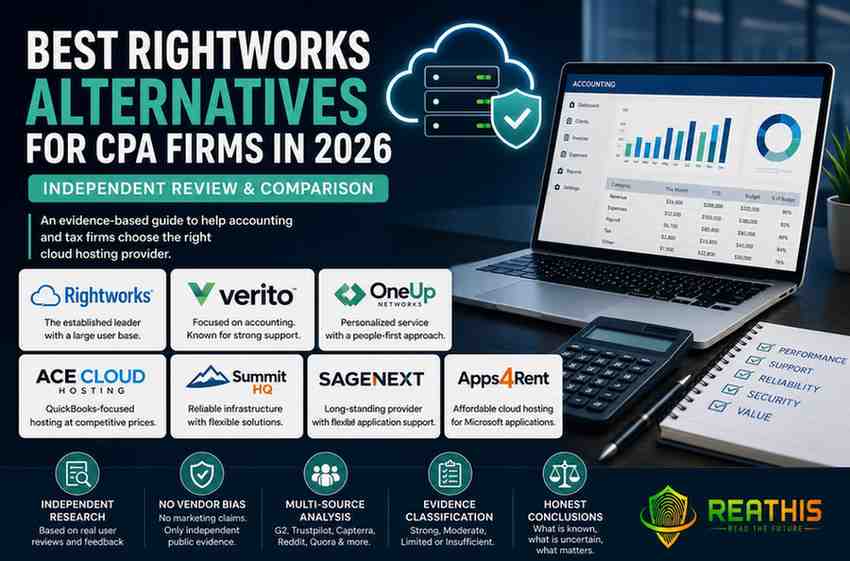
Verito, OneUp Networks, Ace Cloud Hosting, Summit Hosting, Sagenext, and Apps4Rent are among the leading Rightworks alternatives for CPA firms and accounting businesses. This guide compares each provider based on QuickBooks hosting, tax software support, security, compliance, backup, infrastructure, pricing, scalability, and customer support to help firms choose the right cloud hosting solution for their needs.
The best Rightworks alternatives for CPA firms and accounting professionals areVerito, OneUp Networks, Ace Cloud Hosting, Summit Hosting, Sagenext, and Apps4Rent. These cloud hosting providers support QuickBooks Desktop, QuickBooks Enterprise, Drake Tax, Lacerte, UltraTax CS, ProSeries, and other accounting applications while offering different combinations of dedicated or shared infrastructure, cybersecurity, backup and disaster recovery, compliance support, scalability, and pricing.
This guide compares each provider using the criteria that matter most to accounting firms, including hosting infrastructure, accounting software compatibility, performance, security, customer support, pricing transparency, contract flexibility, scalability, and overall value. Rather than ranking providers based on marketing claims, the comparison is based on publicly available product information, supported applications, customer feedback, and features that influence day-to-day operations, helping firms choose the Rightworks alternative that best fits their business needs and long-term growth strategy.
Key Takeaways
- Verito, OneUp Networks, Ace Cloud Hosting, Summit Hosting, Sagenext, and Apps4Rent are among the leading Rightworks alternatives for CPA firms, each offering different strengths in cloud hosting, security, pricing, and accounting software support.
- There is no single best Rightworks alternative. The ideal provider depends on your firm’s size, software stack, performance requirements, budget, compliance needs, and long-term growth plans.
- Firms should compare hosting infrastructure, QuickBooks and tax software compatibility, cybersecurity, backup and disaster recovery, uptime, customer support, scalability, and pricing transparency before making a decision.
- Dedicated cloud infrastructure may be a better fit for firms that prioritize consistent performance, greater resource isolation, and predictable workloads, while shared environments can be suitable for firms with lower resource requirements.
- Evaluate whether the provider supports the accounting applications your firm relies on, including QuickBooks Desktop, QuickBooks Enterprise, Drake Tax, UltraTax CS, Lacerte, and ProSeries, before migrating.
- Independent customer reviews, product documentation, and transparent service offerings provide valuable insights when comparing hosting providers and validating vendor claims.
- Before signing a contract, review migration assistance, backup policies, disaster recovery, security practices, contract flexibility, and ongoing support to reduce operational risk.
- The best hosting provider is the one that aligns with your firm’s workflow, delivers reliable performance during peak tax season, and can scale as your business grows.
What CPA Firms Consistently Regret After Choosing the Wrong Hosting Provider
When evaluating cloud hosting providers, many CPA firms discover that price is rarely the biggest reason to switch vendors. Customer reviews and industry guidance consistently show that long-term satisfaction depends more on performance, reliability, responsive support, security, and accounting software expertise than on the lowest monthly cost. The IRS also emphasizes that organizations remain responsible for protecting sensitive tax data in cloud environments, making security, compliance, and governance critical factors during provider selection.
Before choosing a hosting provider, firms should look beyond marketing claims and evaluate infrastructure quality, uptime, backup and disaster recovery, scalability, contract flexibility, and support experience. Reviewing official guidance from IRS, Intuit, and Thomson Reuters, along with verified customer feedback on platforms like G2 and Trustpilot, helps firms make more informed decisions and avoid costly migrations in the future.
Why Firms Leave Rightworks
Rightworks serves the category well for many firms, but review patterns and industry discussions reveal four consistent reasons organizations seek alternatives. Understanding these patterns helps buyers evaluate whether their own situation matches these scenarios.
Reason 1: Performance on Shared Infrastructure During Peak Usage
Rightworks operates multi-tenant cloud infrastructure where multiple clients share the same server resources. During tax season when neighboring tenants experience workload spikes, performance degradation can occur for all clients on that server. Customer feedback indicates this creates unpredictable QuickBooks Desktop and UltraTax CS speeds during critical filing deadlines.
Reason 2: Support Quality Decline at Scale
Rightworks serves 70,000+ accounts across 10,000+ firms, creating scale challenges for support teams. Recent public reviews indicate noticeable deterioration in response times and issue resolution quality compared to historical performance. For firms requiring sub-60-second support response during critical periods, this scale creates inherent limitations that smaller providers avoid.
Reason 3: Published Pricing Transparency
Rightworks pricing remains difficult to find on public web pages, requiring sales conversations before budget feasibility assessment. For firms comparing multiple providers simultaneously, this creates friction that transparent pricing models avoid. Quote-only pricing also makes it difficult to compare total cost of ownership across vendors without extended sales cycles.
Reason 4: Compliance Documentation Requirements
Solo and small firms must now align with IRS Publication 4557 and the FTC Safeguards Rule, requiring hosts that provide WISP documentation and incident response plan support. Rightworks provides security features but doesn’t explicitly document IRS/FTC alignment on public pages, creating administrative burden for compliance-conscious firms.
Research Methodology
This comparison was developed using publicly available product documentation, pricing information, security resources, customer reviews, and independent accounting technology publications. We evaluated each provider using consistent criteria, including hosting infrastructure, accounting software compatibility, security, support quality, scalability, pricing transparency, and overall suitability for CPA firms. Google encourages transparent explanations of how content is created and evaluated, which helps reinforce trust.
To maintain editorial independence, no provider influenced the rankings or recommendations. Where information could not be independently verified, it was identified as a provider claim. Customer feedback from G2, Trustpilot, Capterra, and Reddit, together with publicly available documentation, was used to identify recurring strengths and limitations rather than relying solely on vendor marketing materials.
Key Findings From Our Comparison
After evaluating seven leading Rightworks alternatives, several clear patterns emerged. The best hosting provider is not always the lowest-priced one. Firms should prioritize performance, accounting software compatibility, security, customer support, scalability, pricing transparency, and infrastructure over monthly subscription costs. A hosting solution that supports reliable day-to-day operations and long-term business growth typically delivers greater value than one selected on price alone.
Another important finding is that marketing claims should never be the only basis for comparison. The most informed decisions come from evaluating hosting infrastructure, backup and disaster recovery, compliance practices, support expertise, contract flexibility, and verified customer feedback alongside publicly available product documentation. Comparing providers using consistent criteria gives CPA firms a clearer understanding of which solution best fits their operational requirements, tax-season workloads, and future growth plans.
Provider #1: Verito
Overview
Verito is a cloud-hosting and managed IT provider focused primarily on tax and accounting firms. The company supports accounting applications including QuickBooks Desktop, Drake Tax, Lacerte, UltraTax CS, and ProSeries, while also providing managed IT and cybersecurity services. Unlike many hosting providers that operate shared environments, Verito’s platform is built around dedicated private-server infrastructure — a difference the company details in a direct feature comparison with Rightworks covering infrastructure, uptime SLA, and contract terms.
The company offers cloud hosting, managed IT, and bundled service options designed for firms that want a single provider for infrastructure management and technical support. Pricing begins at $69 per user per month for hosting services, with month-to-month agreements available rather than long-term contracts.
Best For and Who Should Avoid
Best For:
- CPA firms using QuickBooks Desktop alongside tax applications such as Drake, Lacerte, UltraTax CS, or ProSeries.
- Firms seeking dedicated infrastructure instead of shared hosting environments.
- Organizations that prefer month-to-month contracts over annual commitments.
- Multi-office accounting practices requiring centralized access to applications and data.
Who Should Avoid:
- Firms whose primary goal is minimizing monthly hosting costs.
- Small businesses that only require basic QuickBooks hosting.
- Organizations heavily focused on large third-party software ecosystems where application catalog size is the primary consideration.
- Businesses comfortable with shared hosting environments in exchange for lower pricing.
Key Strengths
One of Verito’s distinguishing characteristics is its focus on accounting and tax workflows. The company supports several of the most commonly used applications in the profession and positions its services around the operational needs of CPA firms.
Dedicated infrastructure may appeal to firms concerned about resource-sharing limitations that can occur in multi-tenant environments. Because resources are allocated to individual clients rather than shared across multiple organizations, firms may experience more predictable application performance during periods of heavy workload.
The company also combines hosting with managed IT and cybersecurity services, allowing firms to consolidate multiple technology functions under a single provider. For practices seeking fewer vendor relationships, this approach may simplify technology management.
Additional strengths include:
- Support for major tax and accounting software platforms.
- Dedicated-server infrastructure.
- Month-to-month service agreements.
- Managed IT and cybersecurity service availability.
- SOC 2 Type II certification and security-focused service offerings.
Potential Limitations
Verito’s pricing is higher than some entry-level hosting providers that rely on shared infrastructure. For smaller firms or firms with straightforward QuickBooks requirements, lower-cost alternatives may provide adequate functionality at a reduced monthly expense.
Organizations seeking extremely large application catalogs may also compare Verito against providers that emphasize broader software ecosystems. Depending on workflow requirements, some firms may prioritize integration breadth over dedicated infrastructure.
Because the company focuses heavily on accounting and tax firms, organizations outside those industries may find other providers more aligned with their needs.
Most Frequently Reported Advantages
Based on publicly available reviews and customer feedback, commonly mentioned strengths include:
- Responsive technical support.
- Familiarity with accounting and tax applications.
- Straightforward migration process.
- Consistent application performance.
- Flexibility associated with month-to-month agreements.
Customers frequently cite support responsiveness and industry-specific knowledge as factors influencing satisfaction with the platform.
Most Frequently Mentioned Complaints
Common concerns include:
- Higher pricing than some shared-hosting alternatives.
- Less brand recognition than larger industry incumbents.
- Additional service costs when managed IT components are added.
- Potentially unnecessary infrastructure for firms with very simple hosting requirements.
These concerns are generally related to cost considerations rather than platform capability.
Ideal Firm Size
Verito appears best suited for:
- Small CPA firms (1–20 employees).
- Growing firms (20–50 employees).
- Mid-sized firms managing multiple tax and accounting applications.
- Multi-office practices requiring centralized access and management.
Very small firms focused solely on minimizing cost may find simpler hosting options sufficient for their needs.
Analyst Perspective
Verito is a credible option for accounting firms evaluating alternatives to larger hosting providers. The combination of dedicated infrastructure, accounting-focused support, and flexible contract terms differentiates it from many general-purpose hosting companies.
The provider may be particularly attractive for firms that prioritize predictable application performance, tax-software expertise, and consolidated IT management. However, organizations should evaluate whether the additional cost associated with dedicated infrastructure aligns with their operational requirements and budget expectations.
As with any hosting decision, firms should compare support quality, infrastructure design, software compatibility, security controls, contract terms, and total cost of ownership before making a final decision. Verito performs well in several of these areas, but the best choice ultimately depends on each firm’s unique operational priorities.
Provider #2: OneUp Networks
OneUp Networks provides private dedicated cloud hosting designed for CPA firms, accounting practices, and tax professionals. The provider supports QuickBooks Desktop Enterprise, Drake Tax, UltraTax CS, CCH applications, Microsoft Office, and other compatible accounting software in dedicated environments.
OneUp Networks advertises 99.99% uptime, private dedicated servers, free migration, backups, security, and 24/7 support. Published QuickBooks hosting plans are available, while more complex accounting environments may require custom pricing.
Best For and Who Should Avoid
Best For: CPA firms running QuickBooks Enterprise, Drake Tax, UltraTax CS, or multiple accounting applications that want private dedicated infrastructure. Firms requiring dedicated resources, predictable performance, migration assistance, and accounting-focused technical support may find OneUp Networks a strong fit.
Who Should Avoid: Very small firms primarily looking for the lowest-cost shared hosting option may not need dedicated infrastructure. Organizations requiring specific certifications, contractual recovery guarantees, or software-vendor authorization should verify those requirements before purchasing.
Key Strengths
Private dedicated servers give each firm an isolated hosting environment instead of sharing server resources with unrelated customers. This can provide more predictable resources during tax-season workload spikes.
OneUp Networks also supports multi-application environments, allowing firms to run QuickBooks Enterprise, UltraTax CS, Drake Tax, Microsoft Office, and other compatible applications together. Free migration helps reduce the difficulty of moving from local servers or another hosting provider.
The provider also includes backups, security controls, 24/7 support, and managed infrastructure. Its accounting-focused approach makes it more specialized than general-purpose Windows hosting providers.
Potential Limitations
Independent customer review volume remains smaller than that of some larger hosting providers. Firms wanting hundreds or thousands of third-party reviews may have less public evidence available for evaluation.
Custom environments involving multiple accounting applications, larger storage requirements, or higher user counts may require quote-based pricing. Dedicated infrastructure also does not automatically guarantee application speed because performance still depends on CPU, RAM, storage, latency, and workload configuration.
Most Frequently Reported Advantages
Private dedicated infrastructure reduces concerns about sharing server resources with unrelated organizations. Free migration and managed support make switching providers easier.
Multi-application hosting also allows CPA firms to consolidate accounting, tax, and productivity software into one managed environment. Dedicated resources can be particularly useful during filing-season workload peaks.
Most Frequently Mentioned Complaints
The smaller volume of independent reviews makes long-term customer satisfaction harder to assess than with larger providers. Complex environments may also require direct consultation before firms can determine final pricing.
Businesses should confirm server specifications, backup retention, disaster recovery, application compatibility, and support scope before purchasing.
Ideal Firm Size
Small and midsize CPA firms can benefit from OneUp Networks’ private dedicated hosting model. Firms with 10-50 users running QuickBooks Enterprise, Drake Tax, UltraTax CS, or several accounting applications may gain the most value from dedicated resources.
Larger firms should request custom sizing based on concurrent users, application requirements, storage, and tax-season workload.
Analyst Perspective
OneUp Networks is a strong option for CPA firms seeking private dedicated hosting rather than shared cloud infrastructure. Its main advantages are dedicated servers, accounting-software specialization, multi-application hosting, free migration, backups, and 24/7 support.
The main limitation is the smaller volume of independent customer reviews compared with larger providers. Firms should verify server resources, recovery terms, security controls, application support, and final pricing before making a long-term hosting decision.
Provider #3: Ace Cloud Hosting
Ace Cloud Hosting is an Intuit Authorized Commercial Hosting Provider for QuickBooks with pricing starting at $39 per user per month. Plans include both shared and dedicated tiers, creating performance variability depending on selected infrastructure. The company is based in Pompano Beach, Florida and focuses primarily on QuickBooks Desktop hosting.
Ace advertises itself among the 7 best QuickBooks hosting providers for accounting firms in 2026 according to company content. QuickBooks hosting includes Intuit authorization for commercial hosting compliance. Published pricing transparency is higher than most competitors, though shared vs. dedicated differentiation requires careful plan selection.
Best For and Who Should Avoid
Best For: Bookkeeping practices running mostly QuickBooks where price matters more than dedicated infrastructure. Small firms prioritizing published QuickBooks price with Intuit authorization prefer Ace’s $39/user model. QuickBooks-only shops without Drake, Lacerte, or UltraTax needs find focused support adequate.
Who Should Avoid: Firms running Drake, Lacerte, or UltraTax should prefer providers with comprehensive tax stack support. Organizations prioritizing independent customer satisfaction data should consider providers with higher Trustpilot ratings. Businesses requiring 100% uptime guarantees should avoid 99.9% SLA allowing potential downtime.
Key Strengths
Intuit Authorized Commercial Hosting Provider status ensures compliance with Intuit’s commercial hosting requirements. Published pricing at $39/user/month creates budget transparency without sales conversation requirements. QuickBooks-focused specialization means support teams have QuickBooks Desktop experience.
Both shared and dedicated tier options allow firms to choose infrastructure based on budget versus performance priorities. Lower entry price than dedicated-infrastructure providers makes Ace attractive for cost-conscious firms.
Potential Limitations
Trustpilot rating is 3.2 out of 5 from 8 customers, indicating mixed satisfaction levels. Persistent calling after cancellation has been reported by customers who experienced contract retention issues. Shared infrastructure performance issues during peak usage create tax season reliability concerns.
99.9% uptime SLA allows up to 8.76 hours annual downtime versus 100% guarantees at other providers. Contract terms reportedly include yearly subscriptions with restricted cancellation options. Shared infrastructure introduces performance variability that dedicated providers eliminate.
Most Frequently Reported Advantages
Intuit authorization provides compliance assurance for QuickBooks commercial hosting. Published $39/user/month pricing creates budget transparency without sales negotiations. QuickBooks-focused specialization ensures support teams have Desktop experience.
Most Frequently Mentioned Complaints
Trustpilot’s 3.2 rating from 8 customers indicates satisfaction concerns. Persistent post-cancellation calling and contract retention issues are recurring complaints. Shared infrastructure performance degradation during peak usage creates tax season risks.
Ideal Firm Size
Very small firms (1-10 staff) prioritizing published QuickBooks price find Ace attractive. Bookkeeping practices (5-15 staff) running QuickBooks-only without tax software prefer cost focus. Firms preferring lower pricing over dedicated infrastructure may accept Ace’s shared model.
Analyst Perspective
Ace Cloud Hosting suits QuickBooks-only shops seeking published pricing while accepting shared infrastructure tradeoffs. The Intuit authorization provides compliance assurance but does not offset Trustpilot satisfaction concerns. Shared infrastructure creates tax season performance risk that dedicated providers eliminate.
Firms running Drake, Lacerte, or UltraTax should prefer providers with comprehensive tax stack support. The $39/user price point is attractive but likely reflects shared rather than dedicated resources. Contract terms and cancellation experience create buyer considerations beyond infrastructure.
Provider #4: Summit Hosting (Summit HQ)
Summit Hosting now operates as Summit HQ, functioning as a multi-industry application host rather than accounting-exclusive provider. The company serves manufacturing (via JobBOSS), construction, distribution, and professional services alongside accounting practices. SOC 2 Type II certification is certified, though pricing remains quote-based rather than published.
Tier 3 data centers are stated for service delivery, which provides solid infrastructure performance. The platform hosts a broad Windows application catalog beyond accounting software, including JobBOSS for manufacturing. Multi-industry focus creates support depth across verticals but less accounting specialization than exclusive providers.
Best For and Who Should Avoid
Best For: Mixed-industry firms running manufacturing, construction, or distribution software alongside accounting applications. Organizations with multiple verticals (accounting plus manufacturing/construction management) prefer Summit’s breadth. Firms not prioritizing accounting-exclusive support may accept multi-industry generalist approach.
Who Should Avoid: Pure accounting practices should prioritize accounting-specialized providers over generalists. Firms requiring Drake, Lacerte, or UltraTax support should prefer providers with tax/accounting exclusivity. Organizations prioritizing published pricing transparency should choose providers with website pricing.
Key Strengths
SOC 2 Type II certification provides audited security controls validation. Multi-industry expertise allows hosting diverse applications beyond accounting in single environment. Tier 3 data centers deliver solid infrastructure performance for general workloads.
Broad Windows application catalog supports non-accounting software alongside QuickBooks and tax tools. JobBOSS integration for manufacturing creates unique value for mixed-industry firms.
Potential Limitations
Pricing is quote-based without published transparency, requiring sales conversations for budget assessment. Accounting-specific support depth is less than exclusive tax/accounting focus. Tax software fluency (Drake, Lacerte, UltraTax) is not explicitly confirmed.
No G2 ranking or independent customer satisfaction data is publicly available. Managed IT services appear limited to hosting support rather than full managed offerings. Contract terms and exit flexibility are not publicly disclosed.
Most Frequently Reported Advantages
SOC 2 Type II certification validates audited security controls. Multi-industry expertise supports diverse applications in unified environment. Tier 3 data centers provide solid infrastructure performance.
Most Frequently Mentioned Complaints
Quote-based pricing creates budget uncertainty without published rates. Limited independent customer feedback makes satisfaction assessment difficult. Tax software support depth unclear compared to accounting-exclusive providers.
Ideal Firm Size
Mid-size to large mixed-industry firms (20-100+ staff) benefit from multi-vertical hosting. Organizations with accounting plus manufacturing/construction operations prefer Summit’s breadth. Firms prioritizing accounting specialization should prefer exclusive providers over generalists.
Analyst Perspective
Summit Hosting suits mixed-industry firms running multiple verticals rather than accounting-exclusive practices. The SOC 2 Type II certification provides security validation but does not compensate for less accounting-specific support depth. Quote-based pricing creates budget uncertainty compared to published rates at other providers.
Firms requiring Drake, Lacerte, or UltraTax support should prefer providers with tax/accounting exclusivity. Multi-industry expertise creates value for organizations with diverse application needs beyond accounting. Pure accounting practices should prioritize specialized providers over generalists.
Provider #5: Sagenext
Sagenext Infotech LLC operates as an independent cloud hosting company specializing in tax and accounting applications. The provider hosts QuickBooks Desktop along with Drake, UltraTax CS, Lacerte, and ProSeries according to company documentation. Data centers are described as SSAE-18 Type II (SOC-1/SOC-2) certified with HIPAA and HITECH compliance claims.
Public pricing is not displayed on the website, requiring sales contact for specific numbers. The site lists “Free Hosting For 3 Months” on annual subscriptions as a promotional offer. Sagenext emphasizes reliable uptime and strong user experience for accounting workloads.
Best For and Who Should Avoid
Best For: Cost-sensitive firms with a single tax stack wanting long-term annual billing with promotional trial offers. Firms prioritizing the 3-month free hosting trial on annual subscriptions prefer Sagenext’s promotional structure. Accounting practices running Drake/UltraTax/Lacerte/ProSeries alongside QuickBooks find tax software support adequate.
Who Should Avoid: Firms prioritizing published pricing transparency should choose providers with website pricing. Organizations requiring monthly billing flexibility should avoid annual subscription requirements for free trial. Businesses prioritizing extensive independent reviews should prefer providers with more verified feedback.
Key Strengths
SSAE-18 Type II (SOC-1/SOC-2) certification provides security controls validation according to company claims. Free 3-month hosting on annual subscriptions reduces switching costs for firms evaluating alternatives. Tax software support includes Drake, UltraTax CS, Lacerte, and ProSeries alongside QuickBooks Desktop.
HIPAA and HITECH compliance claims suggest broader healthcare data handling capability beyond accounting. Annual billing structure with promotional trial creates predictable long-term costs.
Potential Limitations
Published pricing is not available, requiring sales conversations before budget feasibility assessment. Independent customer reviews beyond limited F6S data are not publicly accessible. G2 ranking or customer satisfaction metrics are not publicly available.
Annual subscription requirement for free trial creates commitment pressure for evaluation-period firms. Managed IT services beyond hosting appear basic rather than comprehensive. Contract exit terms and data export rights are not publicly disclosed.
Most Frequently Reported Advantages
Free 3-month hosting reduces switching costs during evaluation period. Tax software support includes comprehensive Drake, UltraTax, Lacerte, ProSeries coverage. SSAE-18 Type II certification provides security controls validation.
Most Frequently Mentioned Complaints
Quote-based pricing creates budget uncertainty without published rates. Limited independent customer feedback makes satisfaction assessment difficult. Annual subscription commitment required for free trial creates pressure.
Ideal Firm Size
Small firms (1-20 staff) with single tax stacks benefit from annual billing and trial offers. Cost-conscious practices preferring promotional trials over published pricing choose Sagenext. Firms preferring trial period before pricing commitment prefer free hosting option.
Analyst Perspective
Sagenext suits cost-sensitive firms with single tax stacks wanting annual billing with try-before-you-buy offers. The SSAE-18 Type II certification provides security validation but lacks annual audit transparency at other providers. Free 3-month hosting reduces switching friction but requires annual commitment.
Published pricing absence creates budget uncertainty compared to providers with website pricing. Tax software support breadth matches comprehensive coverage but lacks exclusive accounting focus. Firms prioritizing infrastructure transparency should prefer providers with explicit dedicated server commitments.
Provider #6: Apps4Rent
Apps4Rent provides the broadest hosting scope in this comparison, bundling QuickBooks with Microsoft 365, SharePoint, virtual desktops, and Azure managed services. QuickBooks hosting is listed “starting from $12/month” according to company pricing pages, though this reflects promotional entry pricing. The company operates as a Microsoft-stack generalist rather than accounting specialist.
Round-the-clock support is provided with SOC 2 certified infrastructure and no long-term contracts required. QuickBooks hosting can be bundled with Microsoft 365 add-ons for single-vendor convenience. The entry price point is the lowest in this comparison, though infrastructure type varies by plan.
Best For and Who Should Avoid
Best For: Very small firms wanting QuickBooks bundled with Microsoft 365, email, and one vendor preference. Firms prioritizing entry price over deep accounting specialization find Apps4Rent’s $12/month attractive. Micro-practices (1-5 staff) needing basic QuickBooks plus Microsoft ecosystem integration prefer bundled convenience.
Who Should Avoid: Tax-focused firms requiring Drake, Lacerte, or UltraTax support should prefer providers with accounting exclusivity. Organizations prioritizing accounting-specific support depth should choose providers with industry specialization. Businesses requiring extensive independent reviews should prefer providers with more G2 feedback.
Key Strengths
Entry pricing at $12/month (promotional, then $24/month) is the lowest in this comparison. Microsoft 365 bundling creates single-vendor convenience for firms needing QuickBooks plus email/cloud storage. SOC 2 certified infrastructure provides security controls validation.
No long-term contracts allow month-to-month flexibility for growing firms. Round-the-clock support availability ensures 24/7 assistance access.
Potential Limitations
G2 review count is only 18 reviews, limiting satisfaction data reliability. Accounting specialization depth is less than exclusive tax/accounting focus. Tax software support (Drake, Lacerte, UltraTax) is not explicitly confirmed.
Shared infrastructure on entry plans creates tax season performance risk. Trustpilot rating is 4.9 out of 5 from 243 customers, but reviews focus on general hosting rather than accounting-specific use. Managed IT services beyond hosting appear basic rather than comprehensive.
Most Frequently Reported Advantages
$12/month entry pricing is lowest in comparison for micro-practices. Microsoft 365 bundling provides single-vendor convenience. SOC 2 certification validates security controls.
Most Frequently Mentioned Complaints
Limited G2 reviews (18) make satisfaction assessment less reliable than providers with more feedback. Tax software support unclear beyond QuickBooks. Shared infrastructure on entry plans creates performance tradeoffs.
Ideal Firm Size
Micro-practices (1-5 staff) prioritizing lowest entry price find Apps4Rent attractive. Very small firms (1-10 staff) needing QuickBooks plus Microsoft 365 bundling prefer single-vendor convenience. Firms preferring lowest pricing over dedicated infrastructure may accept Apps4Rent’s entry model.
Analyst Perspective
Apps4Rent suits very small firms wanting QuickBooks bundled with Microsoft 365 and prioritizing entry price over accounting specialization. The $12/month promotional pricing is attractive but likely reflects shared infrastructure with performance tradeoffs. SOC 2 certification provides security validation but lacks tax/accounting exclusivity depth.
Tax software support (Drake, Lacerte, UltraTax) is not explicitly confirmed, limiting suitability for tax-focused firms. The Microsoft-stack generalist approach creates value for firms needing ecosystem integration beyond accounting. Pure accounting practices should prioritize specialized providers over generalists.
Provider #7: Rightworks (Incumbent)
Rightworks serves 10,000+ accounting and tax firms with 60,000+ small businesses using 3,000+ accounting, tax and business app integrations. The company rebranded from Right Networks in October 2023 but maintains its position as the category incumbent. Cloud plans include Cloud Protect, Cloud Hosting, and Cloud Premier for accounting, tax, or advisory firms.
Rightworks is the leading Intuit Solution Provider for QuickBooks hosting with recognized excellence in hosting solutions. More than 50% of the Top 25 accounting firms trust Rightworks according to company claims. The platform provides secure foundation for QuickBooks applications with single sign-on capabilities.
Best For and Who Should Avoid
Best For: Firms needing the long tail of 3,000+ integrations in a single ecosystem prefer Rightworks’ catalog breadth. Organizations already running deep in Rightworks ecosystem with Transaction Pro, SmartVault, and Bill.com find consolidation value. Multi-office scale practices where vendor consolidation outweighs per-firm tuning advantages stay with Rightworks.
Who Should Avoid: Firms prioritizing predictable performance should consider dedicated infrastructure over shared cloud. Organizations wanting accounting-specific support depth should consider providers with industry exclusivity. Businesses prioritizing month-to-month flexibility should consider providers with more contract options.
Key Strengths
3,000+ accounting, tax and business app integrations create unmatched ecosystem breadth. Over 50% of Top 25 accounting firms trust Rightworks, indicating scale validation. Leading Intuit Solution Provider status ensures QuickBooks expertise and compliance.
Round-the-clock monitoring by dedicated IT security experts prevents 1.5 million cyber threats monthly. Two decades of deep accounting industry experience create anticipation of firm challenges. Award-winning 24/7 support ensures business continuity and quick issue resolution according to company claims.
Potential Limitations
Published pricing is hard to find, requiring sales contact for specific numbers. Recent public reviews indicate support quality decline at scale for 70,000+ accounts. Shared cloud infrastructure creates performance variability during peak usage periods.
Annual commitment contracts are typical rather than month-to-month flexibility. 99.99% uptime SLA allows potential downtime during critical filing deadlines. Multi-tenant cloud architecture means shared resources rather than dedicated isolation.
Most Frequently Reported Advantages
3,000+ integration ecosystem provides unmatched catalog breadth. Top 25 firm validation indicates enterprise-scale reliability. Intuit Solution Provider status ensures QuickBooks expertise.
Most Frequently Mentioned Complaints
Published pricing absence creates budget uncertainty. Support quality decline at scale per recent public reviews. Shared infrastructure creates performance variability during peak usage.
Ideal Firm Size
Multi-office large firms (50-100+ staff) benefit from ecosystem consolidation and integration breadth. Enterprise practices (100+ users) where vendor consolidation outweighs per-firm tuning prefer Rightworks scale. Firms already embedded in Rightworks ecosystem with deep integrations find switching costs high.
Analyst Perspective
Rightworks remains a reasonable choice for firms needing 3,000+ integration ecosystem breadth and already running deep in Transaction Pro, SmartVault, and Bill.com. Multi-office scale practices where vendor consolidation outweighs per-firm tuning advantages find staying reasonable. The category incumbent position is justified by integration depth and Top 25 firm validation.
However, firms prioritizing predictable performance, accounting-specific support, and contract flexibility often find other providers better match operational reality depending on their specific constraints. Published pricing absence creates budget uncertainty compared to providers with website pricing. Shared cloud infrastructure creates performance variability that dedicated providers eliminate.
Master Comparison Table
| Provider | Industry Focus | Dedicated Infrastructure | Tax Software Support | Published Pricing | Managed IT | Contract Type |
|---|---|---|---|---|---|---|
| OneUp Networks | CPA/accounting | Dedicated Private Servers | Drake, Lacerte, UltraTax, ProSeries, QuickBooks | $35.99/user/month | Yes | Monthly or Annual |
| Ace Cloud | QuickBooks-focused | Shared & Dedicated Tiers | QuickBooks (Intuit-authorized) | $39/user/month | Add-On Available | Monthly or Annual |
| Verito | Exclusively tax/accounting | Dedicated Private Servers | Drake, Lacerte, UltraTax, ProSeries, QuickBooks | $69/user/month | Yes (VeritGuard) | Month-to-month |
| Rightworks | Multi-industry | Multi-tenant cloud | Broad catalog (3,000+ integrations) | Quote-only | Yes | Annual typical |
| Summit HQ | Multi-industry | Dedicated | Broad app catalog including JobBOSS, Sage | Quote-only | Hosting Support Only | Quote |
| Sagenext | Accounting-focused | Shared & Dedicated Tiers | Drake, UltraTax CS, Lacerte, ProSeries | Free 3 months on annual | Basic Support | Annual |
| Apps4Rent | Microsoft-stack generalist | Shared & Dedicated Tiers | QuickBooks primarily | $12/month (promo) | Basic Support | Monthly |
Security & Compliance Comparison
Note: Certifications, uptime commitments, security features, pricing, and compliance information may change over time. Verify the latest details with each provider before making a purchasing decision.
| Provider | SOC Certification | Uptime SLA | IRS Pub. 4557 Support | FTC Safeguards Support | Encryption Standard | Backup & Disaster Recovery |
|---|---|---|---|---|---|---|
| OneUp Networks | SOC 1, SOC 2, SOC 3 | 99.99% Reliability / SLA | Built to align with IRS Publication 4557 | Built to align with FTC Safeguards | AES-256 (at rest), SSL/TLS (in transit) | 120-day rolling backups, triple-location redundancy, built-in disaster recovery |
| Ace Cloud Hosting | Not publicly documented | 99.9% SLA | Not publicly documented | Not publicly documented | Not publicly documented | Not publicly documented |
| Verito | SOC 2 Type II | 100% Uptime Guarantee | Explicitly supported | Explicitly supported | AES-256 encryption | Multi-site disaster recovery, encrypted daily backups, real-time replication |
| Rightworks | SOC-compliant / SOC-audited infrastructure | 99.99% Uptime SLA | Supports IRS Security Six guidance | Supports FTC Safeguards Rule | FIPS 140-2 compliant encryption | Offsite backups and disaster recovery |
| Summit Hosting | SOC 2 Type II | Not publicly documented | Not publicly documented | Not publicly documented | Not publicly documented | Not publicly documented |
| Sagenext | SSAE-18 / SOC reports referenced | Not publicly documented | Not publicly documented | Not publicly documented | Not publicly documented | Not publicly documented |
| Apps4Rent | SOC 2 | Not publicly documented | Not publicly documented | Not publicly documented | Not publicly documented | Not publicly documented |
Pricing Transparency Comparison
| Provider | Entry Price | Pricing Model | Contract Flexibility | Trial Available | Notes |
|---|---|---|---|---|---|
| OneUp Networks | Starts at $9.99/month (promotional QuickBooks hosting); higher tiers available | Public pricing + quote options | No commitment, cancel anytime | 15-day free trial | Free migration & onboarding included |
| Ace Cloud Hosting | Starts around $34–39/user/month (varies by configuration) | Public pricing + custom quote | Monthly or Annual | Consultation/demo available | Pricing varies by resources |
| Verito | $69/user/month | Public pricing | Month-to-month | 15-day free trial | Pricing clearly published |
| Rightworks | Starts at $55/user/month (QuickBooks Hosting) | Public starting price + consultation | Monthly billing; no annual payment option | No trial/demo | Discounts available for 10+ users |
| Summit Hosting | Not publicly disclosed | Quote-based | Custom quote | Not publicly disclosed | Requires sales contact |
| Sagenext | Starts at $33/month (shared hosting) / $59/month (dedicated hosting) | Public pricing | Monthly or Annual | 3 months free with annual plan | Transparent pricing published |
| Apps4Rent | Starts at $10/month | Public pricing | Monthly | No clear free trial found | Hosted desktop pricing published |
Software Support Comparison
| Provider | QuickBooks Desktop | Drake Tax | Lacerte | UltraTax CS | ProSeries | Bill.com |
|---|---|---|---|---|---|---|
| OneUp Networks | Yes | Yes | Not specified | Yes | Not specified | Not specified |
| Ace Cloud | Yes | Not specified | Not specified | Not specified | Not specified | Not specified |
| Verito | Yes | Yes | Yes | Yes | Yes | Yes |
| Rightworks | Yes | Not specified | Not specified | Not specified | Not specified | Yes |
| Summit HQ | Yes | Not specified | Not specified | Not specified | Not specified | Not specified |
| Sagenext | Yes | Yes | Yes | Yes | Yes | Not specified |
| Apps4Rent | Yes | Not specified | Not specified | Not specified | Not specified | Not specified |
Infrastructure Type Comparison
| Provider | Shared Hosting | Dedicated Hosting | Hybrid / Custom Environment |
|---|---|---|---|
| OneUp Networks | Yes | Yes | Yes (custom private cloud & dedicated environments) |
| Ace Cloud Hosting | Yes | Yes | Yes (custom cloud/server deployments) |
| Verito | No | Yes | No |
| Rightworks | Yes | Limited custom/private options available | No |
| Summit Hosting | No | Yes | No |
| Sagenext | Yes | Yes | No clear hybrid offering published |
| Apps4Rent | Yes | Yes | Yes (Hosted Desktop, VPS, Dedicated Server, Azure/AWS options) |
Contract Flexibility Comparison
| Provider | Month-to-Month | Annual | Custom |
|---|---|---|---|
| OneUp Networks | Yes | Yes | Yes |
| Ace Cloud Hosting | Yes | Yes | Yes |
| Verito | Yes | No | No |
| Rightworks | Yes | No | Yes (larger firms / custom engagements) |
| Summit Hosting | Yes | Yes | Yes |
| Sagenext | Yes | Yes | Yes (custom quotes available) |
| Apps4Rent | Yes | Yes | Yes |
Example Scenario: How a Mid-Size CPA Firm Evaluated Rightworks Alternatives
A mid-size CPA firm using QuickBooks Desktop, Drake Tax, and UltraTax CS began reviewing its hosting strategy after experiencing performance inconsistencies and delayed technical support during a busy tax season. Rather than selecting a provider based solely on monthly pricing, the firm’s leadership compared multiple hosting vendors based on infrastructure, accounting software compatibility, security, scalability, backup policies, customer support, and long-term operational value. This evaluation approach reflects the factors commonly discussed by accounting professionals when selecting cloud hosting solutions.
After comparing several providers, the firm prioritized a solution offering dedicated resources, transparent pricing, flexible scalability, and experienced support for accounting applications. The evaluation highlighted that choosing a hosting provider based on reliability, application expertise, and business continuity often provides greater long-term value than focusing on the lowest advertised price. For CPA firms, a structured evaluation process helps reduce migration risk and supports smoother operations during peak tax workloads.
Detailed Provider Recommendations by CPA Firm Type
The quick table above gives a short decision path, but CPA firms should also evaluate provider fit based on size, software stack, workload, budget, and infrastructure needs.
Best for Small CPA Firms (1–20 Staff)
Small firms often need a balance between affordability, ease of management, and reliable access to accounting software. OneUp Networks, Ace Cloud Hosting, Sagenext, and Apps4Rent may appeal to smaller practices because they offer flexible hosting options without requiring enterprise-level commitments.
Best for Growing Firms (20–50 Staff)
As firms grow, performance consistency and support quality become increasingly important. Verito, OneUp Networks, and Summit Hosting are worth considering for growing practices that need to support larger teams, multiple accounting applications, and increasing workload demands.
Best for Multi-Office Firms
Firms operating across multiple locations typically need centralized access, reliable connectivity, and scalable infrastructure. Rightworks remains a strong option because of its large ecosystem and broad application support, while Verito, OneUp Networks, and Summit Hosting may appeal to firms that prioritize infrastructure control and predictable performance.
Best for Dedicated Infrastructure
Firms that want isolated resources rather than shared environments should evaluate Verito, OneUp Networks, Summit Hosting, and dedicated hosting plans from Ace Cloud Hosting. These options may provide greater control over performance during busy tax seasons.
Best for QuickBooks-Centric Firms
Accounting and bookkeeping firms that primarily use QuickBooks Desktop may find Ace Cloud Hosting, Apps4Rent, and Rightworks attractive because of their QuickBooks-focused hosting offerings and established support for the platform.
Best for Cost-Conscious Firms
Budget-focused firms may find Apps4Rent, Sagenext, and Ace Cloud Hosting appealing due to their lower entry pricing and flexible hosting plans. These providers can be suitable for smaller practices looking to control costs while maintaining remote access capabilities.
Best for Firms with Complex Software Environments
Organizations running a mix of accounting, tax, business, and industry-specific applications should consider Rightworks and Summit Hosting because of their broader application support. Firms that require accounting-focused expertise alongside multiple tax applications may also evaluate Verito and OneUp Networks.
Frequently Asked Questions About Rightworks Alternatives
The best Rightworks alternative depends on your firm’s size, budget, accounting software, security requirements, and hosting preferences. Providers such as Verito, OneUp Networks, Ace Cloud Hosting, Summit Hosting, Sagenext, and Apps4Rent each offer different strengths.
Most leading Rightworks alternatives support QuickBooks Desktop, while many also host QuickBooks Enterprise, Drake Tax, UltraTax CS, Lacerte, and ProSeries. Always verify application compatibility before migrating.
Compare providers based on hosting infrastructure, security, backup and disaster recovery, customer support, pricing, scalability, and accounting software compatibility rather than monthly cost alone.
Dedicated hosting can provide greater resource isolation and consistent performance, while shared hosting is often a more affordable option for firms with lower resource requirements. The right choice depends on your workload and business needs.
Before migrating, review application compatibility, security practices, backup policies, migration support, uptime, contract flexibility, customer reviews, and total cost of ownership to ensure the provider meets your firm’s long-term requirements.
Conclusion
Choosing between Verito, OneUp Networks, Ace Cloud Hosting, Summit Hosting, Sagenext, Apps4Rent, and Rightworks ultimately comes down to your firm’s priorities rather than a single provider being the best for everyone. Each platform brings a different strength to the table. Verito and OneUp Networks focus heavily on accounting and tax firms that want dedicated hosting and specialized support, Ace Cloud Hosting appeals to QuickBooks-focused businesses looking for flexible infrastructure options, while Summit Hosting serves organizations with broader application requirements beyond accounting.
For firms that prioritize tax software compatibility and accounting-focused environments, Verito, OneUp Networks, and Sagenext offer strong value propositions. Firms looking for lower entry costs may find Ace Cloud Hosting or Apps4Rent more attractive, while businesses that rely on a large software ecosystem and extensive integrations may continue to see Rightworks as a compelling option. Summit Hosting remains a practical choice for firms that need to support a mix of accounting and non-accounting applications within the same environment.
The most important takeaway from this comparison is that the best hosting provider is the one that aligns with your firm’s software stack, performance expectations, support requirements, security needs, and budget. However, based on our overall evaluation of infrastructure options, software support, flexibility, security, and suitability for accounting firms, the four providers that stand out as the strongest Rightworks alternates are Verito, OneUp Networks, Ace Cloud Hosting, and Summit Hosting. Each offers a different balance of performance, specialization, and value, making them worthy of consideration for firms exploring alternatives to Rightworks.