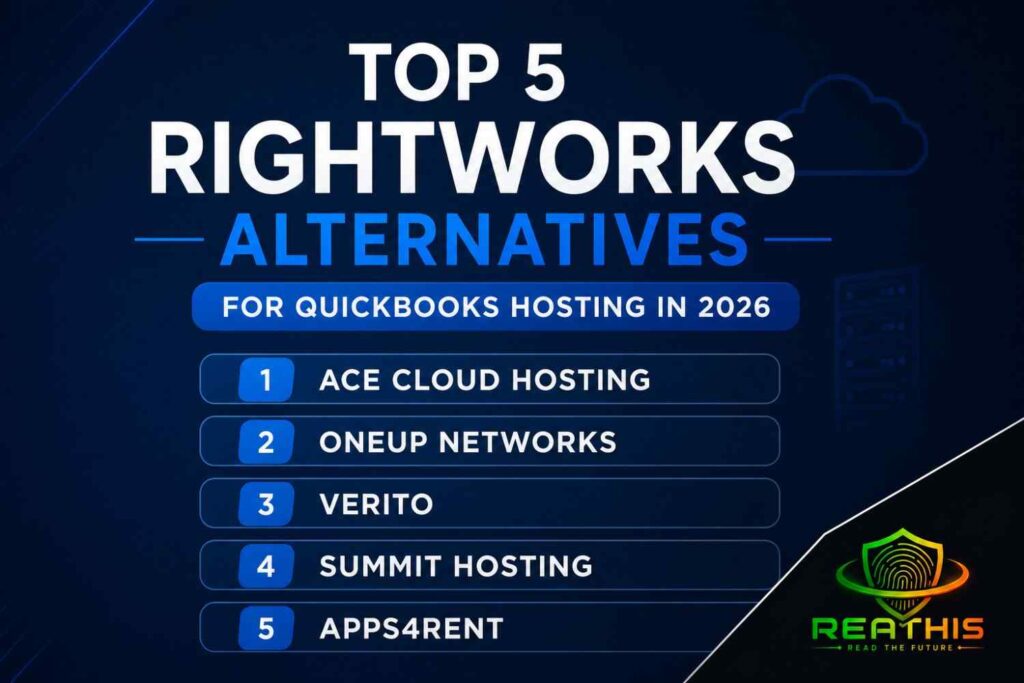
The best Rightworks alternatives for QuickBooks hosting in 2026 are Verito, OneUp Networks, Ace Cloud Hosting, Summit Hosting, and Apps4Rent. Each provider offers secure cloud hosting for QuickBooks Desktop and Enterprise but differs in infrastructure, pricing, security, software compatibility, and support. Ace Cloud Hosting is well suited for businesses seeking an Intuit Authorized Hosting Provider with flexible shared and dedicated hosting. OneUp Networks is designed for firms hosting QuickBooks alongside Thomson Reuters, Drake, and other accounting applications on dedicated private servers. Verito focuses on compliance-first hosting with dedicated infrastructure for CPA and tax firms. Summit Hosting is a strong choice for organizations running QuickBooks together with Sage or other Windows business applications. Apps4Rent offers one of the lowest published entry prices and combines QuickBooks hosting with Microsoft 365 and cloud services. The right provider depends on your firm’s budget, software stack, compliance requirements, performance needs, and long-term growth plans rather than a single overall winner.
Introduction
The Top 5 Rightworks Alternatives for QuickBooks Hosting in 2026 areVerito, OneUp Networks, Ace Cloud Hosting, Verito, Summit Hosting, and Apps4Rent. These providers offer secure cloud hosting for QuickBooks Desktop and Enterprise, but each focuses on different priorities. Ace Cloud Hosting provides affordable Intuit-authorized hosting, OneUp Networks specializes in private dedicated hosting for QuickBooks and tax software, Verito focuses on compliance and dedicated infrastructure for CPA firms, Summit Hosting supports QuickBooks alongside Sage and other business applications, and Apps4Rent delivers one of the lowest published entry prices while integrating Microsoft cloud services. The right choice depends on your firm’s budget, software environment, security requirements, performance expectations, and long-term growth plans.
Rightworks remains one of the most recognized names in QuickBooks hosting, serving thousands of accounting professionals and businesses. However, many firms compare alternatives because they want dedicated server resources, lower ongoing costs, broader support for accounting software, stronger compliance features, or more personalized technical support. As cloud hosting options continue to evolve, choosing the right provider requires looking beyond marketing claims and evaluating real differences in infrastructure, security, migration services, customer support, pricing, and scalability.
This guide provides an unbiased comparison of the Top 5 Rightworks Alternatives for QuickBooks Hosting using consistent evaluation criteria, including QuickBooks compatibility, hosting architecture, security, compliance, migration assistance, pricing transparency, customer reviews, and overall value. Use this guide to evaluate each provider and select the one that best aligns with your firm’s operational, accounting, security, and performance requirements—not just the provider with the highest ranking.
What Is Rightworks?
Rightworks (formerly Right Networks) has hosted QuickBooks for accounting firms since 2002 and describes itself as Intuit’s leading hosting reseller. Its core hosting product, Cloud Hosting — previously marketed as OneSpace — runs QuickBooks Desktop and QuickBooks Online alongside more than 100 other business apps, backed by Tier III/IV data centers, SOC-audited controls, multifactor authentication, and 90-day backups. Above the base plan sit Cloud Hosting Pro and Cloud Premier, which add Microsoft 365 licensing, Transaction Pro import/export tools, and access to a directory of roughly 3,000 tax and accounting applications. A separate Cloud Protect plan covers IT security and device management rather than hosting itself.
On G2, Rightworks holds a strong 4.7-out-of-5 average across 159 reviews, with customers most often citing ease of use and customer service. That reputation is a big part of why Rightworks remains the default choice for many firms, particularly QuickBooks Enterprise users that Intuit points toward it directly.
Firms still look at alternatives for reasons that have little to do with Rightworks doing anything wrong: the base plan runs on shared infrastructure rather than a dedicated server, per-user pricing rises as you add Microsoft 365 or premium tiers, there’s no free trial, and some firms simply want a narrower, accounting-only specialist or a lower published starting price.
How We Evaluated These Providers
We evaluate every provider using the same criteria, including QuickBooks compatibility, dedicated versus shared infrastructure, performance, security and compliance, migration support, customer support quality, pricing transparency, scalability, and independent customer reviews. We base our analysis on information from each provider’s website and documentation, as well as reviews published on G2 and Trustpilot.
ReaThis do not use vendor-published comparison articles or benchmark reports as factual sources for comparative claims because providers often rank themselves using self-reported data and proprietary methodologies. Instead, we rely on official company documentation and independently hosted customer reviews to support our comparisons.
1. Verito
Verito is a cloud hosting and managed IT company built exclusively for tax and accounting firms, founded in 2016 and based in Wilmington, Delaware. Rather than a general host that happens to support QuickBooks, Verito frames its whole platform — VeritSpace for hosting, VeritGuard for managed IT, VeritShield for written information security plan (WISP) documentation — around the compliance requirements accounting firms face.
Hosting model: Every Verito plan runs on a dedicated private server; there’s no shared-hosting tier at any price point, a deliberate trade-off of a higher entry price for guaranteed, non-shared resources.
Security & compliance: Verito builds hosting environments around IRS Publication 4557, the FTC Safeguards Rule, and GLBA by default, with SOC 2 Type II certified data centers, AES-256 encryption, and MFA — arguably its clearest differentiator on this list. Verito maintains its own published comparison of Rightworks alternatives for accounting firms, covering seven providers across pricing, certifications, and support.
Migration & support: Migration is typically completed within 24–48 hours. Support runs 24/7, with a 15-day free trial (no credit card required) and a 30-day money-back guarantee.
Pricing: Dedicated hosting starts at $69 per user, per month (10GB RAM / 40GB storage), plus a one-time setup fee ($200, or $500 for UltraTax environments) and volume discounts for larger teams — the highest starting price on this list.
Reviews: Verito holds a strong 4.9-out-of-5 rating on G2 across more than 150 verified reviews, with support responsiveness as the most-cited strength. The most common criticism in those same reviews is cost — several reviewers specifically flag pricing as high — along with occasional mentions of language-barrier friction with support staff.
Best for: Tax and accounting firms that want compliance documentation built into the hosting relationship and are willing to pay a premium for dedicated-only infrastructure.
2. OneUp Networks
OneUp Networks is a QuickBooks Solution Partner that positions itself specifically as a Rightworks alternative, built around dedicated server infrastructure. Alongside QuickBooks, it hosts the Thomson Reuters CS Professional Suite (UltraTax, Practice CS, Accounting CS), Drake, Lacerte, ProSeries, and Sage, making it a common pick for firms running QuickBooks next to professional tax software.
Hosting model: OneUp emphasizes dedicated resources over multi-tenant shared plans, running on Tier III/IV data centers with SOC 2, ISO 27001, and HIPAA-aligned controls.
Security & migration: MFA, encryption, network isolation, firewalls, and 24/7 monitoring are standard, and free migration and onboarding are included. A 15-day free trial is available with no long-term commitment afterward.
Pricing: OneUp advertises promotional rates $35.99 per user, per month for an initial period, with custom quotes for standard and enterprise pricing. The company states there are no long-term contracts or hidden fees, though full standard pricing isn’t published.
Reviews: G2 reviews are positive and specific, frequently crediting named support engineers with fast, knowledgeable help during migrations from other hosts. A third-party listing shows a run of uniformly five-star feedback, particularly from firms hosting Thomson Reuters applications alongside QuickBooks.
Best for: Multi-software firms — especially those pairing QuickBooks with UltraTax or another Thomson Reuters CS product — that want dedicated infrastructure. Firms whose needs are QuickBooks-only may want to weigh OneUp’s shorter public track record in pure QuickBooks-hosting reviews against providers more established in that specific niche.
3. Ace Cloud Hosting
Ace Cloud Hosting is an Intuit Authorized Hosting Provider and QuickBooks Solution Provider headquartered in Pompano Beach, Florida, with additional offices in Pennsylvania and India. The company reports serving more than 20,000 businesses and has picked up recognition including CPA Practice Advisor’s “Best Outsourced Technology Provider” award in consecutive years and a 2024 Stevie Award for customer service.
Hosting model: Ace Cloud Hosting offers tiered shared-server plans (commonly labeled Essentials, Business, and Enterprise) as well as a separate dedicated-server option for firms wanting isolated resources — start shared, move to dedicated later.
Security & migration: Infrastructure runs across Tier 4/5 data center partners with end-to-end encryption, multifactor authentication, IDS/IPS monitoring, and a 45-day rolling backup window. Migration from an existing provider or on-premises setup is handled during onboarding, and a 7-day free trial is available with no credit card required.
Pricing: Ace Cloud Hosting frequently advertises an introductory rate around $19–20 per user for the first three months. Published third-party pricing data has historically put standard ongoing plans somewhere in the $50–80 per user, per month range depending on QuickBooks version and tier — confirm current numbers directly, since promotional pricing changes often.
Reviews: Feedback on G2 and third-party listing sites is consistently strong, with reviewers repeatedly naming individual support staff and describing fast, one-call resolution. The most common caveat isn’t about service quality — it’s a reminder to clarify what pricing becomes once an introductory offer expires.
Best for: Firms that want Intuit-authorized hosting at a competitive entry price, with room to graduate to a dedicated server as they grow.
4. Summit Hosting
Summit Hosting, now operating as Summit, has hosted QuickBooks and Sage applications since 2016 and continues to support a broad range of accounting and business-critical Windows applications beyond QuickBooks.
Hosting Model: Summit assigns every customer a dedicated single-tenant server by default and prices its services competitively with many providers’ shared-hosting plans rather than positioning dedicated infrastructure as a premium upgrade.
Security & Migration: Summit protects customer environments with AES-256 encryption, TruGrid multi-factor authentication, 24/7 monitoring, and controls aligned with HIPAA and PCI DSS requirements. The company starts each migration with a free consultation and currently offers a 30-day free trial.
Pricing: Summit doesn’t publish per-user pricing — quotes follow a consultation based on user count, applications, and storage. Older third-party estimates put average per-user costs around $50–55 per month, but treat that as a dated reference point rather than a current quote.
Reviews: Feedback on Trustpilot is a genuine mix. Many reviewers describe fast escalation to a real engineer and quick resolution, and Summit’s team publicly responds to nearly every review, including critical ones. But a handful of reviewers report repeated outages and slow, multi-day ticket resolution, which is worth weighing against the larger number of positive reports.
Best for: Firms running QuickBooks alongside Sage or other Windows-based software that want dedicated servers without a separate “dedicated” pricing tier, and that are comfortable getting a quote through a sales conversation.
5. Apps4Rent
Apps4Rent has offered cloud hosting since 2003 and is an Intuit Authorized Host, a Microsoft Solutions Partner, and an authorized Citrix Partner. Unlike the other four providers, QuickBooks hosting is one product in a much larger catalog that includes Microsoft 365, Azure, SharePoint, and Dynamics CRM hosting, making Apps4Rent the most generalist cloud provider on this list rather than an accounting-hosting specialist.
Hosting model: Apps4Rent offers both a low-cost, session-based single-user plan and dedicated team plans, so firms can start small and move to reserved resources as they grow.
Security & migration: The company cites SOC 2 Type II certified data centers (built on New York/New Jersey infrastructure), daily backups, and 24/7/365 support with a stated 30-second response goal for chat and calls. Migration and setup are included with no separate setup fee.
Pricing: Apps4Rent’s published pricing is among the most transparent of the five. Session-based single-user hosting starts at $12 per month (promotional), with dedicated team plans starting at $34.95 per month and scaling to $254.95 per month for a 30-plus-user tier; additional users run about $26 per user, per month.
Reviews: Apps4Rent has a large review volume on G2 and Trustpilot — well over 200 on Trustpilot alone — and the large majority are positive, frequently naming individual support agents. Some reviewers report receiving upsell offers during support interactions, while others report needing ongoing assistance to resolve connectivity issues.
Best for: Firms that want the lowest published entry price here and would rather buy QuickBooks hosting, Microsoft 365, and general cloud infrastructure from one vendor instead of stitching several together.
Comparison Table
| Provider | Best For | Dedicated Servers | QuickBooks Support | Migration | Support | Starting Price | Ideal Firm Size |
|---|---|---|---|---|---|---|---|
| Rightworks | Largest app marketplace | Shared (base plan) | Desktop, Online, Enterprise | Assisted | 24/7 phone/chat/email | ~$60–85/user/mo; no free trial | Solo to enterprise |
| Ace Cloud Hosting | Budget-conscious, Intuit-authorized | Optional (shared or dedicated) | Pro, Premier, Enterprise, Accountant, POS | Assisted, 7-day trial | 24/7 phone/chat/email | From ~$20/user/mo (promo) | Solo to 50+ users |
| OneUp Networks | Multi-software (QuickBooks + tax software) | Yes | Pro, Premier, Enterprise, Accountant, legacy | Free, 15-day trial | 24/7, named engineers | From ~$10–36/user/mo (promo) | Small to mid-size |
| Verito | Compliance-first, dedicated performance | Yes (dedicated only) | Pro, Premier, Enterprise, Accountant (2015+) | White-glove, 24–48 hrs | 24/7, sub-60-second goal | From $69/user/mo | Solo to 100 users |
| Summit Hosting | QuickBooks + Sage / multi-app | Yes (dedicated by default) | Desktop, Enterprise, Online | Consultation-based | 24/7 phone/portal/email/Slack | Quote-based, not published | Small to enterprise |
| Apps4Rent | Lowest entry price + Microsoft 365 bundle | Optional (session-based or dedicated) | Pro, Premier, Enterprise, Accountant, industry editions | Included, no setup fee | 24/7/365, 30-sec goal | From $12/user/mo (promo) | Solo to 30+ users |
Pricing changes frequently and promotional rates typically apply only to an initial period — confirm current numbers directly with each provider before deciding.
Pros and Cons at a Glance
| Provider | Pros | Cons |
|---|---|---|
| Ace Cloud Hosting | Lower entry pricing; Intuit-authorized; shared or dedicated options; strong support reviews | Introductory pricing rises later; standard rate requires a sales call |
| OneUp Networks | Perivate dedicated servers as standard; strong multi-software support; positive, specific reviews | Smaller public review base for QuickBooks-only use; full pricing not published |
| Verito | Dedicated-only infrastructure; deep compliance focus; very strong G2 rating | Highest starting price here; some reviews cite cost and support-language friction |
| Summit Hosting | Dedicated-by-default at shared-hosting pricing; broad app support (QuickBooks + Sage) | No published pricing; some reviewers report inconsistent support experiences |
| Apps4Rent | Lowest published entry price; bundles Microsoft 365/Azure; large positive review volume | Generalist provider, not accounting-specialized; occasional upsell complaints |
How to Choose a Rightworks Alternative
Budget. Every provider above advertises an attractive introductory rate. Ask specifically what the price becomes after month three, six, or twelve, and whether that rate is locked in.
Number of users and growth plans. A two-person bookkeeping practice and a 40-person CPA firm have different priorities. Smaller firms often do fine on shared or session-based hosting; firms with five or more concurrent users, or anyone running heavy reports during tax season, tend to benefit more from dedicated servers.
Remote work needs. If your team works across multiple locations or devices, verify that the hosting provider supports Mac, tablet, and mobile access and allows simultaneous multi-user access to the same company file by default.
Security and compliance. For CPA and tax firms, look for SOC 2 (Type I vs. Type II matters), encryption at rest and in transit, MFA, and — increasingly relevant under the FTC Safeguards Rule and IRS Publication 4557 — whether the provider assists with written information security plan (WISP) documentation.
Performance. Shared hosting is typically cheaper, but performance can vary with how many tenants share a server. Dedicated hosting costs more but isolates your firm’s resources, which matters most during month-end close or tax season.
Support quality. Read recent reviews, not just the highlight reel on a homepage. Look for how firms describe response times during their busiest periods.
Migration. Ask what’s included (data, add-ons, permissions, printer mappings) and get a realistic timeline in writing, especially near a filing deadline.
Scalability. Confirm you can add users or storage, or move from shared to dedicated hosting, without a service interruption or a new contract.
There’s no universal “best” answer — the right provider is the one whose defaults match how your firm actually works.
Frequently Asked Questions
It depends on priorities. Verito and OneUp Networks lead on dedicated infrastructure, Ace Cloud Hosting and Apps4Rent lead on published starting price, and Summit Hosting leads on running QuickBooks alongside other software like Sage.
Yes. Intuit ended new retail sales of QuickBooks Desktop Pro, Premier, and Mac for most new U.S. customers in September 2024. Existing customers can still host and use their licensed versions, while Intuit continues to sell and support QuickBooks Enterprise for hosted and multi-user deployments.
Not always. Solo users and small teams often do fine on shared hosting. Dedicated servers matter more with several concurrent users, heavy add-ons, or large company files that slow down during peak periods.
Verito and OneUp Networks both build around accounting and tax-firm workflows and compliance needs. Summit Hosting and Ace Cloud Hosting also serve CPA firms heavily, alongside a broader small-business customer base.
Yes, on most of these providers. OneUp Networks and Summit Hosting are both built around running several applications on one server; Rightworks offers this through its app marketplace and add-on tiers.
Published starting rates here range from about $12/user/month (promotional, session-based) to $69/user/month (dedicated-only), with most standard shared plans landing around $40–80/user/month once promotional pricing ends.
Yes, in nearly all cases. Your QuickBooks license belongs to you, and reputable hosts handle company-file migration during onboarding. Ask each candidate exactly what they need from your current host to complete the move.
Final Verdict for Top 5 Rightworks Alternatives for QuickBooks Hosting
None of these five providers is a universal upgrade over Rightworks — each optimizes for something different.
Ace Cloud Hosting may suit firms that want Intuit-authorized hosting at a lower published starting price, with room to move from shared to dedicated infrastructure as they grow.
OneUp Networks may suit firms running QuickBooks alongside Thomson Reuters tax software or Drake that want dedicated resources without Verito’s premium.
Verito may suit tax and accounting firms that want compliance documentation built into the hosting relationship and are willing to pay the highest starting price here for dedicated-only infrastructure.
Summit Hosting may suit firms juggling QuickBooks and Sage (or other Windows-based software) that want dedicated servers priced like shared hosting, and don’t mind getting pricing through a conversation.
Apps4Rent may suit firms that want the lowest entry price on this list and would rather consolidate QuickBooks hosting with Microsoft 365 and Azure under one vendor.
Rightworks itself remains a reasonable, well-reviewed default for firms already inside its ecosystem — especially QuickBooks Enterprise users Intuit points toward it directly, and firms that value the largest available app marketplace over the lowest sticker price.
Before signing with any provider, get current pricing in writing (not just the promotional rate), ask for references from firms your size, and confirm the security certifications your compliance obligations require. The right host is the one that fits your firm’s budget, software stack, security needs, performance requirements, and support expectations — not necessarily the one at the top of a “best of” list.