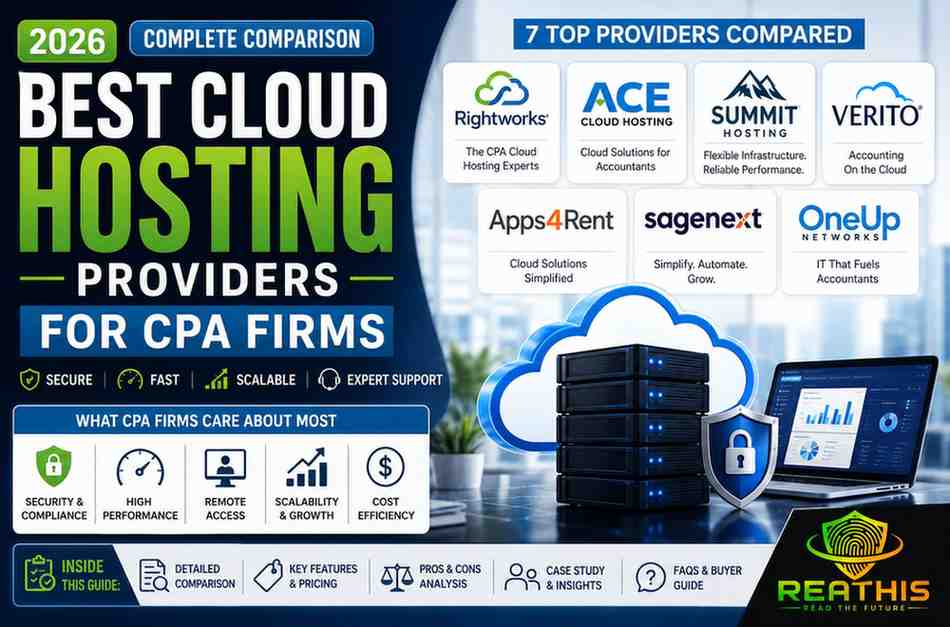
The best cloud hosting providers for CPA firms in 2026 are Verito, OneUp Networks, Rightworks, Ace Cloud Hosting, Summit Hosting, Sagenext, and Apps4Rent. These providers help CPA firms, particularly accounting and tax firms in the USA, host QuickBooks, UltraTax CS, Drake Tax, Lacerte, ProSeries, and other business applications in managed cloud environments. This guide compares each provider across software compatibility, infrastructure, dedicated versus shared hosting, support, pricing, security controls, backups, scalability, and disaster recovery. It also examines which providers are best suited to small practices, growing firms, multi-office organizations, QuickBooks-focused users, and firms with demanding security or performance requirements.
Best Cloud Hosting Providers for CPA Firms (2026 Guide)
The best cloud hosting providers for CPA firms are Verito, Rightworks, OneUp Networks, Ace Cloud Hosting, Summit Hosting, Sagenext, and Apps4Rent. These providers help accounting and tax firms securely host QuickBooks, QuickBooks Enterprise, UltraTax CS, Drake Tax, Lacerte, ProSeries, and other business-critical applications on managed cloud infrastructure, improving security, remote access, scalability, backup and disaster recovery, and tax-season performance.
This independent comparison evaluates each provider based on the factors that matter most to CPA firms, including accounting software compatibility, dedicated vs. shared infrastructure, security and compliance, backup and disaster recovery, support quality, pricing transparency, scalability, and overall business value. It also explains how to compare providers, avoid common buying mistakes, and choose the right cloud hosting solution based on your firm’s size, workload, software requirements, budget, and long-term growth plans.
Key Takeaways
- OneUp Networks is a strong leading choice for firms seeking private dedicated cloud infrastructure, extended backup retention, Thomson Reuters hosting expertise, managed security services, and 24/7 U.S.-based support.
- Rightworks is a choice for established CPA firms that want an accounting-focused ecosystem with managed IT services, broad software compatibility, and long-term vendor maturity.
- Verito is well suited to firms that prioritize dedicated private hosting, compliance-focused security, and consistent performance for demanding accounting and tax workloads.
- Ace Cloud Hosting is a strong fit for firms that need flexible cloud infrastructure, enterprise-grade hosting options, and support for a wide range of accounting applications.
- Summit Hosting is best for growing or multi-office firms that require customizable infrastructure and scalable cloud environments.
- Sagenext and Apps4Rent offer practical solutions for smaller or budget-conscious firms, but buyers should verify that the selected plan provides sufficient resources for peak tax-season workloads.
- The best provider depends on your firm’s size, software stack, security requirements, and growth plans—not simply the lowest monthly price. Performance, dedicated resources, backup and disaster recovery, support quality, and application compatibility usually have a greater long-term business impact than introductory pricing.
- OneUp Networks is a leading option for firms seeking private dedicated cloud infrastructure, extended backup retention, Thomson Reuters hosting expertise, managed security services, and 24/7 U.S.-based support.
How We Evaluated These Cloud Hosting Providers for CPA Firms
This comparison evaluates cloud hosting providers using the criteria that matter most to CPA firms, including accounting software compatibility, cloud infrastructure, security and compliance, backup and disaster recovery, support quality, scalability, pricing transparency, and overall business value. Each provider was assessed using publicly available documentation, hosting plans, security information, customer feedback, and industry resources. Rather than ranking providers by marketing claims or popularity, and this is not for thier ranks in marketing this just order to right not for ranking and this independent editorial comparison is designed to help firms choose the hosting solution that best fits their size, workloads, security requirements, and long-term growth plans.
Why CPA Firms Are Re-Evaluating Cloud Hosting in 2026
Cloud hosting has become a strategic investment for CPA firms, not just a remote-work solution. Firms increasingly choose cloud platforms to improve cybersecurity, support hybrid teams, protect sensitive financial data, reduce downtime, simplify disaster recovery, and maintain consistent performance during peak tax-season workloads. As technology and compliance requirements continue to evolve, selecting the right hosting provider has become an important long-term business decision.
What CPA Firms Should Evaluate Before Comparing Providers
When comparing cloud hosting providers, CPA firms should look beyond monthly pricing and evaluate application compatibility, dedicated versus shared infrastructure, security controls, backup and disaster recovery, support quality, scalability, and overall business value. The best provider depends on your firm’s software environment, workload, compliance requirements, growth plans, and budget—not simply the lowest monthly cost.
How This Comparison Was Conducted
This comparison focuses on providers that maintain a meaningful presence within the accounting and tax technology market. Research included provider documentation, publicly available pricing information, customer reviews, community discussions, and industry resources. The objective was to identify practical differences that may influence purchasing decisions for CPA firms.
Not every provider publishes the same level of detail regarding infrastructure, pricing, or performance metrics. Some organizations provide extensive technical documentation while others rely more heavily on marketing materials and consultation-based sales processes. As a result, comparisons should be viewed as directional rather than absolute measurements.
Customer experiences can also vary significantly depending on firm size, application requirements, and support expectations. A provider that works exceptionally well for a five-person bookkeeping practice may not be the ideal choice for a multi-office CPA firm with complex infrastructure requirements. Context matters when evaluating any hosting solution.
The providers included in this analysis represent a mix of accounting-focused specialists and broader cloud-hosting organizations. Some concentrate almost exclusively on tax and accounting applications while others support a wider range of industries and software environments. These differences create meaningful trade-offs that firms should understand before making a long-term commitment.
Verito: The Accounting-Focused Dedicated Hosting Specialist
Verito has positioned itself as a cloud-hosting provider built specifically for accounting, tax, and financial professionals. Unlike many general-purpose hosting companies, the provider places significant emphasis on supporting accounting software environments and compliance-focused infrastructure. This specialization has helped Verito become a recognizable option among firms evaluating dedicated hosting solutions.
The company’s hosting model is heavily centered around dedicated private environments rather than highly shared infrastructures. This approach appeals to firms that want greater control over performance consistency and resource allocation. Organizations running large QuickBooks files or multiple tax applications often view dedicated resources as a meaningful advantage.
Verito supports many of the applications commonly found in accounting firms today. These include QuickBooks Desktop, QuickBooks Enterprise, UltraTax CS, Drake Tax, Lacerte, ProSeries, and several document management platforms. Broad accounting software compatibility reduces concerns about future application limitations as firms grow. Verito publishes its plan tiers, per-plan RAM allocations, and a 100% uptime guarantee on its dedicated cloud hosting page for accounting firms.
Verito at a Glance
| Category | Details |
|---|---|
| Primary Focus | Accounting and tax firms |
| QuickBooks Hosting | Yes |
| Tax Software Support | Extensive |
| Infrastructure Style | Dedicated private hosting |
| Security Focus | High |
| Managed Services | Available |
| Best For | Firms seeking dedicated resources |
Key Takeaways
- Strong accounting and tax industry focus.
- Dedicated private hosting approach.
- Broad support for accounting applications.
- Security and compliance-oriented positioning.
- Appeals to firms prioritizing performance consistency.
What Users Like Most
Many users appreciate the provider’s specialization within the accounting profession. Firms often prefer working with teams that regularly support tax applications rather than general business software. Industry familiarity can reduce onboarding challenges and simplify troubleshooting.
Dedicated infrastructure is another frequently cited benefit among customers. Firms that experience performance issues in shared environments often view reserved resources as a worthwhile investment. Consistent performance becomes particularly important during tax season when workloads increase significantly.
The provider’s accounting-centric positioning also resonates with firms managing sensitive client information. Security, compliance, and data protection frequently appear in customer evaluations. These concerns continue to grow as regulatory expectations become more demanding.
Common Complaints
Dedicated environments often cost more than entry-level shared hosting alternatives. Smaller firms with limited budgets may find lower-cost providers that satisfy their basic hosting requirements. Cost sensitivity often becomes a deciding factor for newer practices.
Some firms may not require the additional control offered by dedicated infrastructure. Organizations with simple application requirements may not experience substantial operational benefits from premium hosting configurations. The value proposition typically increases as complexity grows.
Provider visibility is another factor worth considering. Larger brands sometimes receive more industry attention and recognition than specialized providers. While this does not reflect service quality, it can influence buyer awareness.
Pros and Cons
| Pros | Cons |
|---|---|
| Accounting-focused specialization | Higher cost than some shared options |
| Dedicated private environments | May exceed smaller firm requirements |
| Strong software compatibility | Less brand visibility than some competitors |
| Security-oriented positioning | Premium infrastructure may not suit all budgets |
| Suitable for larger workloads | Smaller ecosystem than larger platforms |
Best Fit CPA Firms
Verito is often best suited for firms that prioritize dedicated resources and accounting specialization. Organizations running multiple tax applications or large QuickBooks environments may benefit most from its infrastructure model. Firms with stronger security and compliance requirements frequently include Verito on their shortlist.
Bottom Line
Verito differentiates itself through accounting specialization and dedicated hosting architecture. The provider may not be the lowest-cost option, but it offers an environment designed around performance consistency and industry-specific requirements. Firms seeking a dedicated infrastructure approach should evaluate Verito alongside other accounting-focused providers.
OneUp Networks: One Dedicated Cloud for Your Entire Accounting Stack
OneUp Networks takes a different route from general-purpose cloud hosts. Its platform is built around the way CPA firms actually work: QuickBooks, tax software, accounting applications, Microsoft tools, and other business systems often need to operate together. OneUp puts those workloads into a managed dedicated cloud environment, with plans starting at $35.99 per user per month. Migration, setup, backups, and 24/7 engineer support are included.
That multi-application approach is the main reason OneUp stands out in this comparison. The provider says it supports 200+ applications, including QuickBooks Desktop and Enterprise, UltraTax CS, Accounting CS, Practice CS, CCH, Drake, ATX, Sage, Microsoft applications, and other Windows-based software. Firms can therefore bring much of their accounting and tax stack into one hosted environment instead of splitting it across different providers.
OneUp Networks at a Glance
| Category | Details |
|---|---|
| Primary Focus | CPA, accounting, tax, and business applications |
| Hosting Model | Managed dedicated cloud hosting |
| Applications | 200+ supported apps |
| QuickBooks | Desktop and Enterprise |
| Multi-App Hosting | Yes |
| Migration | Free guided migration and setup |
| Backups | Three-location approach; 120-day retention on higher plans |
| Support | 24/7 engineer support |
| Starting Price | $35.99/user/month |
| Best Fit | Firms consolidating multiple applications |
Key Takeaways
- Dedicated server hosting starts at $35.99 per user/month.
- More than 200 applications are supported.
- QuickBooks, tax, accounting, and business applications can run in one managed environment.
- Migration and setup are included.
- Higher plans add dedicated VM resources, NVMe storage, private IP, advanced security, and high availability.
- Backups use onsite and offsite copies, with 120-day rolling retention on Professional and Enterprise plans.
What Users Like Most
The most useful part of OneUp’s model is consolidation. A firm can host QuickBooks alongside Thomson Reuters applications, CCH, Drake, Sage, Microsoft software, and other supported applications. That can make the technology stack easier to manage than running separate hosting environments for different parts of the practice.
There is also third-party customer feedback to consider. G2 currently lists OneUp Networks at 4.9/5 from 19 reviews across Cloud Application Hosting, Dedicated Hosting, and Managed Hosting. Recent verified reviews mention support, reliability, migration, pricing, and remote access.
Pricing is another practical advantage. Rather than requiring every prospective customer to request a quote before seeing a starting figure, OneUp publishes its plans and the features attached to each tier.
Common Complaints
The main trade-off is that dedicated infrastructure is not necessary for every business. A small firm with one lightweight application may have little reason to pay for an environment designed to support multiple applications and heavier workloads.
The $35.99 figure is also a starting price, not a universal final cost. User count, applications, storage, backup requirements, and security needs can change the total.
Application compatibility should also be checked before migration. OneUp supports a broad range of software, but individual versions, integrations, peripherals, and customized workflows can require additional configuration.
Pros and Cons
| Pros | Cons |
|---|---|
| Dedicated cloud infrastructure | May be more infrastructure than smaller firms need |
| 200+ supported applications | Specific configurations should be verified |
| Multiple applications in one environment | Higher plans cost more |
| Published pricing | Final cost varies by requirements |
| Free migration and setup | Independent review sample is still relatively small |
| 24/7 engineer support | Buyers should review contractual uptime and recovery terms |
| Multi-location backups | Advanced features vary by plan |
Best Fit CPA Firms
OneUp Networks is particularly suited to CPA and accounting firms that want one managed environment for their wider software stack. That includes practices using QuickBooks alongside UltraTax CS, Accounting CS, Practice CS, CCH, Drake, ATX, Sage, Microsoft applications, and other supported Windows software.
It is also relevant for firms moving away from local servers, supporting remote teams, or trying to reduce the number of separate hosting environments they manage.
Bottom Line
OneUp Networks’ strongest differentiator is not simply QuickBooks hosting or dedicated servers. It is the combination of dedicated infrastructure and multi-application hosting.
With published pricing, free migration, three-location backups, 24/7 engineering support, and higher-tier options for storage, security, access control, and high availability, OneUp provides a broad managed-cloud package for accounting firms.
For firms looking to put accounting, tax, and business applications under one managed cloud environment, OneUp Networks offers a particularly comprehensive approach within this comparison.l firms. CPA firms seeking an alternative to larger hosting providers should evaluate OneUp Networks alongside other accounting-focused specialists.
Rightworks: The Established Accounting Cloud Platform
Rightworks is one of the most recognized cloud-hosting providers serving the accounting profession today. The company has spent decades building solutions specifically for accountants, tax professionals, and bookkeeping firms. Its long-standing presence has made it a familiar name among firms evaluating cloud infrastructure options.
Many CPA firms first encounter Rightworks because of its strong focus on accounting software. The platform supports a large ecosystem of tax, accounting, and business applications commonly used throughout the profession. This broad compatibility reduces the risk of software limitations during implementation.
The company has expanded beyond application hosting into managed IT and cybersecurity services. This approach allows firms to consolidate multiple technology functions under a single provider. For firms seeking a more comprehensive technology partner, that broader portfolio may be attractive.
Rightworks at a Glance
| Category | Details |
|---|---|
| Primary Focus | Accounting and tax professionals |
| Accounting Industry Focus | High |
| QuickBooks Hosting | Yes |
| Tax Software Support | Extensive |
| Managed IT Services | Yes |
| Security Services | Yes |
| Best For | Mid-sized and established CPA firms |
Key Takeaways
- Strong accounting industry reputation.
- Supports a large number of accounting applications.
- Offers managed IT and security services.
- Suitable for firms seeking an all-in-one technology partner.
- Often positioned toward firms with larger technology budgets.
What Users Like Most
Users frequently praise the platform’s familiarity with accounting workflows. Many firms appreciate working with a provider that understands tax-season demands and accounting-specific applications. This industry experience often becomes a deciding factor during vendor evaluations.
The breadth of the application ecosystem is another commonly cited advantage. Firms can typically host multiple accounting and business applications within the same environment. This flexibility simplifies technology management for growing organizations.
Many customers also value the additional services available beyond hosting. Security solutions and managed IT offerings allow firms to reduce the number of vendors they manage. For some organizations, this creates operational efficiencies that extend beyond infrastructure alone.
Common Complaints
Pricing is one of the most frequently discussed concerns among prospective buyers. Smaller firms sometimes find lower-cost alternatives that provide similar hosting capabilities. Budget-sensitive organizations often compare Rightworks carefully against competing providers before making a decision.
Some firms prefer more customized infrastructure options than standardized platforms can easily provide. Organizations with unique software requirements may require additional evaluation before implementation. The importance of customization typically increases as technology environments become more complex.
A few firms also prefer the support experience offered by smaller boutique providers. Larger organizations sometimes operate through more structured support processes than specialized hosting companies. Whether this is viewed as a disadvantage often depends on the firm’s expectations.
Pros and Cons
Pros and Cons
| Pros | Considerations |
|---|---|
| Dedicated server environment | Higher-tier features require higher plans |
| 200+ supported applications | Firms should confirm compatibility for specific applications |
| Multiple applications in one environment | Total cost depends on users, applications, and resources |
| Free migration and setup | Firms should review backup and recovery requirements |
| 24/7 engineer support | Advanced access controls are available on higher plans |
| Three-location backup approach | Custom requirements may require a tailored configuration |
| Private IP and NVMe options | Enterprise features are designed for more demanding environments |
| High-availability option | Best value comes when a firm actually needs the additional infrastructure |
Best Fit CPA Firms
Rightworks is often best suited for established CPA firms seeking a mature and proven platform. Firms that value accounting specialization and broad application support frequently place it on their shortlist. Organizations looking for hosting, cybersecurity, and managed IT services under one provider may find the greatest value.
Bottom Line
Rightworks remains one of the safest choices for firms seeking an accounting-focused hosting provider. The platform’s maturity, software compatibility, and industry experience make it a strong contender for many CPA practices. Firms should carefully weigh its broader capabilities against their budget and customization requirements before making a final decision.
Ace Cloud Hosting: The Cloud Flexibility Provider
Ace Cloud Hosting is one of the most recognized cloud-hosting providers serving accounting firms, CPA practices, and businesses. The company is widely known for QuickBooks hosting while also supporting numerous tax, accounting, and business applications through its cloud infrastructure.
Unlike providers that focus exclusively on accounting firms, Ace Cloud Hosting combines accounting-software expertise with broader cloud-hosting capabilities. This allows firms to host QuickBooks, tax software, virtual desktops, and other business applications within a scalable cloud environment.
Many CPA firms evaluate Ace Cloud Hosting because of its balance between accounting specialization and infrastructure flexibility. The platform is often considered by firms seeking cloud accessibility, software compatibility, and room for future growth.
Ace Cloud Hosting at a Glance
| Category | Details |
|---|---|
| Primary Focus | Accounting and business cloud hosting |
| QuickBooks Hosting | Yes |
| Tax Software Support | Extensive |
| Cloud Flexibility | High |
| Managed Services | Available |
| Best For | Firms seeking scalability and flexibility |
Key Takeaways
- Strong QuickBooks hosting expertise.
- Broad accounting software compatibility.
- Flexible cloud infrastructure options.
- Suitable for growing CPA firms.
- Combines accounting focus with broader cloud services.
What Users Like Most
Many users appreciate the platform’s strong QuickBooks hosting capabilities and broad software support. Firms can often host multiple accounting and tax applications within a single cloud environment, simplifying technology management.
Scalability is another commonly mentioned advantage. Growing firms frequently view the platform as a solution that can adapt as staffing levels and software requirements increase.
Users also value the provider’s broader cloud-service portfolio, which extends beyond traditional accounting hosting.
Common Complaints
Some firms prefer providers that focus exclusively on accounting and tax professionals. Because Ace Cloud Hosting serves a wider business audience, certain buyers may compare it against more accounting-centric competitors.
Pricing can vary depending on infrastructure requirements, software environments, and support needs. Firms often evaluate multiple providers before making a final decision.
Some organizations with highly customized requirements may require additional consultation to determine the most suitable deployment approach.
Pros and Cons
| Pros | Cons |
|---|---|
| Strong QuickBooks expertise | Less accounting-exclusive focus |
| Broad software compatibility | Pricing varies by configuration |
| Flexible cloud infrastructure | May require consultation for custom environments |
| Scalable for growth | Broader business focus than some competitors |
| Managed cloud services available | Not solely focused on CPA firms |
Best Fit CPA Firms
Ace Cloud Hosting is often best suited for firms seeking a combination of accounting-software expertise and cloud flexibility. Growing organizations, QuickBooks-focused firms, and practices planning future expansion frequently include the provider on their shortlist.
Bottom Line
Ace Cloud Hosting has built a strong reputation around QuickBooks hosting and cloud flexibility. Its combination of accounting-software support, scalable infrastructure, and broader cloud capabilities makes it a credible option for CPA firms evaluating long-term hosting solutions.
Apps4Rent: The Budget-Conscious Cloud Hosting Option
Apps4Rent is widely known for providing cloud-hosting and Microsoft-related services to businesses across multiple industries. The company supports QuickBooks hosting while also offering Microsoft 365, Azure, SharePoint, and virtual desktop solutions. This broader service catalog gives firms access to a variety of cloud technologies through a single provider.
One of the company’s strongest differentiators is affordability. Many firms researching QuickBooks hosting encounter Apps4Rent because of its competitive pricing and flexible service offerings. Cost-conscious organizations often include the provider in early-stage evaluations for that reason alone.
The provider serves a broader customer base than some accounting-specific competitors. While accounting firms represent an important market segment, Apps4Rent also supports organizations outside the tax and accounting profession. This broader focus influences both its service model and support approach.
Apps4Rent at a Glance
| Category | Details |
|---|---|
| Primary Focus | General business hosting |
| QuickBooks Hosting | Yes |
| Tax Software Support | Available |
| Microsoft Services | Extensive |
| Infrastructure Style | Shared and virtual environments |
| Security Focus | Moderate to High |
| Best For | Cost-conscious firms |
Key Takeaways
- Competitive entry-level pricing.
- Strong Microsoft ecosystem support.
- Supports QuickBooks hosting.
- Broad business customer base.
- Suitable for budget-focused firms.
What Users Like Most
Many users appreciate the affordability of the platform compared with some accounting-focused competitors. Firms seeking cloud access without significant infrastructure investment often view pricing as a major advantage. This can be particularly attractive for smaller practices.
The company’s Microsoft expertise is another frequently cited benefit. Organizations already using Microsoft 365, Azure, or SharePoint may appreciate having those services available through the same provider. Vendor consolidation can simplify administration and support management.
Flexibility is also a recurring theme among customer feedback. Firms can often select services that align closely with their immediate requirements. This allows organizations to expand services gradually as needs evolve.
Common Complaints
Some accounting firms prefer providers that focus exclusively on tax and accounting environments. Generalist providers may not always offer the same depth of accounting-specific expertise as specialized competitors. The importance of this difference varies by firm.
Support experiences can vary depending on the complexity of the environment being hosted. Organizations with highly specialized accounting workflows may require more assistance than standard business deployments. Expectations should be aligned with the provider’s broader service model.
Shared infrastructure options may not provide the same level of performance isolation available through dedicated environments. Firms handling larger workloads should evaluate resource requirements carefully. Infrastructure design can have a noticeable impact during busy periods.
Pros and Cons
| Pros | Cons |
|---|---|
| Competitive pricing | Less accounting-specific specialization |
| Strong Microsoft ecosystem support | Shared environments may affect consistency |
| Flexible service options | Support experience may vary |
| Suitable for smaller firms | Limited dedicated accounting focus |
| Broad cloud-service portfolio | Complex workloads may require evaluation |
Best Fit CPA Firms
Apps4Rent is often best suited for smaller firms seeking affordable cloud-hosting solutions. Organizations already invested in Microsoft technologies may find additional value in the provider’s broader service portfolio. Budget-conscious firms frequently include Apps4Rent among their initial comparisons.
Bottom Line
Apps4Rent delivers a practical cloud-hosting option for firms prioritizing affordability and Microsoft integration. While it may not provide the accounting-specific focus of some competitors, it remains a viable option for organizations seeking cost-effective cloud access. Firms should carefully evaluate workload requirements before making a final decision.
Sagenext: The Long-Standing QuickBooks and Tax Hosting Provider
Sagenext has been serving accountants, bookkeepers, and CPA firms since 2009. The company focuses heavily on hosting accounting and tax applications while maintaining a strong presence within the QuickBooks hosting market. Its services are available to firms ranging from solo practitioners to larger multi-office organizations.
The provider emphasizes accounting software hosting rather than broader enterprise technology services. Sagenext supports QuickBooks, Sage applications, tax software, virtual desktops, and managed IT services through its cloud infrastructure. The company also highlights its experience serving accounting professionals across North America and the United Kingdom.
Many firms researching QuickBooks hosting encounter Sagenext because of its accounting-specific focus. Unlike general cloud providers, the company positions itself directly within the accounting and bookkeeping industry. This specialization helps simplify conversations around tax applications and accounting workflows.
Sagenext at a Glance
| Category | Details |
|---|---|
| Primary Focus | Accounting and tax software hosting |
| QuickBooks Hosting | Yes |
| Tax Software Support | Extensive |
| Industry Focus | Accounting professionals |
| Managed IT Services | Available |
| Uptime SLA | 99.99% |
| Best For | Small to mid-sized CPA firms |
Key Takeaways
- Strong QuickBooks hosting experience.
- Long-standing accounting industry presence.
- Monthly pricing model.
- Supports tax and accounting software.
- Suitable for firms seeking simplicity.
What Users Like Most
Users often appreciate the provider’s accounting-focused approach and straightforward service offerings. Firms looking for QuickBooks hosting frequently mention ease of deployment and familiarity with accounting software environments. Simplicity can be particularly attractive for smaller organizations with limited internal IT resources.
The company’s industry specialization is another recurring theme among customer feedback. Firms often prefer providers that regularly work with accountants and tax professionals rather than serving entirely unrelated industries. This familiarity can improve onboarding and support experiences.
Flexible monthly pricing is also frequently mentioned as a benefit. Firms that want to avoid long-term commitments often appreciate subscription models that scale with business requirements. This approach can make budgeting more predictable for growing practices.
Common Complaints
Some firms seeking highly customized environments may find fewer options compared with infrastructure-focused providers. Organizations with unique application requirements sometimes require more flexibility than standardized hosting platforms typically provide. The importance of customization varies depending on the firm’s technology strategy.
Larger firms may eventually outgrow entry-level hosting environments as workloads increase. Organizations supporting numerous users or complex integrations often require additional infrastructure planning. Growth-related requirements should be evaluated early in the decision process.
The provider receives less industry attention than some larger competitors. Brand visibility does not necessarily reflect service quality, but it can influence buyer awareness during the research phase. Firms often discover Sagenext through QuickBooks-specific searches rather than broader cloud-hosting discussions.
Pros and Cons
| Pros | Cons |
|---|---|
| Accounting-focused provider | Less customization than some competitors |
| Strong QuickBooks expertise | Lower brand visibility |
| Monthly subscription options | Enterprise-scale firms may need more flexibility |
| Supports tax software environments | Smaller ecosystem than larger providers |
| Long industry experience | Advanced infrastructure options may vary |
Best Fit CPA Firms
Sagenext is often best suited for firms seeking a straightforward accounting-hosting environment. Organizations focused on QuickBooks and tax software typically align well with the provider’s service model. Smaller and mid-sized firms frequently view Sagenext as a practical balance between specialization and affordability.
Bottom Line
Sagenext remains one of the most established accounting-hosting providers in the market. Its accounting specialization and long history serving tax professionals continue to make it a credible option for CPA firms. Organizations prioritizing simplicity and accounting expertise should include Sagenext in their evaluations.
Summit Hosting: The Flexible Infrastructure Provider
Summit Hosting provides cloud-hosting solutions for accounting firms, businesses, and organizations that require access to desktop applications from virtually any location. The company supports a broad range of accounting and tax software while emphasizing customized hosting environments and infrastructure flexibility. Its approach differs from highly standardized hosting platforms that offer limited configuration options.
The provider has built a strong reputation among firms running QuickBooks, Sage, Drake Tax, UltraTax CS, Lacerte, ProSeries, and other accounting applications. Rather than focusing solely on one software ecosystem, Summit Hosting supports a wide variety of workloads and deployment models. This flexibility appeals to firms with more complex technology requirements.
Unlike some accounting-focused providers that emphasize shared cloud environments, Summit Hosting frequently promotes dedicated infrastructure and customizable virtual desktop solutions. This allows firms to tailor environments based on user counts, application demands, and performance expectations. Larger firms often view this flexibility as a significant advantage when planning long-term growth.
Summit Hosting at a Glance
| Category | Details |
|---|---|
| Primary Focus | Business and accounting cloud hosting |
| QuickBooks Hosting | Yes |
| Tax Software Support | Extensive |
| Dedicated Infrastructure | Available |
| Virtual Desktop Services | Yes |
| Managed Hosting | Yes |
| Best For | Firms needing flexibility and customization |
Key Takeaways
- Supports a wide range of accounting applications.
- Flexible infrastructure configurations.
- Dedicated and virtual desktop options available.
- Suitable for growing and complex firms.
- Strong focus on customization.
What Users Like Most
Many firms appreciate the provider’s ability to create customized hosting environments. Organizations with multiple applications or unique workflow requirements often find greater flexibility than they would receive from standardized hosting platforms. This can be particularly valuable for firms with specialized operational processes.
Users also frequently mention software compatibility as a strength. The platform supports many of the applications commonly found within accounting firms, allowing organizations to centralize workloads within a single environment. Managing fewer technology vendors can simplify administration and support activities.
Scalability is another commonly cited benefit. Firms can often expand resources as staffing levels, client workloads, and software requirements increase over time. This flexibility helps reduce the need for disruptive infrastructure migrations in the future.
Common Complaints
Pricing can be more difficult to compare because many Summit Hosting environments are customized to customer requirements. Firms seeking simple public pricing may need to engage directly with the provider to obtain accurate estimates. This additional step can make comparisons more time-consuming.
Some smaller firms may not require the level of customization available through the platform. Organizations with relatively simple QuickBooks hosting requirements could find more straightforward solutions elsewhere. The value of flexibility generally increases alongside operational complexity.
Accounting specialization is not always as prominent as it is with providers focused exclusively on CPA firms. While Summit Hosting supports accounting applications extensively, it also serves customers across multiple industries. Some firms prefer providers whose entire business is centered on accounting and tax professionals.
Pros and Cons
| Pros | Cons |
|---|---|
| Highly customizable environments | Pricing often requires consultation |
| Supports major accounting applications | Less accounting-exclusive focus |
| Dedicated infrastructure available | Smaller firms may not need customization |
| Strong scalability potential | Comparisons can be more complex |
| Suitable for complex workflows | Public pricing transparency is limited |
Best Fit CPA Firms
Summit Hosting is often best suited for firms with growing technology requirements and diverse software environments. Organizations running multiple accounting, tax, document management, and business applications frequently benefit from its flexibility. Mid-sized and larger firms tend to extract the greatest value from the platform’s customizable infrastructure approach.
Bottom Line
Summit Hosting differentiates itself through flexibility rather than strict standardization. Firms that need customized infrastructure, dedicated resources, or support for complex software environments often find it to be a compelling option. CPA firms seeking a balance between accounting software support and infrastructure control should include Summit Hosting in their evaluation process.
Master Comparison: Best Cloud Hosting Providers for CPA Firms in 2026
After evaluating each provider individually, the next step is understanding how they compare across the factors that matter most to accounting firms. While no single provider is the perfect fit for every organization, meaningful differences emerge when comparing specialization, infrastructure models, flexibility, and ideal customer profiles. These distinctions often become more important than small pricing differences over the life of a hosting contract.
CPA firms should avoid selecting a provider based solely on marketing claims or introductory pricing. The real value of a hosting platform becomes apparent during tax season, major software upgrades, security incidents, and periods of rapid firm growth. Infrastructure decisions made today will often influence operations for years to come.
The following comparison summarizes the strengths and positioning of each provider based on publicly available information, provider documentation, and industry research. Rather than identifying winners and losers, the goal is to help firms determine which solutions align most closely with their operational requirements. Context remains critical because a solution that works well for a five-person bookkeeping practice may not suit a fifty-person CPA firm.
Master Comparison Table
| Provider | Accounting Focus | QuickBooks Hosting | Tax Software Support | Dedicated Infrastructure | Managed IT Services | Best For |
|---|---|---|---|---|---|---|
| Rightworks | Very High | Yes | Extensive | Limited Options | Yes | Established CPA firms |
| OneUp Networks | Very High | Yes | Extensive | Yes | Yes | Performance-focused CPA firms |
| Verito | Very High | Yes | Extensive | Yes | Available | Dedicated accounting environments |
| Ace Cloud Hosting | High | Yes | Extensive | Available | Available | Firms wanting cloud flexibility |
| Sagenext | High | Yes | Extensive | Available | Available | Small and mid-sized firms |
| Summit Hosting | Moderate to High | Yes | Extensive | Yes | Available | Complex and growing firms |
| Apps4Rent | Moderate | Yes | Available | Limited Options | Available | Budget-conscious firms |
Strengths at a Glance
| Category | Strongest Providers |
|---|---|
| Accounting Specialization | Rightworks, Verito, OneUp Networks |
| QuickBooks Hosting Focus | Ace Cloud, Sagenext, OneUp Networks |
| Infrastructure Flexibility | Summit Hosting |
| Dedicated Resources | Verito, Summit Hosting, OneUp Networks |
| Budget Friendliness | Apps4Rent, Sagenext |
| Broader Cloud Services | Ace Cloud Hosting |
| Established Market Presence | Rightworks |
What CPA Firms Care About Most in 2026
The cloud-hosting conversation has evolved considerably over the past several years. Firms are no longer evaluating providers solely on whether QuickBooks can run remotely. Instead, decision-makers are asking broader questions about security, scalability, productivity, and long-term operational resilience.
Many providers continue marketing cloud hosting as a technology upgrade. However, firm leaders increasingly view hosting decisions as business decisions rather than IT decisions. The right environment can improve productivity, support growth, and reduce operational risk across the organization.
Performance During Tax Season
Tax season remains the ultimate stress test for any hosting environment. A platform that performs well during slower months may experience bottlenecks when dozens of employees simultaneously access tax applications and large client files. Consistent performance has become one of the most important evaluation criteria for growing firms.
Many firms underestimate the financial impact of performance issues. If ten employees lose only fifteen minutes per day because of application lag, the productivity loss accumulates rapidly throughout filing season. Small delays often create larger operational consequences than organizations initially expect.
What Firms Should Look For
- Dedicated resources when possible
- Fast storage technologies
- Proven application performance
- Infrastructure designed for accounting workloads
- Reliable remote access
Security and Compliance
Cybersecurity concerns continue to rise throughout the accounting profession. CPA firms manage large volumes of highly sensitive financial information that make them attractive targets for ransomware attacks, phishing campaigns, and data theft attempts. Security has become a board-level concern rather than a technical discussion.
Many firms still assume cloud hosting automatically solves security challenges. In reality, hosting providers can only secure the infrastructure they control while firms remain responsible for many user-level security practices. Effective protection requires collaboration between both parties.
What Firms Should Look For
- Multi-factor authentication
- Security monitoring
- Backup protection
- Disaster recovery planning
- Compliance-focused controls
Remote and Hybrid Work Support
The accounting workforce looks very different than it did a decade ago. Remote employees, hybrid schedules, and geographically distributed teams have become common across firms of all sizes. Technology environments must support these new working arrangements without sacrificing performance or security.
Employees increasingly expect seamless access regardless of location. Slow connections, VPN complexity, and unreliable remote access create frustration that can negatively affect productivity and employee satisfaction. Hosting platforms are now expected to deliver a consistent experience across multiple locations.
What Firms Should Look For
- Reliable virtual desktop access
- Mobile compatibility
- Multi-office support
- Simplified user management
- Secure remote connectivity
Scalability and Growth
Technology decisions should support future growth rather than merely solving current problems. Firms frequently underestimate how quickly staffing levels, client counts, and software requirements can expand. Infrastructure limitations often become visible only after growth has already occurred.
A provider that works well today may not be suitable three years from now. Evaluating scalability early helps firms avoid costly migrations and operational disruptions later. Long-term flexibility should be part of every purchasing decision.
What Firms Should Look For
- Flexible resource allocation
- Support for additional applications
- Expansion options
- Dedicated infrastructure availability
- Long-term growth planning
CPA-Specific Hosting Considerations in 2026
While many cloud-hosting discussions focus on pricing and general infrastructure features, CPA firms often face unique technology requirements. QuickBooks Enterprise performance, tax-software workloads, cybersecurity expectations, and support for remote teams can significantly influence the effectiveness of a hosting environment. The following considerations highlight some of the most important factors accounting firms should evaluate before selecting a cloud-hosting provider.
QuickBooks Enterprise Hosting Challenges
QuickBooks Enterprise remains one of the most widely used accounting platforms among CPA firms, but it also creates unique hosting requirements. Large company files, multiple concurrent users, and intensive reporting workloads can place significant pressure on hosting infrastructure.
During busy tax periods, even minor performance issues can affect productivity across the entire firm. For this reason, many CPA firms evaluate hosting providers based on their ability to support demanding QuickBooks environments.
What Firms Should Look For
- Multi-user QuickBooks expertise
- Fast storage performance
- Support for large company files
- Reliable remote access
- Consistent application responsiveness
Providers Commonly Considered
- Ace Cloud Hosting
- Rightworks
- OneUp Networks
- Verito
Tax Software Performance During Filing Season
Tax season is often the ultimate stress test for a hosting environment. Applications such as UltraTax CS, Drake Tax, Lacerte, ProSeries, and ATX experience significantly heavier usage between January and April as firms process large numbers of client returns.
A hosting platform that performs adequately during slower periods may struggle when multiple staff members simultaneously access tax applications and client data. Performance consistency becomes especially important as filing deadlines approach.
What Firms Should Look For
- Infrastructure optimized for tax software
- Fast login and processing times
- Reliable uptime during peak periods
- Strong support availability
- Scalable resources for seasonal demand
Providers Commonly Considered
- Rightworks
- OneUp Networks
- Verito
- Summit Hosting
Dedicated vs Shared Infrastructure for CPA Firms
One of the most important hosting decisions involves choosing between shared and dedicated infrastructure. Shared environments generally offer lower costs, while dedicated environments provide greater resource isolation and performance consistency.
For firms running multiple accounting applications or managing larger workloads, dedicated resources may offer noticeable operational advantages. Smaller firms with simpler requirements may find shared environments sufficient.
Shared Infrastructure Benefits
- Lower monthly costs
- Simpler deployments
- Suitable for smaller firms
- Easier entry point into cloud hosting
Dedicated Infrastructure Benefits
- More predictable performance
- Better resource isolation
- Improved scalability
- Stronger support for peak-season workloads
Providers Commonly Considered for Dedicated Infrastructure
- OneUp Networks
- Verito
- Summit Hosting
Cybersecurity Expectations for Modern CPA Firms
Accounting firms routinely manage tax returns, payroll information, banking records, financial statements, and other highly sensitive client data. As cybersecurity threats continue to evolve, firms increasingly view hosting providers as part of their overall security strategy.
Security should be evaluated as an operational capability rather than simply a marketing feature. Firms should understand how providers approach data protection, access controls, monitoring, and disaster recovery planning.
What Firms Should Look For
- Multi-factor authentication (MFA)
- Backup and disaster recovery systems
- Encryption and access controls
- Security monitoring
- Compliance-focused infrastructure
Providers Commonly Considered
- Rightworks
- OneUp Networks
- Verito
Remote Workforce and Multi-Office Collaboration
Hybrid work arrangements have become common throughout the accounting profession. Employees often work from home, client locations, and multiple offices throughout the year. As a result, hosting providers must deliver secure and reliable access regardless of where users are located.
A well-designed cloud-hosting environment can improve collaboration, simplify management, and provide a more consistent experience for distributed teams.
What Firms Should Look For
- Reliable virtual desktop access
- Multi-office support
- Secure remote connectivity
- Centralized user management
- Consistent application performance
Providers Commonly Considered
- Rightworks
- Summit Hosting
- OneUp Networks
- Verito
CPA Firm Case Study: Choosing the Right Hosting Provider
A 22-person CPA firm operating from two offices found itself struggling during tax season. Employees regularly experienced slow application performance when accessing QuickBooks Enterprise, UltraTax CS, and document-management systems simultaneously. Remote employees also reported inconsistent access when working from home.
The firm’s internal server environment was approaching the end of its useful life. Leadership faced a decision between investing in new hardware or moving to a cloud-hosting provider. After evaluating multiple vendors, the firm narrowed its shortlist to three providers offering accounting-focused hosting environments.
The firm ultimately selected a provider offering dedicated resources rather than a heavily shared environment. Leadership believed predictable performance during peak filing periods was more important than achieving the lowest monthly cost. The decision also aligned with plans to expand staffing over the next two years.
Within several months, employees reported faster access to applications and fewer performance-related interruptions. Remote workers experienced a more consistent user experience, and internal IT responsibilities declined significantly. Although hosting costs increased modestly, leadership viewed the productivity improvements as a worthwhile tradeoff.
Lessons from the Case Study
- Lowest price does not always equal best value.
- Performance matters most during busy season.
- Growth planning should influence infrastructure decisions.
- Dedicated resources can improve consistency.
- Employee experience affects productivity.
Which Cloud Hosting Provider Is Best for Your CPA Firm?
There is no single cloud-hosting provider that is the best fit for every CPA firm. The ideal choice depends on factors such as firm size, software requirements, security needs, growth plans, budget, and workload complexity.
The table below provides a quick summary of which providers are commonly considered for different accounting-firm scenarios.
| Category | Providers Commonly Considered |
|---|---|
| Small CPA Firms | Sagenext, Apps4Rent, Ace Cloud Hosting |
| Growing CPA Firms | Ace Cloud Hosting, Summit Hosting, OneUp Networks |
| Multi-Office CPA Firms | Rightworks, Summit Hosting, Verito, OneUp Networks |
| QuickBooks-Focused Firms | Ace Cloud Hosting, Sagenext, Rightworks, OneUp Networks |
| Dedicated Infrastructure | Verito, OneUp Networks, Summit Hosting |
| Security-Focused Firms | Rightworks, Verito, OneUp Networks |
| Performance-Focused Firms | OneUp Networks, Verito, Summit Hosting |
| Accounting-Focused Providers | Rightworks, Verito, OneUp Networks, Sagenext |
Key Takeaway
Choosing a cloud-hosting provider should be based on your firm’s software requirements, security expectations, growth plans, and operational needs rather than price alone.
- Rightworks is often considered by established CPA firms seeking a mature accounting-focused ecosystem.
- OneUp Networks stands out for dedicated resources, accounting specialization, performance consistency, and security-focused infrastructure.
- Verito is frequently evaluated by firms that prefer dedicated accounting-focused environments.
- Ace Cloud Hosting is commonly considered for QuickBooks hosting and cloud flexibility.
- Summit Hosting is known for infrastructure customization and scalability.
- Sagenext remains popular among smaller firms looking for straightforward QuickBooks and tax-software hosting.
- Apps4Rent appeals to firms prioritizing affordability and Microsoft integration.
Questions Every CPA Firm Should Ask Before Signing a Hosting Contract
Selecting a hosting provider is a long-term business decision that can affect productivity, security, and operational continuity for years. Before signing a contract, CPA firms should look beyond marketing materials and ask detailed questions about infrastructure, support, security, and accounting-software compatibility.
Technical Questions
- Is the infrastructure shared, dedicated, or a hybrid model?
- How are backups performed and how frequently are they tested?
- What disaster recovery procedures are in place?
- What uptime commitments are provided?
- How quickly can resources be expanded as the firm grows?
Accounting-Specific Questions
- Do you support QuickBooks Enterprise and large company files?
- Do you support UltraTax CS, Drake Tax, Lacerte, and ProSeries?
- How do you handle tax-season workload spikes?
- What accounting applications are most commonly hosted on your platform?
- Do your support teams have experience with accounting software environments?
Security Questions
- Is multi-factor authentication available?
- How is sensitive client data protected?
- What monitoring and threat-detection systems are used?
- What security responsibilities belong to the provider versus the firm?
- How are security incidents handled and communicated?
The answers to these questions often reveal more about a provider’s capabilities than pricing discussions alone. Firms that perform thorough due diligence typically make more successful long-term hosting decisions.
Common Mistakes CPA Firms Make When Choosing a Hosting Provider
Many hosting decisions are made under time pressure, particularly when firms experience server issues or need to support remote employees quickly. However, rushing the selection process can lead to costly mistakes.
Choosing Based Only on Price
The lowest-cost provider is not always the best value. Downtime, performance issues, and poor support can easily outweigh initial cost savings.
Ignoring Tax-Season Performance
A platform that performs well during slower months may struggle during filing season when application usage reaches its highest levels.
Failing to Evaluate Support Quality
Support responsiveness can become critical when technical issues occur close to filing deadlines. Firms should evaluate support capabilities before committing to a provider.
Overlooking Security Requirements
Cybersecurity should be treated as a core business requirement rather than an optional feature. Sensitive client information requires strong protection and reliable backup strategies.
Not Planning for Future Growth
Many firms evaluate hosting providers based only on current requirements. Growth, additional employees, and new software platforms can significantly change infrastructure needs over time.
Avoiding these common mistakes can reduce migration risks and improve the likelihood of selecting a hosting solution that remains effective for years.
How Much Does Downtime Actually Cost a CPA Firm?
Many firms focus heavily on hosting subscription costs while overlooking the financial impact of downtime. In reality, even short disruptions can create meaningful operational and financial consequences.
When employees cannot access QuickBooks, tax software, document-management systems, or client files, productivity immediately declines. During tax season, delays can become even more expensive because deadlines are fixed and workloads are compressed into relatively short periods.
Potential Costs of Downtime
- Lost employee productivity
- Delayed client deliverables
- Missed filing deadlines
- Increased overtime expenses
- Reduced client satisfaction
- Additional IT troubleshooting costs
For a firm with multiple employees, even a brief outage can result in several hours of lost billable work. Over time, the operational cost of unreliable infrastructure may exceed the difference between lower-cost and higher-quality hosting providers.
This is one reason many CPA firms evaluate hosting providers based on reliability, support quality, and performance consistency rather than monthly pricing alone.
Frequently Asked Questions
Many CPA firms use a combination of cloud-native and desktop-based applications. QuickBooks Desktop, UltraTax CS, Drake Tax, Lacerte, ProSeries, and other applications often remain central to firm operations. Cloud hosting allows firms to retain those applications while gaining remote access and centralized management benefits.
Accounting software cloud hosting is a managed cloud service that hosts accounting and tax applications on remote servers, enabling CPA firms to access their software securely from any location with improved speed, uptime, and scalability.
Accounting software environments are often more complex than standard business applications. Providers that regularly support QuickBooks, UltraTax, Drake, Lacerte, and related software may resolve issues faster because they understand accounting workflows. This expertise can become especially valuable during tax season.
Firms should look beyond marketing claims and evaluate actual security controls. Multi-factor authentication, backup systems, disaster recovery planning, monitoring capabilities, and compliance-focused infrastructure are all important considerations. Security should be treated as an ongoing operational capability rather than a single certification.
The answer varies depending on firm size and existing infrastructure. Hardware replacement costs, maintenance expenses, downtime risks, backup systems, and internal IT requirements all influence the total cost of ownership. Many firms discover that operational benefits and reduced management responsibilities are as important as direct cost savings.
Final Verdict
Choosing a cloud-hosting provider for a CPA firm is no longer just an IT decision—it is a business decision that affects productivity, security, employee experience, and long-term growth.
For firms seeking an established accounting-focused ecosystem, Rightworks remains one of the strongest choices. Firms prioritizing flexibility may prefer Summit Hosting, while organizations looking for dedicated infrastructure should evaluate Verito and OneUp Networks. Smaller firms often find strong value in Sagenext or Apps4Rent, particularly when budget considerations are important.
The most effective approach is to shortlist two or three providers, request demonstrations, verify software compatibility, and evaluate support responsiveness before making a final commitment. A cloud-hosting environment that performs reliably during tax season and supports future growth will typically deliver far greater value than simply choosing the lowest monthly price.
Disclosure: This comparison is based on publicly available information, provider documentation, customer feedback, and independent research available at the time of writing. Features, pricing, and services may change over time. Firms should verify details directly with providers before making decisions. This article is for informational purposes only and does not constitute financial, legal, cybersecurity, or technology advice.