






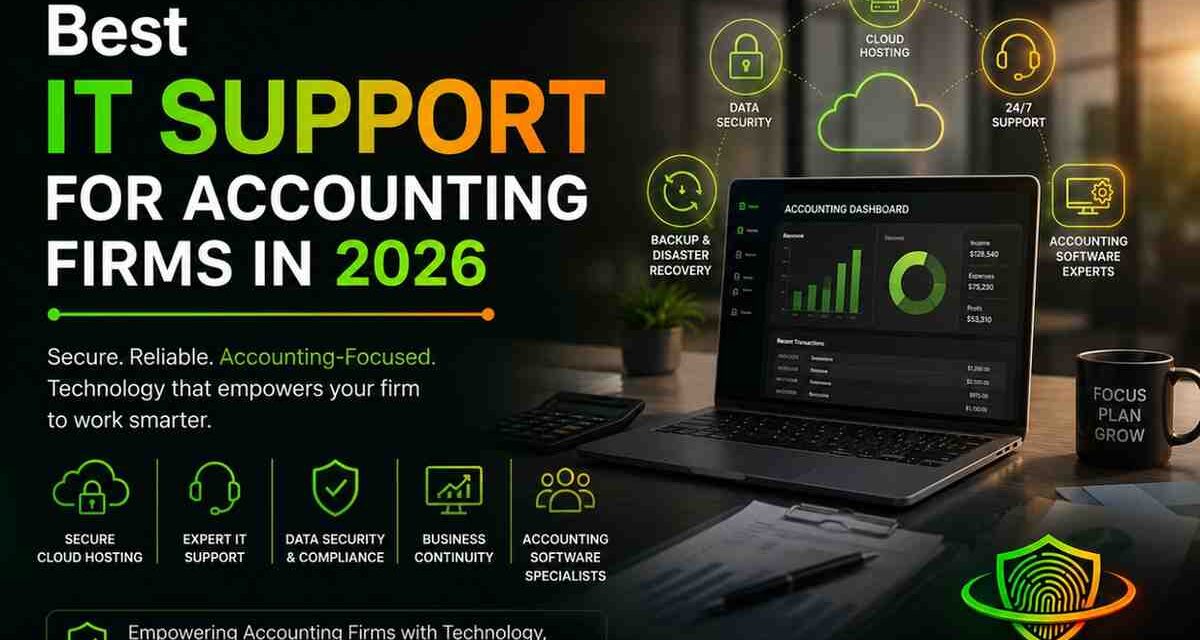

The best IT support providers for accounting firms in 2026 combine managed IT services, cloud hosting, cybersecurity, compliance support, and accounting software expertise. Leading providers such as Verito, Rightworks, OneUp Networks, Ace Cloud Hosting, and Summit Hosting each serve different firm requirements based on size, budget, security needs, and software environments. Verito stands out for small-to-mid-sized CPA firms, Rightworks excels in enterprise-grade managed IT and security, OneUp Networks offers strong value for cloud hosting, Ace Cloud Hosting focuses on security and compliance, and Summit Hosting is well-suited for firms using QuickBooks, Sage, and dedicated hosting environments. When evaluating accounting IT support providers, firms should prioritize expertise in QuickBooks hosting, tax software hosting, remote workforce support, backup and disaster recovery, cybersecurity protection, compliance requirements, and responsive technical support to ensure operational continuity and long-term growth.
The best IT support for accounting firms in 2026 depends on firm size, software stack, compliance needs, and support quality. The strongest providers are Verito, Rightworks, OneUp Networks, Ace Cloud Hosting, and Summit Hosting. Verito is best overall for small-to-mid accounting and tax firms, Rightworks is best for large multi-office firms, OneUp Networks is best for value-focused CPA cloud hosting, Ace Cloud Hosting is best for security-focused managed IT, and Summit Hosting is best for QuickBooks, Sage, and dedicated-server hosting.
Accounting firms need specialized IT support because they manage sensitive client data, tax returns, payroll records, financial documents, and deadline-driven accounting software. The right provider should offer managed IT services for accounting firms, CPA IT support, IT services for CPAs, accounting firm cybersecurity, cloud hosting for accounting firms, QuickBooks hosting, tax software hosting, backups, remote access, and compliance support aligned with IRS Publication 4557 and FTC Safeguards Rule expectations.
Independent Review Note
This guide is an independent informational comparison of IT support providers for accounting firms. No provider sponsored, reviewed, or approved this ranking, and this article does not use affiliate links or paid placements. Providers were evaluated based on accounting software support, managed IT capabilities, cybersecurity, compliance relevance, backup policies, support quality, pricing transparency, scalability, and public reputation signals. Vendor claims, pricing, certifications, and support terms can change, so firms should verify current details directly before choosing a provider.
Scoring Weight: Security and compliance: 25% · Accounting software support: 20% · Support quality: 20% · Pricing and value: 15% · Scalability: 10% · Reputation signals: 10%
Why accounting firms need specialized IT support
Accounting firms are not typical small businesses, and they should not be treated like typical IT clients. A CPA firm holds Social Security numbers, bank details, payroll records, and complete financial histories for hundreds or thousands of clients. That concentration of sensitive data makes accounting practices unusually attractive to criminals — and unusually exposed when technology fails.
The stakes rose again with the FTC Safeguards Rule and IRS Publication 4557, which now expect tax and accounting firms to maintain a written information security program, multi-factor authentication, encryption, and monitored access controls. Generic IT support rarely accounts for these obligations. Specialized IT support for accounting firms does.
There is also the calendar. Few industries have a workload curve as steep as tax season. From January through April, a firm’s application performance, concurrent-user capacity, and support responsiveness matter more than at any other time of year. An outage on April 14 is not an inconvenience; it is lost billable hours and a compliance risk.
Three forces have pushed most firms toward cloud hosting and managed IT services:
Security pressure. Phishing, ransomware, and business email compromise disproportionately target firms that hold financial data. The mitigations — endpoint detection and response (EDR), managed firewalls, security awareness training, and 24/7 monitoring — are difficult to run in-house at a small or mid-sized firm.
Compliance weight. Beyond the FTC and IRS rules, firms serving healthcare or public-company clients often inherit HIPAA, PCI DSS, or SOC obligations. Meeting them requires audited infrastructure and documentation most firms cannot produce alone.
Remote and hybrid work. Desktop tax and accounting software — QuickBooks Desktop, Drake, UltraTax, Lacerte, ProSeries — was never designed for distributed teams. Hosting those applications in the cloud, or delivering them through virtual desktop infrastructure (VDI), lets staff work securely from any location without VPN headaches or “who has the company file” problems.
The result is a distinct category: providers that combine accounting software hosting, cybersecurity, and managed IT services for accounting firms into one relationship. The five companies in this guide are among the most established names in that category.
Why accounting firms need specialized IT support (the deeper case)
It is worth being precise about what “specialized” buys a firm, because it is the single biggest reason to choose an accounting-focused provider over a general managed service provider (MSP).
A generalist MSP can host a Windows server. What it usually cannot do is answer, at 9 p.m. before a deadline, why a Drake e-file is rejecting, why UltraTax is locking a data path, or why a QuickBooks company file will not open in multi-user mode. Accounting-specific IT support means the first person who answers the phone has seen that exact error before — not once, but hundreds of times.
Specialization also shapes the infrastructure. Accounting workloads are I/O-heavy and spiky. A provider that tunes servers for large QuickBooks company files, simultaneous multi-user access, and seasonal concurrency will outperform a general host running the same software on generic virtual machines. That is why several providers in this comparison emphasize dedicated servers, NVMe storage, and resource isolation rather than shared, multi-tenant environments.
Finally, specialization affects compliance. An accounting IT service provider that lives in this world builds IRS Publication 4557, the FTC Safeguards Rule, and the Gramm-Leach-Bliley Act (GLBA) into its default configuration — including written information security plan (WISP) documentation — instead of treating them as custom projects.
What are managed IT services for accounting firms?
Managed IT services for accounting firms are a subscription model in which an external provider takes ongoing responsibility for a firm’s technology — monitoring, securing, patching, backing up, and supporting it — for a predictable monthly fee, instead of the firm hiring internal IT staff or calling a break-fix technician when something breaks.
For accounting practices, a complete managed IT offering typically includes:
- Help desk and user support — a staffed desk for password resets, access changes, and day-to-day issues.
- Proactive monitoring — 24/7 watch over servers, endpoints, and networks to catch problems before they cause downtime.
- Patch management — timely operating-system and application updates to close security gaps.
- Device and endpoint management — provisioning, securing, and monitoring laptops and workstations, including EDR.
- Managed security — firewalls, MFA, email filtering, threat detection, and security awareness training.
- Backup and disaster recovery — automated backups with defined recovery objectives so a firm can restore quickly after data loss or an outage.
- Compliance support — WISP creation, audit-ready documentation, and controls aligned to FTC, IRS, HIPAA, and PCI requirements.
The distinction that matters when comparing providers: some sell application hosting (they run your QuickBooks or tax software in their cloud), some sell managed IT (they manage your devices, network, and security wherever work happens), and the strongest sell both as a single, integrated service. Rightworks, Verito, and Ace Cloud Hosting each package hosting and managed IT together; Summit and OneUp Networks lean primarily toward hosting with managed-service layers.
How IT support for CPAs differs from traditional IT services
Traditional IT support is reactive and generic: a ticket is opened, a technician responds, a device is fixed. IT support for CPAs is proactive, compliance-aware, and software-specific.
Four differences stand out:
1. Regulatory fluency. A CPA-focused provider treats the FTC Safeguards Rule and IRS Pub 4557 as baseline requirements, not add-ons. It can produce a WISP and speak to GLBA obligations. A general IT shop usually cannot.
2. Application expertise. CPA IT support is measured on how well it keeps tax and accounting software running — Drake, Lacerte, UltraTax, ProSeries, ProSystem fx, and QuickBooks Enterprise — under load. General IT support is measured on uptime of hardware.
3. Seasonal scalability. CPA firms need to add users for busy season and scale back afterward. Providers built for accountants expect this rhythm and price for it; general providers often lock firms into rigid annual tiers.
4. Data sensitivity and continuity. Because a breach or extended outage at a CPA firm carries legal and reputational consequences, accounting IT support puts heavier emphasis on encryption, MFA, isolation of client data, and tested disaster recovery than a typical small-business IT plan.
In short, IT services for CPAs are a niche within managed IT — and the providers below have organized their entire businesses around that niche (with one, Summit, sitting slightly closer to the generalist end).
Best IT services for accounting firms compared: executive summary
The table below summarizes how the five providers compare at a glance. Detailed evidence follows in the sections after it.
| Provider | Best for | Main strengths | Main weaknesses | Support quality | Security | Scalability | Accounting software support | Overall assessment |
|---|---|---|---|---|---|---|---|---|
| OneUp Networks | Small firms and cost-sensitive buyers wanting an accounting-focused specialist | Accounting-specific focus; performance-oriented (NVMe/DDR5, dedicated servers); 24/7 human support; aggressive pricing; 120-day backup retention | Smallest scale and shortest track record; thin independent review volume; certification list largely self-reported | Strong in early reviews; small sample | Broad controls advertised (MFA, EDR, IDS/IPS, SOC/HIPAA-ready) — mostly self-reported | Good (dedicated servers, elastic users) | QuickBooks, Thomson Reuters CS, CCH, Drake, Sage | Promising specialist challenger; least independently verified |
| Summit Hosting | QuickBooks/Sage/ERP-centric SMBs and multi-industry businesses | Long operating history; large infrastructure footprint; dedicated-server model; SOC 2-audited; US-based support | Thinner tax-software depth (QB/Sage/ERP-centric); mixed independent support reviews; add-on fees in some listings | Mixed (praised escalation vs. reachability complaints) | Strong (SOC 2, zero-trust, MFA, patching); HIPAA/PCI aligned | Strong (dedicated, customizable resources) | QuickBooks, Sage, ERP; tax suites not a specialty | Solid dedicated-server host; better for QB/Sage than tax prep |
| Rightworks | Larger, multi-office firms wanting one vendor for hosting + security + on-site IT | Largest and most established; 3,000+ apps; deepest managed IT and security; scale; used by many top-25 firms | Premium and less transparent pricing; documented complaints on support wait times and login/performance speed | Award-winning at its best; inconsistent at scale | Strong at scale (EDR, SSO, WISP, training; SOC-certified) | Excellent (built for firm growth and M&A) | All major tax suites + QuickBooks (3,000+ apps) | The category benchmark for breadth; watch cost and support experience |
| Verito | Small-to-mid tax and accounting firms wanting dedicated servers + specialist support + compliance | Exclusive accounting/tax focus; dedicated private server on every plan; SOC 2 Type II; compliance baked in; top independent review standing; transparent month-to-month pricing | Smaller scale; no ATX support; lighter on-site network footprint than Rightworks; bold uptime marketing | Excellent (fast, accounting-trained, highly rated) | Strong (SOC 2 Type II, AES-256, MFA; IRS/FTC/GLBA aligned) | Good (per-firm dedicated; seasonal scaling) | Drake, Lacerte, UltraTax, ProSeries, QuickBooks (2,000+); ATX excluded | Best-fit specialist for the target audience |
| Ace Cloud Hosting | Security-focused firms and those wanting deep managed security | Long track record; broad certifications (SOC 2 Type II + ISO 27001/27017/27018/20000); major partnerships (Intuit Elite, Microsoft, CrowdStrike); broad tax + accounting apps; many awards | Some Enterprise-workload and migration complaints; not exclusively accounting; offshore support component | Strong overall; occasional friction | Very strong (multi-cert, CrowdStrike-backed SOC, EDR) | Strong (VDI/DaaS, pay-as-you-go) | QuickBooks, Sage, Drake, ATX, ProSeries, Lacerte, ProSystem fx | Strongest all-rounder on certifications and managed security |
Provider overviews
1. OneUp Networks
Company overview : OneUp Networks is a US-based cloud hosting and managed services provider focused specifically on accountants, CPA firms, and tax professionals. It is the newest and smallest of the five providers here, and it positions itself explicitly against generic hosts by tuning its environment around accounting workflows. The company reports serving roughly 8,000 users across 10-plus countries — a fraction of the larger players, but a base it has built quickly.
Core services : Cloud hosting for QuickBooks, Thomson Reuters CS Suite, Drake, Lacerte, ProSeries, ATX, Sage, and other accounting applications; Virtual Desktop Infrastructure (VDI); managed IT; managed security; backup and disaster recovery; and compliance services. OneUp Networks also enables firms to host their entire accounting technology stack—including QuickBooks, tax software, and Microsoft applications—within a single cloud environment, with Citrix support for resource-intensive workloads.
Target customers : Small and mid-sized accounting firms, tax preparers, and CPA practices — particularly firms frustrated by slow local machines, backup failures, or scripted, bot-first support from a previous provider.
Hosting infrastructure : OneUp Networks leans hard on performance messaging: NVMe SSD storage with high throughput, DDR5 memory, dedicated (non-shared) storage, and enterprise network redundancy. It advertises a 120-day rolling backup retention window and 99.99% uptime, and says it owns its infrastructure rather than reselling.
Security capabilities : The company describes MFA, encrypted daily backups, EDR with AI/ML-based threat detection, intrusion detection and prevention (IDS/IPS), managed firewalls, and around-the-clock network and security operations monitoring. It states it maintains a broad set of certifications and attestations — including HIPAA, HITRUST, ISO 27001, PCI DSS, and AICPA SOC 2. These are presented on the company’s own site; independent, third-party confirmation of the full list is limited, so firms with strict due-diligence requirements should request current audit reports directly.
Managed IT offerings : Proactive monitoring, patch management, backup and recovery, and managed security are bundled with hosting. OneUp’s differentiator is “human support without bot filtering” — 24/7 access to engineers familiar with accounting software.
Accounting software support : QuickBooks (Pro, Premier, Enterprise, Accountant), the Thomson Reuters CS Professional Suite (UltraTax CS, Practice CS, Accounting CS, FileCabinet CS), CCH Professional software, Drake, Sage, and ATX. OneUp Networks is a QuickBooks Solution Provider with Intuit.
Competitive advantages : Accounting specialization, a performance-first infrastructure story, genuinely 24/7 human support, generous backup retention, and aggressive entry pricing with a free trial and free migration. Its clearest disadvantage is simply youth: the smallest footprint and the thinnest independent track record of the five.
2. Summit Hosting
Company overview: Summit (formerly Summit Hosting) has operated since the mid-2000s and grew into one of the larger independent hosting providers in the financial-software niche through a series of mergers and acquisitions. Company and third-party materials cite more than 8,000 servers and over 30,000 end-users across the United States and Canada. Over time Summit has broadened well beyond application hosting into a wider managed-infrastructure platform (private cloud, bare metal, colocation, and more) spanning many data centers, with QuickBooks and Sage hosting sitting as one vertical within that platform.
Core services: QuickBooks cloud hosting, Sage hosting, ERP hosting (including SAP Business One), dedicated Windows server hosting, Desktop-as-a-Service (DaaS), and managed services as optional add-ons. Its “Summit Secure Workspace” bundles the security layer.
Target customers: Small-to-mid-market organizations, typically 5 to 500 users, concentrated in accounting, construction, real estate, non-profit, and professional services — especially businesses committed to desktop QuickBooks or Sage that want to outsource server maintenance.
Hosting infrastructure: Summit’s core differentiator is a dedicated-server model: each client gets its own server rather than sharing resources, with the ability to scale CPU, RAM, and storage independently. It cites top-tier data centers, high availability, and — depending on the page — uptime figures from 99% to 99.99%.
Security capabilities: AES-256 encryption at rest and in transit, MFA, zero-trust network architecture, network segmentation, automatic patch management, and 24/7 security operations monitoring. Summit’s infrastructure is described as SOC 2-audited and aligned with HIPAA and PCI DSS; broader materials reference ISO 27001, GDPR, and NIST alignment depending on the service. Nightly backups with a 15-day retention window are included, and Summit Secure Workspace ships with every environment.
Managed IT offerings: Managed services (software updates, user management, proactive optimization) are available as add-ons rather than a fully integrated managed-IT-plus-on-site-network offering. For accounting-specific configuration, Summit is frequently paired with implementation partners.
Accounting software support: Strong on QuickBooks (Pro, Premier, Enterprise, Accountant) and the full Sage family (50, 100, 300, 500, and Sage Construction & Real Estate), plus general Windows applications. Its coverage of dedicated tax-prep suites — Drake, UltraTax, Lacerte, ProSeries, ProSystem fx — is thinner and not a marketed specialty; Summit can host many Windows apps, but tax-focused firms should confirm fit.
Competitive advantages: A long operating history, a large and capable infrastructure footprint, a genuine dedicated-server architecture, US-based support, and SOC 2-audited security. Its weaknesses for this audience: a QuickBooks/Sage/ERP center of gravity rather than deep tax-suite support, mixed independent reviews of support reachability, and packaging that can add fees (for example, a separately listed Secure Workspace charge in some third-party listings).
3. Rightworks
Company overview: Rightworks — known as Right Networks until its 2023 rebrand — is the largest and most established provider in this comparison. Founded in 2002 and headquartered in Nashua, New Hampshire, it describes itself as the preferred cloud service provider for 70,000-plus businesses and accounting and tax firms, including more than half of the top 25 US accounting firms. Independent profiles estimate revenue in the hundreds of millions, placing it in a different weight class from the others.
Core services: Cloud hosting for desktop accounting and tax applications, managed IT services, cybersecurity, single sign-on, and a broader platform (marketed under names including OneSpace and Cloud Premier) that consolidates a firm’s apps, security, and IT support into one relationship. It also offers Spark AI, a security-conscious AI assistant, and runs the Rightworks Community, the largest peer network for accounting professionals.
Target customers: The full spectrum — from solo practitioners and local firms to large, multi-office regional and national firms. Rightworks is aimed squarely at firms that want a single technology partner to handle hosting, security, and IT together, and that are consolidating or adding offices.
Hosting infrastructure: A managed, purpose-built cloud platform giving secure access to 3,000-plus accounting, tax, and business applications from anywhere. Backups scale by tier — from 90-day retention up to two years of backups with hourly snapshots on higher plans — and the platform is designed to onboard new staff or offices quickly.
Security capabilities: This is a Rightworks strength. The platform includes EDR, cloud-managed firewalls, MFA, passwordless single sign-on (so staff never handle individual credentials), device backup, encryption, security awareness training, and WISP management. The company reports blocking large volumes of threats daily and preventing on the order of 1.5 million cyber threats monthly, backed by 24/7/365 monitoring and SOC-certified data centers. It also offers on-site security management, such as physical firewalls and wireless access points — a capability the pure hosts here generally do not match.
Managed IT offerings: The most complete in this group. Beyond hosting and security, Rightworks manages in-office networks, Microsoft Office and email, device monitoring, and user onboarding/offboarding — a genuine managed IT services layer rather than a hosting add-on.
Accounting software support: The broadest ecosystem here: Lacerte, ProSeries, Drake, UltraTax cs, QuickBooks Desktop and Online, the Thomson Reuters CS Professional Suite, CCH ProSystem fx, and CCH Axcess, among 3,000-plus apps.
Competitive advantages: Scale, longevity, the widest application ecosystem, the deepest managed IT and security stack (including on-site network management), and a track record with the largest firms. The trade-offs are real, though: independent reviews include recurring complaints about slow QuickBooks Desktop load times, file and email porting issues, and long support wait times — and pricing is premium and less transparent than the specialists. Rightworks is the most capable platform in the category; it is not the highest-rated on day-to-day support experience or value.
4. Verito
Company overview:Verito Technologies, founded in 2016 and headquartered in Wilmington, Delaware, is a private cloud hosting and managed IT provider built exclusively for tax and accounting firms. It serves more than 1,000 CPA firms, tax preparers, enrolled agents, and bookkeeping practices across the US. It was co-founded by Jatin Narang (CEO, a Microsoft Certified Systems Engineer and Forbes Technology Council member) and Cam Majors (CRO), who co-authored a 2026 book on modernizing accounting firms — a signal of the firm’s deliberate positioning as accounting-technology specialists rather than generalists.
Core services: Verito’s platform is organized into four products: VeritSpace (private cloud hosting), VeritGuard (managed IT and endpoint security), VeritComplete (hosting and managed IT bundled), and VeritShield WISP (written information security plan documentation for IRS and FTC compliance).
Target customers: Small-to-mid-market tax and accounting firms — commonly cited as roughly 3 to 100 users — that run desktop tax and accounting software, need secure access across locations, and want compliance handled for them. Several public reviews note firms switching to Verito from larger providers after reliability frustrations.
Hosting infrastructure:Verito’s defining choice is a dedicated private server for every firm on every plan — even the entry tier — so a firm’s CPU, RAM, and storage are never shared with another tenant and client data stays isolated. It advertises nightly automated backups with multiple restore points (typically 60-plus days of retention), documented RPO/RTO with off-site replication, and a stuck-application recovery tool (Verito AppManager). Verito markets “100% uptime since 2016,” a strong claim best read as its stated reliability record rather than an independently audited guarantee.
Security capabilities:SOC 2 Type II certified, with AES/256-bit encryption in transit and at rest, MFA, endpoint detection, and continuous monitoring. Crucially for this audience, every environment is built to align with IRS Publication 4557, the FTC Safeguards Rule, and GLBA by default, with compliance documentation included.
Managed IT offerings: VeritGuard extends protection to a firm’s local devices, network security, and compliance monitoring; VeritComplete makes the hosting team and the IT team the same team. This is a real managed IT service, though its on-site network footprint is lighter than Rightworks’.
Accounting software support: Drake, Lacerte, UltraTax, ProSeries, QuickBooks (all desktop versions), Sage, Xero, CCH ProSystem fx, plus practice-management tools like TaxDome, Karbon, and Financial Cents — 2,000-plus applications in total. One notable exclusion: ATX is not currently supported, which matters for firms standardized on that suite.
Competitive advantages:Exclusive accounting/tax focus, dedicated infrastructure even at entry level, SOC 2 Type II with compliance built in, transparent month-to-month pricing with a money-back guarantee, and the strongest independent review standing of the five. Verito reports a 4.9-out-of-5 rating across 170-plus verified G2 reviews and multiple category-leading G2 rankings (including top placement for “Relationship” in a Summer 2026 managed-hosting report). Its limits are scale, the ATX gap, and a smaller on-site IT footprint than the market leader.
5. Ace Cloud Hosting
Company overview:Ace Cloud Hosting (ACH), part of Real Time Cloud Services, was founded in 2004 and is headquartered in Pompano Beach, Florida, with additional offices in Bethel Park, Pennsylvania, and Gurugram, India. It reports serving more than 20,000 businesses globally and is one of the most decorated providers in the accounting-hosting space, citing 100-plus industry awards.
Core services: QuickBooks hosting, Sage hosting, tax software hosting, virtual desktop infrastructure (VDI/DaaS), managed IT services, managed security services, and public cloud (IaaS). It is an Intuit Authorized Commercial Host and QuickBooks Solution Provider (at the “Elite” tier), and a Microsoft Direct/CSP partner.
Target customers: Accounting firms, CPAs, tax professionals, and SMBs — plus adjacent professions such as law and real estate. Ace serves everyone from solo practitioners to mid-market and enterprise buyers, with a notable strength for firms that prioritize security and managed cybersecurity.
Hosting infrastructure: SSD-based high-performance servers with a 99.99% uptime SLA (some materials cite 99.999%), delivered through Tier 4 and Tier 5 US-based data center partners. It advertises a 45-day rolling backup retention window with built-in business continuity and disaster recovery, plus dedicated-server options.
Security capabilities: Among the strongest and most independently substantiated here. Ace holds ISO/IEC 27001, ISO 20000, ISO 27017, and ISO 27018 certifications, and cites SOC 2 Type II (and SOC 3) compliance at the data-center level, with real-time monitoring aligned to HIPAA and PCI DSS. Its managed security stack — IDS/IPS, next-gen antivirus, MFA, encryption, layered firewalls, DNS filtering, email security, EDR, and a 24/7 SOC — is bolstered by a CrowdStrike partnership, alongside alliances with Intuit, Citrix, Microsoft, and AWS.
Managed IT offerings: A full managed IT and MSP layer: endpoint management, server and network monitoring, OS management, secure SSO, patch management, backup and disaster recovery, migration services, and 24/7/365 help desk.
Accounting software support : Broad tax and accounting coverage: QuickBooks (all editions, including region-specific versions and Point of Sale), Sage (50, 100, 300, 500, 100 Contractor, 300 CRE), and tax suites including Drake, ATX, ProSeries, Lacerte, and ProSystem fx, plus 200-plus add-ons. (Firms on the Thomson Reuters CS/UltraTax stack specifically should confirm current support.)
Competitive advantages :The deepest certification portfolio in this comparison, serious managed-security capability (CrowdStrike-backed SOC), a long track record, broad software coverage including ATX, strong awards and Intuit/Microsoft partnerships, and generally strong support reviews. Its weaknesses: a handful of public reports of subpar performance and slow issue resolution on demanding QuickBooks Enterprise workloads and migrations, a support model that includes offshore staffing, and a not-exclusively-accounting focus.
Detailed feature comparison
The tables below compare the five providers across the dimensions that matter most when evaluating IT support for accounting firms. Ratings reflect the weight of available evidence; “~” indicates a capability that exists but is either not a marketed specialty or should be confirmed for your specific stack.
IT support services
| Capability | OneUp Networks | Summit Hosting | Rightworks | Verito | Ace Cloud Hosting |
|---|---|---|---|---|---|
| Help desk (24/7) | Yes (human, no bot filtering) | Yes (US-based) | Yes (24/7 Customer Care) | Yes (accounting-trained) | Yes (24/7/365) |
| Proactive monitoring | Yes | Yes | Yes (24/7/365) | Yes | Yes (24/7 SOC) |
| Patch management | Yes | Yes (automatic) | Yes | Yes | Yes |
| User support / onboarding | Yes (free onboarding) | Yes | Yes (fast staff onboarding) | Yes (white-glove) | Yes (dedicated rep on many plans) |
| Device management | Yes | Add-on | Yes (incl. on-site) | Yes (VeritGuard) | Yes (MSP layer) |
| Remote assistance | Yes | Yes | Yes | Yes | Yes |
Cybersecurity
| Capability | OneUp Networks | Summit Hosting | Rightworks | Verito | Ace Cloud Hosting |
|---|---|---|---|---|---|
| Multi-factor authentication | Yes | Yes | Yes | Yes | Yes |
| Endpoint protection / EDR | Yes (AI/ML EDR) | Yes | Yes (EDR) | Yes | Yes (CrowdStrike-backed) |
| Threat detection | Yes (IDS/IPS) | Yes | Yes (24/7) | Yes | Yes (IDS/IPS + SOC) |
| Security monitoring | Yes (NOC/SOC) | Yes (24/7) | Yes (24/7/365) | Yes | Yes (24/7 SOC) |
| Backup systems | Yes (120-day retention) | Yes (15-day retention) | Yes (90-day to 2-year) | Yes (60+ day retention) | Yes (45-day retention) |
| Disaster recovery | Yes | Yes (DRaaS available) | Yes | Yes (documented RPO/RTO) | Yes (built-in BC/DR) |
| Compliance support | HIPAA/PCI/SOC (self-reported) | SOC 2, HIPAA, PCI aligned | SOC-certified; WISP incl. | SOC 2 Type II; IRS/FTC/GLBA; WISP | SOC 2 Type II + ISO 27001/27017/27018 |
Accounting software support
| Software | OneUp Networks | Summit Hosting | Rightworks | Verito | Ace Cloud Hosting |
|---|---|---|---|---|---|
| QuickBooks (Pro/Premier/Accountant) | Yes | Yes | Yes | Yes | Yes |
| QuickBooks Enterprise | Yes | Yes | Yes | Yes | Yes |
| Drake | Yes | ~ | Yes | Yes | Yes |
| UltraTax (Thomson Reuters CS) | Yes | ~ | Yes | Yes | ~ |
| Lacerte | Yes | ~ | Yes | Yes | Yes |
| ProSeries | Yes | ~ | Yes | Yes | Yes |
| Thomson Reuters CS Professional Suite | Yes | ~ | Yes | Yes | ~ |
| CCH ProSystem fx | Yes | ~ | Yes | Yes | Yes |
| ATX | Yes | ~ | ~ | No | Yes |
| Sage family | Yes | Yes | ~ | Yes | Yes |
Support evolves and firms host many applications on general Windows environments. Always confirm your exact stack — versions included — with the vendor before committing.
Cloud infrastructure
| Attribute | OneUp Networks | Summit Hosting | Rightworks | Verito | Ace Cloud Hosting |
|---|---|---|---|---|---|
| Private cloud | Yes | Yes | Yes (managed platform) | Yes (per firm) | Yes |
| Dedicated hosting | Yes | Yes (core model) | Available by tier | Yes (every plan) | Yes (available) |
| Virtual desktops (VDI/DaaS) | Yes | Yes (DaaS) | Yes | Yes | Yes (VDI/DaaS) |
| Performance emphasis | NVMe / DDR5 | Dedicated resources | Broad app platform | Isolated dedicated servers | SSD, Tier 4/5 DCs |
| Scalability | Elastic users | Independent CPU/RAM/storage | Built for firm growth/M&A | Seasonal up/down | Pay-as-you-go |
| Reliability (stated) | 99.99% | 99%–99.99% | High-availability | “100% since 2016” (claim) | 99.99% SLA |
Customer support
| Attribute | OneUp Networks | Summit Hosting | Rightworks | Verito | Ace Cloud Hosting |
|---|---|---|---|---|---|
| Availability | 24/7 | 24/7/365 | 24/7 | 24/7/365 | 24/7/365 |
| Onboarding | Free, guided | Structured (1–3 weeks) | 2–4 weeks | 24–48 hours (white-glove) | Guided, fast |
| Migration assistance | Free | Managed | Included | Included, rapid | Included |
| Managed services | Bundled | Add-on | Fully integrated | Bundled (VeritComplete) | Fully integrated (MSP) |
| Technical expertise | Accounting-trained | US-based generalist + specialist | Accounting specialists | Accounting/tax specialists | Accounting + security specialists |
| Independent support sentiment | Positive (small sample) | Mixed | Award-winning but inconsistent at scale | Consistently high | Strong overall |
Pricing and value
Pricing in this category is fluid, frequently promotional, and usually quote-based for anything beyond an entry plan. The figures below are approximate publicly listed or reported starting prices intended only to convey relative positioning; confirm a written quote for your user count and stack.
| Attribute | OneUp Networks | Summit Hosting | Rightworks | Verito | Ace Cloud Hosting |
|---|---|---|---|---|---|
| Approx. starting price (reported) | ~$35.99/user/mo | ~$53–$55/user/mo (+ Secure Workspace in some listings) | ~$59.99/user/mo and up | VeritSpace ~$69/user/mo; VeritComplete ~$129/user/mo | ~$35–$44.99/user/mo (promos lower) |
| Pricing transparency | Partly public; quote-based | Partly public; quote-based | Least transparent; premium | Most transparent; published tiers | Fairly transparent; pay-as-you-go |
| Free trial | 15 days | 30 days | Demo-led | 15 days + 30-day money-back | 7 days |
| Contract flexibility | Monthly or annual | Varies | Typically annual | Month-to-month, no cancellation fees | Flexible |
| Included features | Backups, migration, support | Dedicated server, Secure Workspace | Deep security + managed IT | Dedicated server, compliance, WISP option | Security, migration, support |
| Overall value signal | High (for small firms) | Moderate | Premium (pay for breadth) | Strong (specialist value) | Strong (certifications per dollar) |
Managed IT support services for accounting firms: key features to expect
If you are evaluating providers on their managed IT services for accountants — not just hosting — hold each one to the same checklist:
- A staffed 24/7 help desk with accounting fluency. All five offer round-the-clock support; the differentiator is whether the first responder understands tax software, not just Windows. Verito and Ace emphasize accounting-trained engineers; Rightworks fields accounting specialists at scale; OneUp Networks stresses human (non-bot) support.
- Proactive monitoring and patching. Every provider here monitors and patches, but ask about response-time commitments and whether monitoring extends to your local devices or only to their hosted servers.
- Managed backup and tested disaster recovery. Retention windows vary widely — from 15 days (Summit) to 45 (Ace), 60-plus (Verito), 90 days to two years (Rightworks), and 120 days (OneUp Networks). Longer is better, but tested recovery matters more than raw retention. Ask for documented RPO/RTO.
- Layered managed security. Look for EDR, MFA, managed firewalls, email filtering, and security awareness training. Rightworks and Ace go deepest here (WISP management and CrowdStrike-backed SOC, respectively).
- Compliance documentation. For accounting and tax firms, a provider that supplies a WISP and maps controls to IRS Pub 4557, the FTC Safeguards Rule, and GLBA saves months of work. Verito (VeritShield), Rightworks, and Ace all address this directly.
IT solutions for accounting firms: what to look for
When comparing IT solutions for accounting firms, weigh these factors in roughly this order of importance for a typical practice:
- Security and compliance posture. Prioritize independently verifiable credentials — a current SOC 2 Type II report dated within the last 12 months carries more weight than a long self-reported list. On this measure, Ace (SOC 2 Type II plus a full ISO stack) and Verito (SOC 2 Type II with IRS/FTC/GLBA alignment) lead.
- Accounting software fit. Confirm the provider hosts your exact applications and versions. A firm on ATX should note Verito’s exclusion; a firm on the Thomson Reuters CS suite should confirm depth with Ace or Summit.
- Support quality. Read independent reviews, not just testimonials. Look for consistent praise of response times and accounting-specific problem solving.
- Infrastructure model. Dedicated servers (Summit, Verito, and available from OneUp Networks and Ace) generally outperform shared, multi-tenant hosting for large QuickBooks files and multi-user work.
- Scalability and seasonality. Ensure you can add users for busy season and scale back — and understand the cost of doing so.
- Pricing transparency and exit terms. Favor providers that publish pricing, avoid punitive contracts, and grant clean data-export rights at termination. Verito’s month-to-month terms are the most firm-friendly here.
How to choose an IT service provider for your accounting firm
A practical, evidence-based selection process:
Step 1 — Define your stack and constraints. List every application and version, your user count at peak and off-peak, your compliance obligations (FTC, IRS, HIPAA, PCI), and whether you need local-device and on-site network management or only hosted-application support.
Step 2 — Get seven answers in writing from each finalist: a SOC 2 Type II report dated within 12 months; a published uptime SLA; a published support response-time target; whether plans are dedicated or shared; contract length and exit terms; a migration timeline commitment; and data-export rights at termination. Cleaner answers signal a more confident vendor.
Step 3 — Test support before you buy. Use the free trial to open real tickets during a busy window and measure how fast a knowledgeable human responds.
Step 4 — Weight the evidence to your profile. A five-person tax firm and a 300-person multi-office firm should not choose the same way. Use the “best by use case” and “final rankings” sections below to match a provider to your situation rather than to a marketing headline.
IT support for tax firms: essential security and compliance requirements
Tax firms carry the heaviest compliance load in this audience, and it intensifies precisely when systems are under the most strain. Any provider on your shortlist should demonstrably support:
- A written information security plan (WISP). Required under IRS Publication 4557 and expected under the FTC Safeguards Rule. Verito, Rightworks, and Ace provide WISP documentation or management; OneUp Networks and Summit address security strongly but should be asked directly about WISP deliverables.
- Multi-factor authentication everywhere. Now a baseline expectation from the IRS and FTC. All five offer it.
- Encryption in transit and at rest. AES-256 is the standard; Summit, Verito, and Ace state it explicitly.
- GLBA and FTC Safeguards alignment. Verito builds this in by default; Ace and Rightworks map controls to it.
- Seasonal scalability without a compliance gap. Adding temporary or offshore staff for busy season must not weaken access controls. Rightworks’ passwordless single sign-on with location and time-of-day policies, and Verito’s isolated dedicated environments, are strong models here.
- Tested disaster recovery. A tax firm cannot afford a multi-day outage in April. Confirm documented recovery objectives and evidence of tested restores.
Trust and reputation analysis
Marketing claims are easy; independent signals are harder to manufacture. Here is how the five providers look on evidence outside their own websites.
Customer reviews. Verito shows the strongest independent standing: a reported 4.9-out-of-5 average across 170-plus verified G2 reviews and multiple category-leading G2 rankings in 2026, with reviewers frequently citing reliability and responsive, accounting-literate support. Ace Cloud Hosting also earns broadly positive reviews across G2 and Trustpilot, praised for fast support and QuickBooks performance, with occasional friction on demanding Enterprise migrations. Rightworks presents a split picture — award-winning recognition and many satisfied firms, alongside a meaningful set of reviews reporting slow logins, file/email porting problems, and long support waits, particularly as firms scale. Summit’s independent reviews are mixed, with some customers praising fast escalation and others reporting difficulty reaching a live person during outages. OneUp Networks’s reviews are positive but drawn from a small sample, reflecting its youth.
Testimonials and case studies. All five publish customer stories. The most instructive are the switching narratives: multiple public reviews describe firms moving to Verito or Ace from larger incumbents after reliability or support frustrations — a useful signal of where firms land when a first choice disappoints.
Industry recognition. Ace Cloud Hosting is the most decorated, citing “Best Outsourced Technology Provider” from the CPA Practice Advisor Readers’ Choice Awards in consecutive years, a 2024 Stevie Award for customer service, Gartner recognition, and 100-plus awards overall. Rightworks holds repeated G2 customer honors and deep AICPA-community visibility. Verito reports numerous G2 category leaderships.
Certifications. On independently substantiated security credentials, Ace (SOC 2 Type II plus ISO 27001, 27017, 27018, and 20000) and Verito (SOC 2 Type II) are the clearest. Summit cites SOC 2-audited infrastructure with HIPAA/PCI alignment. Rightworks references SOC-certified data centers. OneUp Networks lists an extensive certification set on its own site that is harder to verify independently.
Partnerships. Ace’s alliances (Intuit Elite QuickBooks Solution Provider, Microsoft Direct/CSP, Citrix, CrowdStrike, AWS) are the broadest. OneUp Networks and Ace are Intuit QuickBooks Solution Partners/Providers; Rightworks has long-standing Intuit and market-leader relationships; Verito partners with the BDO Alliance USA and the AICPA and supports practitioner bodies including NATP, NAEA, and NSA.
Pros and cons
OneUp Networks
Pros
- Purpose-built for accountants, CPAs, and tax professionals.
- Performance-focused infrastructure (NVMe storage, DDR5, dedicated storage).
- Genuinely 24/7 human support with no bot-first filtering.
- Generous 120-day backup retention and free migration.
- SOC 2-audited, with HIPAA and PCI alignment and US-based support.
Cons
- Smallest scale and shortest track record of the five.
- Thin volume of independent, third-party reviews.
- Broad certification list is largely self-reported and harder to verify.
- Less-established on-site managed-IT and network footprint than the larger players.
Summit Hosting
Pros
- Long operating history and large infrastructure footprint.
- True dedicated-server model with independently scalable resources.
- SOC 2-audited, with HIPAA and PCI alignment and US-based support.
- Excellent fit for QuickBooks, Sage, and ERP workloads.
Cons
- Tax-prep-suite support (Drake, UltraTax, Lacerte, ProSeries) is thin and not a specialty.
- Mixed independent reviews on support reachability during outages.
- Add-on packaging (for example, Secure Workspace fees in some listings) can raise effective cost.
- Broadening beyond accounting means a less accounting-exclusive focus.
Rightworks
Pros
- The largest, most established, and most complete platform in the category.
- Widest application ecosystem (3,000-plus apps, all major tax suites).
- Deepest managed IT and security, including on-site network management, WISP, and security awareness training.
- Proven with the largest and multi-office firms; built for growth and consolidation.
Cons
- Premium pricing that is the least transparent here.
- Documented, recurring complaints about slow logins and performance.
- Support experience can be inconsistent at scale (long wait times, porting issues).
- Breadth can mean more complexity than a small firm needs.
Verito
Pros
- Exclusive focus on tax and accounting firms.
- Dedicated private server on every plan, including entry level.
- SOC 2 Type II with IRS Pub 4557, FTC Safeguards, and GLBA alignment built in.
- The strongest independent review standing of the five.
- Transparent, month-to-month pricing with a 30-day money-back guarantee.
Cons
- Smaller scale than Rightworks or Ace.
- Does not currently support ATX.
- Lighter on-site network-management footprint than the market leader.
- “100% uptime” is a marketing claim rather than an audited guarantee.
Ace Cloud Hosting
Pros
- The deepest, most independently verified certification portfolio (SOC 2 Type II + ISO 27001/27017/27018/20000).
- Serious managed security, including a CrowdStrike-backed 24/7 SOC.
- Long track record, broad software support (including ATX), and 100-plus awards.
- Strong Intuit (Elite) and Microsoft partnerships and generally strong support reviews.
Cons
- Some public reports of subpar performance and slow resolution on heavy QuickBooks Enterprise workloads and migrations.
- Support model includes offshore staffing.
- Not exclusively accounting-focused.
- UltraTax/Thomson Reuters CS depth should be confirmed for firms on that stack.
Best provider by use case
Small accounting firms. OneUp Networks and Verito are the strongest fits. OneUp Networks offers accounting-specialized hosting at aggressive prices for cost-sensitive practices; Verito adds dedicated servers and SOC 2 Type II compliance without a heavy price jump, plus month-to-month flexibility that suits a small firm testing the water.
Mid-sized accounting firms. Verito and Ace Cloud Hosting lead. Both pair dedicated-capable infrastructure with real managed IT and strong, verifiable security. Verito wins on accounting-specific support and transparency; Ace wins on certification depth and managed security.
Large accounting firms. Rightworks is the natural choice. Its scale, 3,000-plus-app ecosystem, on-site network management, and experience with top-25 firms make it the most capable platform for large, complex, multi-application environments — provided the firm accepts premium pricing and manages the support-experience risks.
CPA firms. Verito and Rightworks. Verito is the best-fit specialist for most CPA firms; Rightworks is the better choice for larger CPA firms wanting a single vendor for hosting, security, and IT across many offices.
Tax professionals. Verito and Ace Cloud Hosting. Both host the core tax suites (Drake, Lacerte, UltraTax, ProSeries) with accounting-literate support and compliance alignment. Firms on ATX should favor Ace (or another ATX-supporting host), since Verito does not support it.
Security-focused organizations. Ace Cloud Hosting first, Verito close behind. Ace’s SOC 2 Type II plus full ISO stack and CrowdStrike-backed SOC give it the strongest independently verified security posture; Verito’s SOC 2 Type II with built-in IRS/FTC/GLBA alignment is a close second and more tailored to accounting compliance specifically.
Multi-office firms. Rightworks. Passwordless single sign-on, rapid office and staff onboarding, on-site network management, and consolidation experience make it the clearest fit for firms operating across many locations or growing through acquisition.
Firms requiring managed IT services. Rightworks and Ace Cloud Hosting. Both deliver a genuine, fully integrated managed IT layer — devices, networks, security, and help desk — rather than a hosting add-on. Rightworks goes furthest on on-site infrastructure; Ace offers a robust MSP layer with standout managed security. Verito (VeritComplete) is an excellent bundled option for smaller firms that want hosting and managed IT from one team.
Final rankings
These rankings weigh features, security, support quality, and value for the target audience — accounting and tax firms — over marketing claims, based on the evidence gathered. “Best” is contingent on firm profile; the use-case section above should override a headline ranking whenever your situation differs from the typical firm the ranking assumes.
#1 — Verito
For the specific audience of this guide, Verito is the best-fit provider on the balance of the evidence. It is built exclusively for tax and accounting firms; it puts every firm on a dedicated private server even at the entry tier; it holds SOC 2 Type II certification with IRS Pub 4557, FTC Safeguards, and GLBA alignment built in; and it carries the strongest independent review standing of the five (a reported 4.9/5 across 170-plus verified reviews and multiple category-leading G2 rankings). Add transparent, month-to-month pricing with a money-back guarantee and accounting-literate support, and Verito best satisfies the brief’s emphasis on support quality, verifiable security, and value. Its limits — smaller scale, no ATX support, and a lighter on-site network footprint — keep it from being the right answer for every firm, but for most small-to-mid tax and accounting practices it is the sharpest choice.
#2 — Rightworks
Rightworks is the most capable and established platform in the category, and reasonable buyers could rank it first. It offers the widest application ecosystem, the deepest managed IT and security stack (including on-site network management, WISP, and security awareness training), enormous scale, and a track record with the largest firms. It lands at #2 rather than #1 because the very metrics the brief prioritizes — support experience and value — are where it shows the most strain: independent reviews document slow logins, porting issues, and long support waits, and its pricing is premium and the least transparent here. For large and multi-office firms that need breadth above all, Rightworks is still the top pick.
#3 — OneUp Networks
As one of the fastest-growing providers serving accounting and tax firms, OneUp Networks has established itself as a credible option through dedicated infrastructure, responsive 24/7 support, robust backup policies, and competitive pricing. Its platform is designed specifically for firms that require reliable access to business-critical accounting applications. It ranks third not because of any significant gaps in its offering, but because the providers ranked above it have longer operating histories, larger volumes of independent customer reviews, and broader publicly verifiable compliance records. While its independent evidence base is comparatively smaller, OneUp Networks’s combination of performance, support quality, and accounting-focused expertise makes it a strong contender for small and mid-sized firms.
#4 — Ace Cloud Hosting
Ace is the strongest all-rounder and the security leader on independently verified credentials. Its SOC 2 Type II plus ISO 27001/27017/27018/20000 portfolio, CrowdStrike-backed SOC, broad software support (including ATX), long track record, and heavy award recognition make it a dependable choice — especially for security-focused firms. It ranks fourth only narrowly, held back by a handful of public reports of performance and support friction on heavy QuickBooks Enterprise workloads and migrations, an offshore support component, and a focus that spans beyond accounting. Many firms will find it a co-equal alternative to the two providers above.
#5 — Summit Hosting
Summit is a well-resourced, dependable dedicated-server host with a long history, a large infrastructure footprint, and SOC 2-audited security. It is an excellent choice for QuickBooks-, Sage-, and ERP-centric SMBs and multi-industry businesses. It ranks fifth for this specific audience because its tax-prep-suite depth is thinner than the accounting specialists’, its independent support reviews are mixed, and some packaging adds cost. Firms whose needs center on QuickBooks and Sage — rather than tax preparation software — should weigh Summit more highly than this position suggests.
Frequently asked questions
The best IT support for accounting firms in 2026 depends on firm size, software stack, compliance needs, and support quality. The strongest providers are Verito, Rightworks, OneUp Networks, Ace Cloud Hosting, and Summit Hosting. Verito is best for small-to-mid accounting and tax firms, Rightworks is best for large multi-office firms, OneUp Networks is best for value-focused CPA cloud hosting, Ace Cloud Hosting is best for security-focused managed IT, and Summit Hosting is best for QuickBooks, Sage, and dedicated-server hosting.
Accounting firms need specialized IT support because they manage sensitive client data, tax returns, payroll records, financial documents, and deadline-driven accounting software. Generic IT support may not understand CPA workflows, tax-season pressure, QuickBooks hosting, tax software hosting, cybersecurity, backups, remote access, and compliance needs such as IRS Publication 4557 and FTC Safeguards Rule expectations.
Managed IT services for accounting firms should include help desk support, proactive monitoring, cybersecurity, MFA, endpoint protection, cloud hosting, QuickBooks hosting, tax software hosting, backups, disaster recovery, patch management, remote access, and compliance support. The best CPA IT support providers also understand accounting applications such as QuickBooks, Drake, UltraTax, Lacerte, ProSeries, Sage, and CCH.
Managed IT services for accounting firms should include help desk support, proactive monitoring, cybersecurity, MFA, endpoint protection, cloud hosting, QuickBooks hosting, tax software hosting, backups, disaster recovery, patch management, remote access, and compliance support. The best CPA IT support providers also understand accounting applications such as QuickBooks, Drake, UltraTax, Lacerte, ProSeries, Sage, and CCH.
For most CPA firms, Verito and OneUp Networks are among the strongest choices due to their accounting-focused services, dedicated hosting, and specialized support. The best option depends on your firm’s size, software needs, and compliance requirements.
Accounting firms should choose an IT support provider by comparing security, compliance support, accounting software expertise, support quality, pricing, backups, remote access, scalability, and reputation. Firms should also confirm whether the provider supports their exact software stack, including QuickBooks, UltraTax, Drake, Lacerte, ProSeries, Sage, CCH, cloud hosting, and tax software hosting.
Methodology and disclosures
This comparison synthesizes publicly available information from each vendor’s website; third-party review platforms (G2, Trustpilot, Clutch, Serchen); company profiles (Crunchbase, LinkedIn, and independent listing sites); and industry commentary, gathered in early 2026. Claims sourced only to a vendor’s own marketing are identified as such, and rankings reflect independent analyst judgment rather than paid placement or vendor input. No provider reviewed or approved this article. Product capabilities, certifications, pricing, and ownership change frequently; verify current details — and request current audit documentation — directly with each provider before making a purchasing decision. This guide is informational and is not legal, financial, or compliance advice.
Suggested internal-link anchors for publication: QuickBooks hosting; QuickBooks Enterprise hosting; tax software hosting; cloud hosting for accounting firms; managed IT services; cybersecurity services; disaster recovery solutions; remote desktop solutions; virtual desktop infrastructure (VDI); accounting software hosting.
