
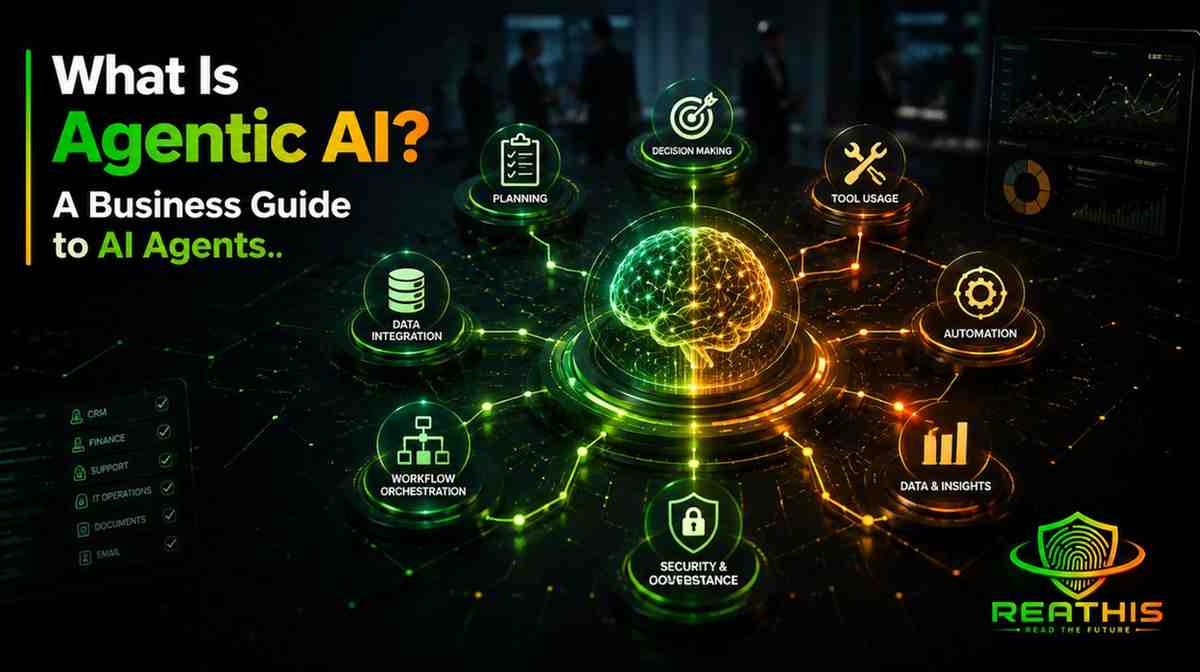
Agentic AI is an advanced form of artificial intelligence that can understand goals, plan steps, use tools, access data, make decisions within defined limits, and complete multi-step workflows. Unlike generative AI, which mainly creates content or answers questions, agentic AI helps businesses move work forward across systems such as CRM, ERP, customer support platforms, finance tools, IT service desks, email, spreadsheets, and knowledge bases. This guide explains what agentic AI is, how AI agents work, how agentic AI differs from generative AI and traditional automation, where businesses can use it, which platforms are shaping the market, what risks companies must manage, and how leaders should implement agentic AI safely with governance, permissions, monitoring, and human oversight.
Introduction
Agentic AI is artificial intelligence that can plan, act, use tools, and complete tasks across business workflows, unlike traditional chatbots that mainly respond to prompts. It is becoming important for business leaders, CIOs, CTOs, operations teams, and digital transformation leaders because companies are no longer asking only whether AI can write faster or summarize better. They are now asking whether AI can help complete real work. complete real work.
For years, most business use of AI focused on content creation, chatbots, document summarization, data analysis, search, and question answering. Agentic AI goes further. It can understand a goal, break that goal into smaller steps, decide which systems or tools are needed, take action through connected applications, and adjust based on results.
This does not mean businesses should hand full control to AI. Agentic AI is powerful because it can act, but that also makes it riskier than normal AI chatbots. A chatbot may give a wrong answer. An AI agent may update a CRM record, send an email, trigger a workflow, approve a step, retrieve sensitive data, or make a recommendation that affects a customer or employee.
That is why agentic AI should be understood as both a business opportunity and an operating model. The companies that benefit most will not be the ones that deploy the most agents. They will be the ones that choose the right workflows, define permissions clearly, keep humans involved where needed, monitor every action, and measure real business outcomes.
What Is Agentic AI?
Agentic AI refers to AI systems that can work toward a goal with a level of autonomy. Instead of only responding to a prompt, agentic AI can plan a task, decide what information it needs, use tools, interact with business systems, and complete a workflow within rules set by humans.
A simple AI assistant might answer a question like, “What are my top sales leads this week?” An agentic AI system could go further by checking CRM activity, reviewing email engagement, identifying high-priority accounts, drafting outreach messages, creating follow-up tasks, and alerting the sales team.
The difference is action. Generative AI produces an output. Agentic AI moves a process forward. In business terms, agentic AI is useful when a task has a clear goal, repeatable steps, connected data, and measurable results. It is not just a smarter chatbot. It is a workflow system powered by AI reasoning, tools, memory, data access, and guardrails.
How Agentic AI Works
Agentic AI usually combines several parts: a language model, instructions, memory, tools, business data, workflow logic, and safety controls. The language model interprets the request, reasons through the task, and decides what steps are needed. Tools allow the agent to do something outside the chat interface, such as searching a database, calling an API, updating a record, creating a ticket, or retrieving a document.
A typical agentic AI workflow includes:
- Understanding the user’s goal
- Breaking the task into smaller steps
- Retrieving relevant data
- Choosing the right tool or application
- Taking action through APIs or connected systems
- Asking for human approval when required
- Logging actions for review
- Monitoring results and adjusting the next step
This matters because business work rarely happens in one place. A customer support task may involve a helpdesk, CRM, order history, email, knowledge base, and escalation workflow. A finance task may involve invoices, approvals, spreadsheets, ERP records, and reporting dashboards. Agentic AI becomes valuable when it can connect these steps safely.
Agentic AI vs Generative AI vs Traditional Automation
Generative AI, traditional automation, and agentic AI are related, but they are not the same. Generative AI creates content. Traditional automation follows fixed rules. Agentic AI uses AI reasoning and tools to complete goal-based tasks.
| Feature | Generative AI | Traditional Automation | Agentic AI |
|---|---|---|---|
| Main purpose | Creates content or answers questions | Follows fixed rules | Completes tasks and workflows |
| Autonomy | Low to moderate | Low, rule-based | Moderate to high within limits |
| Tool usage | Optional | Predefined | Core capability |
| Flexibility | High for language tasks | Low when conditions change | Higher when context changes |
| Best use case | Writing, summarizing, ideation | Repetitive rule-based processes | Multi-step business workflows |
| Main risk | Inaccurate or misleading output | Broken process logic | Operational, security, and governance risk |
This distinction matters for executives. A generative AI mistake may produce an inaccurate paragraph. A traditional automation mistake may fail at a fixed step. An agentic AI mistake may act inside a business system. That makes permissions, approvals, audit trails, and monitoring essential.
Why Agentic AI Matters for Businesses
Agentic AI matters because it shifts AI from a productivity tool to a work execution layer. Instead of helping employees only create drafts or find information, AI agents can help coordinate actions across systems.
The business value is strongest in workflows where employees spend time moving information from one place to another. Many teams still copy data between tools, search for context, write updates, assign tasks, chase approvals, and summarize status manually. Agentic AI can reduce this coordination work when the workflow is clearly defined.
However, businesses should avoid vague promises such as “AI employees” or “fully autonomous teams.” The strongest early use cases are narrow, measurable, and supervised. A support ticket triage agent, invoice matching agent, sales research agent, or IT incident summary agent is more practical than a broad agent expected to run an entire department.
Key Benefits of Agentic AI
Agentic AI can improve business operations when it is applied to the right processes. The goal should not be to replace every task with AI, but to reduce repetitive coordination, speed up decisions, and help teams work with better context.
| Business Benefit | How Agentic AI Helps | Example |
|---|---|---|
| Faster workflow execution | Moves work across systems with fewer manual steps | Retrieves data, updates CRM, creates follow-up tasks |
| Better customer response | Uses context to classify, route, and draft support actions | Summarizes customer history before escalation |
| Higher sales productivity | Automates research and next-step preparation | Scores leads and drafts outreach |
| More efficient finance operations | Supports matching, reconciliation, review, and reporting | Flags invoice differences for human review |
| Stronger IT operations | Triage, incident summaries, and routine checks | Routes tickets and suggests fixes |
| Better knowledge access | Pulls answers from internal systems and documents | Finds policy details or project status faster |
The best benefits come when the agent is connected to reliable data and constrained by clear rules. Poor data, unclear workflows, or broad permissions can reduce value and increase risk.
Enterprise Use Cases of Agentic AI
Agentic AI can be used across many business functions, but the best starting point is usually a narrow workflow with a clear result. Companies should avoid starting with a broad “AI worker” project. A focused agent is easier to test, govern, improve, and measure.
| Business Function | Agentic AI Use Case | Good Starting Point |
|---|---|---|
| Customer support | Ticket triage, response drafting, escalation | Classify tickets and suggest responses |
| Sales | Lead qualification, CRM updates, follow-ups | Research accounts and prepare outreach |
| Marketing | Campaign reporting, research, content workflows | Summarize campaign performance |
| Finance | Invoice matching, reconciliation, reporting | Flag invoice and purchase order mismatches |
| HR | Onboarding, policy Q&A, document workflows | Answer employee policy questions |
| IT | Ticket routing, incident summaries, system checks | Summarize incidents and recommend next steps |
| Legal | Contract review support, clause extraction | Extract renewal dates and key clauses |
| Operations | Vendor follow-ups, workflow monitoring | Track delayed approvals and notify owners |
The best agentic AI use case has five qualities: it is repeatable, measurable, low to moderate risk, connected to available data, and valuable enough to justify automation.
Agentic AI Platforms and Vendor Landscape
The agentic AI platform market is growing quickly. Major cloud, CRM, workflow, and enterprise software vendors are adding tools for building, deploying, monitoring, and governing AI agents.
| Platform | Main Strength | Best Fit |
|---|---|---|
| Amazon Bedrock Agents | Agents that use foundation models, APIs, knowledge bases, memory, monitoring, and AWS-managed infrastructure | AWS-first enterprises |
| Microsoft Foundry Agent Service | Managed platform for prompt agents and hosted agents with tools, identity, observability, RBAC, and Microsoft ecosystem integration | Microsoft and Azure users |
| Google Gemini Enterprise / Agent Platform | Enterprise AI agents connected with Google models, Workspace, data, and agent orchestration | Google Cloud and data-driven teams |
| Salesforce Agentforce | CRM-focused agents for customer service, sales, employee support, and business workflows | Salesforce-heavy sales and service teams |
| ServiceNow AI Agents | Workflow automation, AI Agent Studio, AI Agent Orchestrator, AI Control Tower, IT, HR, CRM, risk, and operations workflows | ITSM, operations, and enterprise workflow teams |
The right platform depends on where a company’s data, users, and workflows already live. A Microsoft-heavy organization may find Microsoft Foundry easier to adopt. An AWS-native company may prefer Bedrock Agents. A company centered on Salesforce may begin with Agentforce. A ServiceNow-heavy enterprise may start with IT, HR, or operations workflows inside ServiceNow.
There is no universal best platform. The best choice depends on existing systems, governance needs, data access, security controls, development skills, and the business process being automated.
Risks and Challenges of Agentic AI
Agentic AI creates new risks because agents can take action, not just generate text. This makes governance more important than in normal chatbot or content-generation projects.
Common risks include unauthorized system access, prompt injection, data leakage, incorrect tool usage, poor audit trails, over-automation, unclear accountability, vendor lock-in, and rising compute or token costs.
The biggest mistake companies make is treating AI agents like ordinary software automation. Traditional automation follows fixed instructions. Agentic AI makes probabilistic decisions based on context. That means testing, observability, access control, and human review are not optional.
| Risk | Why It Matters | Control Needed |
|---|---|---|
| Unauthorized access | Agents may reach sensitive systems or data | Least-privilege permissions |
| Prompt injection | Malicious inputs may influence agent behavior | Input filtering and tool restrictions |
| Data leakage | Agents may expose confidential information | Data classification and access rules |
| Incorrect actions | Agents may update or trigger wrong records | Human approval for sensitive actions |
| Poor audit trail | Teams may not know what the agent did | Full logs and traceability |
| Over-automation | Companies may automate unclear processes | Start with narrow workflows |
| Unclear ownership | No one owns agent outcomes | Defined business and technical owners |
Agentic AI governance must be designed before deployment, not after something goes wrong.
How Businesses Should Implement Agentic AI
A strong agentic AI strategy starts small and scales gradually. Companies should not begin by trying to automate an entire department. They should begin with one workflow that is repetitive, measurable, and safe enough to test.
1. Choose a Narrow Workflow
Start with a task that has a clear goal and clear success metric. Good examples include support ticket classification, account research, invoice matching, meeting preparation, internal knowledge retrieval, or IT incident summarization.
2. Define Permissions Clearly
AI agents should only have access to the systems and actions they need. Avoid broad access to email, finance systems, customer data, HR records, or sensitive documents unless there are strong controls.
3. Keep Humans in the Loop
Sensitive actions should require human approval. This includes sending external emails, approving payments, changing customer records, escalating compliance issues, or making decisions that affect customers or employees.
4. Track Every Action
Enterprises need logs that show what the agent saw, what it decided, which tools it used, what action it took, and whether a human approved the action. Without logs, trust breaks down quickly.
5. Measure Business Outcomes
Track time saved, response speed, error reduction, customer satisfaction, employee adoption, and cost impact. If the agent does not improve a measurable outcome, it should not be scaled.
Agentic AI Readiness Checklist
Before deploying AI agents, businesses should check whether the workflow, data, systems, and governance are ready.
| Readiness Area | Question to Ask |
|---|---|
| Workflow clarity | Is the process documented and repeatable? |
| Data quality | Does the agent have reliable data to use? |
| Tool access | Which systems can the agent use? |
| Permissions | Does the agent have only the access it needs? |
| Human approval | Which actions require human sign-off? |
| Monitoring | Can every decision and action be traced? |
| Risk level | What could go wrong if the agent acts incorrectly? |
| Success metric | How will business value be measured? |
If a company cannot answer these questions, it is not ready to scale agentic AI. It may still be ready for a limited pilot.
Key Insights Most Articles Miss
Most articles describe agentic AI as a technology trend. The bigger issue is operational design. AI agents do not fix broken workflows. They expose them.
First, agentic AI needs clean processes. If a workflow is unclear, inconsistent, or undocumented, an AI agent will struggle to execute it safely.
Second, specialized agents are usually more useful than general agents. A finance review agent, support triage agent, or IT incident agent is easier to manage than a broad business assistant with too many responsibilities.
Third, context matters as much as the model. A well-designed agent connected to reliable company data and clear rules may outperform a stronger model with poor context.
Fourth, governance becomes more important as the agent becomes more useful. The more actions an agent can take, the more carefully access, approvals, and monitoring must be controlled.
Fifth, observability will become a major enterprise requirement. Leaders will not trust agents they cannot audit.
The Future of Agentic AI
The future of agentic AI is likely to move from single agents to coordinated multiagent systems. Instead of one agent trying to complete an entire workflow, businesses may use teams of specialized agents that collaborate. One agent may gather data, another may analyze it, another may draft an action, and another may check compliance before a human approves the final step.
This shift will make governance more complex. Companies will need clear agent identities, scoped permissions, tool registries, approval workflows, logs, testing environments, and monitoring dashboards. Agentic AI will become less about “chat with AI” and more about managing digital workflows safely.
The companies that succeed will treat agentic AI as a controlled operating system for work. The companies that fail will treat it as a shortcut.
Conclusion
Agentic AI is not just a new name for chatbots. It represents a shift from AI that answers questions to AI that helps complete work. For businesses, the opportunity is significant: faster workflows, better customer service, improved sales productivity, more efficient finance operations, stronger IT support, and reduced manual coordination.
The risk is also real. AI agents can access systems, use tools, make decisions, and trigger actions. That means businesses need permissions, governance, monitoring, audit trails, human approval, and clear accountability.
The best starting point is simple: choose one narrow workflow, define success, limit access, keep humans involved, track every action, and measure the result. Agentic AI works best when it is treated as a controlled business capability, not a hype-driven experiment.
FAQs
What is agentic AI in simple terms?
Agentic AI is AI that can understand a goal, plan steps, use tools, and take action to complete tasks instead of only answering questions.
How is agentic AI different from generative AI?
Generative AI creates content or answers questions. Agentic AI uses AI reasoning, tools, data, and workflow logic to complete tasks across systems.
Is agentic AI the same as AI agents?
AI agents are systems or applications that use agentic AI capabilities. Agentic AI is the broader concept, while AI agents are the practical tools built from that concept.
How is agentic AI different from automation?
Traditional automation follows fixed rules. Agentic AI can interpret context, make decisions, use tools, and adapt within defined limits.
What are common agentic AI use cases?
Common use cases include customer support triage, sales research, CRM updates, invoice review, IT ticket routing, incident summaries, contract review, document workflows, and internal knowledge retrieval.
Is agentic AI risky?
Yes. Agentic AI can be risky if deployed without access controls, monitoring, human approval, security testing, and audit trails. The risk is higher because agents can take action, not just generate text.
Should small businesses use agentic AI?
Small businesses can use agentic AI, but they should start with low-risk workflows such as customer follow-ups, reporting, document summaries, internal task tracking, or simple research tasks.
What is the best way to start with agentic AI?
The best way to start is with one narrow workflow, limited permissions, clear success metrics, human approval for sensitive actions, and full monitoring of what the agent does.
Which platforms support agentic AI?
Major platforms include Amazon Bedrock Agents, Microsoft Foundry Agent Service, Google Gemini Enterprise, Salesforce Agentforce, and ServiceNow AI Agents. The right platform depends on the company’s existing systems, data, workflows, and governance needs.



Leave a Reply