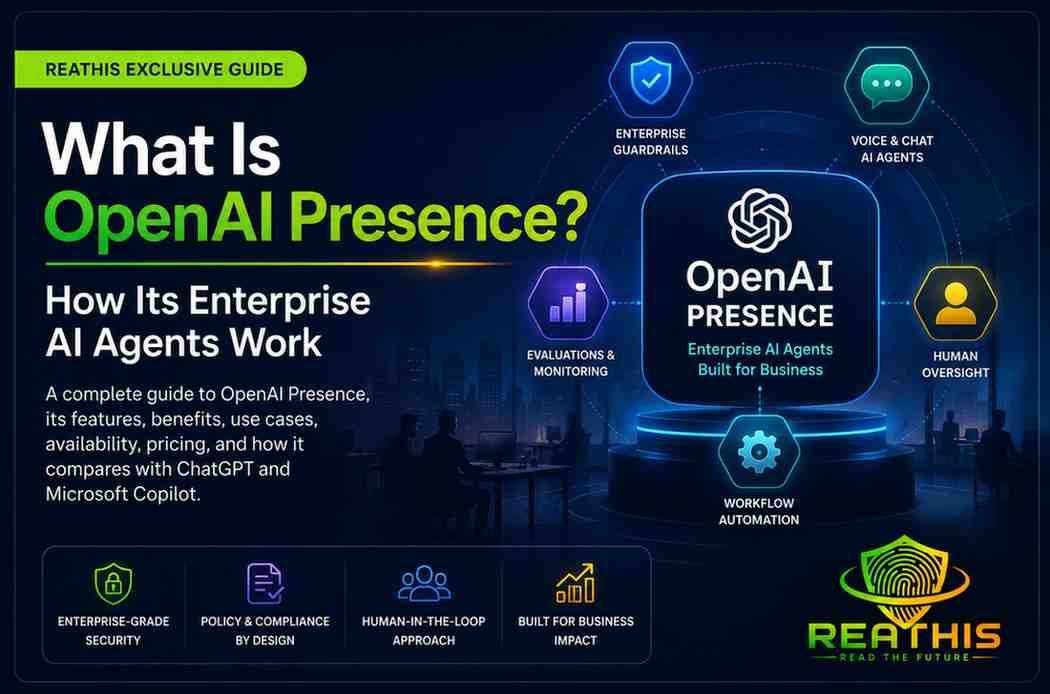
This guide explains what OpenAI Presence is, why OpenAI launched it, how it works, who can use it, its enterprise AI capabilities, security features, current availability, and how it compares with other AI platforms.
- Launch: July 22, 2026
- Developer: OpenAI
- Available For: Eligible enterprise organizations through Limited General Availability (GA)
- Purpose: Deploy trusted voice and chat AI agents for customer support and internal business workflows.
- Supports: Enterprise knowledge integration, approved business actions, voice AI, chat AI, and workflow automation.
- Key Features: AI guardrails, human approval workflows, simulations, evaluations, continuous monitoring, and enterprise governance.
- Pricing: OpenAI has not announced public pricing or a self-service version.
- Comparison: Learn how OpenAI Presence differs from ChatGPT and Microsoft Copilot.
- ReaThis Analysis: We separate OpenAI’s verified claims from unanswered questions to help businesses better understand the platform.
OpenAI Presence is a managed enterprise AI platform that helps organizations deploy trusted voice and chat AI agents across customer support and internal business operations. Announced by OpenAI on July 22, 2026, the platform combines advanced AI models with enterprise governance, security controls, human approval workflows, simulations, evaluations, and continuous monitoring. Instead of serving as another AI chatbot, OpenAI Presence enables businesses to build AI agents that can access approved company systems, automate business tasks, follow organizational policies, and escalate complex situations to human employees when needed.
As enterprise AI adoption grows, organizations need more than powerful AI models—they also need reliable deployment, operational oversight, and governance to use AI safely in production. OpenAI developed Presence to address these challenges by providing a managed platform for building, deploying, monitoring, and continuously improving enterprise AI agents. In this guide, you’ll learn how OpenAI Presence works, who can use it, its key features, security safeguards, current availability, limitations, and how it compares with ChatGPT and Microsoft Copilot.
Key Takeaways
- OpenAI launched Presence on July 22, 2026 as a managed enterprise AI platform.
- The platform enables organisations to deploy voice and chat AI agents for customer-facing and internal business workflows.
- OpenAI combines AI models with governance, guardrails, simulations, evaluations, monitoring, and human oversight to support responsible enterprise deployments.
- Businesses can integrate approved company knowledge and systems while controlling how AI agents access information and perform authorised actions.
- Presence supports human approval and escalation workflows, allowing employees to remain involved in high-risk or complex decisions.
- The platform is currently available only to eligible enterprise organisations through a limited General Availability programme.
- OpenAI has not announced public pricing, self-service access, or a broader rollout timeline.
What Is OpenAI Presence?
OpenAI Presence is a managed enterprise AI platform that helps organizations build, deploy, operate, monitor, and continuously improve AI agents for customer-facing and internal business workflows. Instead of functioning as a standalone chatbot, Presence integrates AI models with company policies, business systems, approved actions, governance controls, and human oversight to support real-world operations.
According to OpenAI, Presence enables AI agents to:
- Answer customer questions.
- Resolve support requests.
- Access approved company systems.
- Retrieve and update business information.
- Complete authorized actions.
- Follow organizational policies and standard operating procedures (SOPs).
- Escalate conversations to human employees when required.
Unlike consumer AI tools, OpenAI Presence targets organizations that require high reliability, operational oversight, governance, and compliance before deploying AI into production environments. The platform supports both customer-facing services and internal business operations, including customer support, outbound sales, insurance claims, billing, and employee IT support.
Why Did OpenAI Build Presence?
Over the past few years, many businesses have demonstrated that AI can answer questions, summarize information, and automate repetitive tasks. However, successfully deploying AI across real business operations presents a different challenge.
According to OpenAI, organizations often struggle with questions such as:
- Can the AI follow company policies consistently?
- Can it access only approved business systems?
- How should it behave when policies change?
- How can companies measure AI performance?
- Who approves updates before deployment?
- When should the AI transfer conversations to human employees?
These challenges require more than a powerful language model. Businesses also need governance, operational controls, evaluation systems, simulations, deployment expertise, and ongoing monitoring to ensure AI agents remain accurate, reliable, and trustworthy as products, customer expectations, and company policies evolve.
OpenAI developed Presence to address these operational challenges. Instead of asking organizations to build their own governance framework around AI models, Presence combines the necessary tools into a managed platform that helps enterprises deploy and improve AI agents while maintaining control over business processes.
Why OpenAI Presence Matters
OpenAI Presence represents a broader shift in enterprise AI. Rather than competing solely on the intelligence of its language models, OpenAI is expanding into enterprise software that supports the entire lifecycle of AI deployment—from planning and testing to governance, monitoring, and continuous improvement. This strategy positions the company as a provider of production-ready AI systems, not just AI models.
For organizations, this approach could reduce the complexity of deploying AI responsibly. Instead of assembling multiple tools for policy management, evaluations, simulations, and monitoring, businesses can adopt a platform that integrates these capabilities into a single managed solution.
ReaThis Insight
OpenAI’s announcement highlights an important industry trend: the competitive advantage is shifting from building smarter AI models to deploying trustworthy AI systems in production. OpenAI Presence reflects this change by combining AI reasoning with governance, operational oversight, and continuous improvement—areas that many enterprises consider essential before adopting AI for high-value business workflows.
How Does OpenAI Presence Work?
Unlike traditional AI chatbots that simply answer questions, OpenAI Presence operates as a managed enterprise platform that combines AI models with business knowledge, governance, policies, security controls, evaluations, and human oversight. OpenAI designed the platform to help organizations deploy AI agents that perform useful work while remaining aligned with company rules and operational requirements. According to the company, Presence integrates these capabilities into a single managed system instead of requiring businesses to assemble multiple tools on their own.
At a high level, OpenAI Presence follows a continuous operational cycle:
- Connect approved business systems and knowledge sources.
- Configure policies, permissions, and workflows.
- Deploy AI agents for voice or chat interactions.
- Evaluate performance through testing and simulations.
- Monitor conversations and outcomes.
- Improve agent behavior using feedback and updated policies.
- Keep human employees involved whenever an approval or escalation is required.
This approach allows organizations to treat AI agents as part of their workforce while maintaining visibility and control over how they operate.
Understanding AI Agents
An AI agent is more than a chatbot. Traditional chatbots usually answer questions using information that users provide during a conversation. AI agents, however, can reason through tasks, retrieve information from approved systems, follow business policies, perform authorized actions, and determine when they should transfer work to a human employee.
For example, an enterprise AI agent might:
- Verify a customer’s identity.
- Retrieve account information.
- Explain billing details.
- Process an approved refund.
- Schedule an appointment.
- Update an internal support ticket.
- Escalate complex situations to a human specialist.
Instead of completing only one task, AI agents can coordinate multiple steps while following organizational rules and predefined approval processes. OpenAI Presence provides the infrastructure needed to manage these agents in production environments.
Core Components of OpenAI Presence
According to OpenAI, Presence combines several capabilities into one enterprise platform.
1. AI Models
The platform uses OpenAI’s latest AI models as the reasoning engine behind enterprise agents. These models understand natural language, interpret customer requests, generate responses, and decide which approved actions to take within organizational boundaries.
Rather than exposing the raw model directly to customers, Presence surrounds it with governance and operational controls.
2. Company Knowledge
Every business has unique information that public AI models cannot know.
Presence allows organizations to connect approved internal knowledge, including:
- Product documentation
- Internal policies
- Help center articles
- Operating procedures
- Customer information
- Knowledge bases
- Internal documentation
As a result, AI agents can provide responses based on company-specific information rather than relying only on general knowledge.
3. Business Actions
One of the biggest differences between enterprise AI agents and consumer chatbots is the ability to perform approved actions.
Instead of only answering questions, Presence agents can complete authorized workflows such as:
- Updating support tickets
- Processing approved customer requests
- Scheduling appointments
- Creating follow-up tasks
- Searching internal systems
- Retrieving account information
Organizations decide which actions AI agents may perform and under what conditions.
Voice and Chat Agents
OpenAI Presence supports both voice and chat interactions.
This flexibility allows organizations to deploy AI agents across multiple communication channels without building separate systems for each one.
Examples include:
Customer Support
Customers can speak naturally with an AI agent that answers questions, retrieves account information, and resolves common issues before escalating complex requests.
Internal IT Support
Employees can ask the AI agent to:
- Reset passwords
- Locate internal documentation
- Troubleshoot software issues
- Submit service requests
Sales Teams
Sales agents can:
- Qualify leads
- Answer product questions
- Schedule meetings
- Route high-value prospects to human representatives
Insurance
AI agents can:
- Collect claim information
- Verify submitted details
- Explain policy coverage
- Transfer complex cases to licensed professionals
Human-in-the-Loop Design
One of the most important aspects of OpenAI Presence is that it does not attempt to replace human decision-makers.
Instead, OpenAI designed the platform around human oversight.
When an AI agent encounters situations involving:
- high financial risk,
- legal uncertainty,
- unusual customer requests,
- policy exceptions, or
- low confidence,
the system can transfer the conversation to a human employee or request approval before completing the action.
This approach helps organizations reduce operational risk while still benefiting from AI automation.
Key Features of OpenAI Presence
Policy-Aware Responses
Organizations can configure AI agents to follow internal policies and standard operating procedures.
Instead of generating unrestricted answers, agents operate within business-defined rules.
Secure System Access
Presence connects only to systems that an organization explicitly authorizes.
Companies determine:
- which systems agents can access,
- what information they can retrieve,
- and which actions they may perform.
Workflow Automation
AI agents can automate repetitive tasks, allowing employees to focus on more complex work.
Typical workflows include:
- Customer onboarding
- Appointment scheduling
- Support ticket routing
- Internal documentation search
- Billing inquiries
- Employee assistance
Continuous Monitoring
Organizations can monitor:
- conversation quality,
- response accuracy,
- customer satisfaction,
- escalation frequency,
- policy compliance,
- operational performance.
Monitoring helps identify opportunities for improving AI behavior over time.
Continuous Improvement
Unlike static software, AI agents improve through ongoing evaluation.
Organizations can:
- refine prompts,
- update policies,
- expand knowledge sources,
- adjust workflows,
- improve escalation logic,
- retrain operational behavior through managed updates.
According to OpenAI, Presence includes structured evaluation processes that allow enterprises to improve deployments while maintaining reliability.
Why This Architecture Matters
Many organizations already have access to powerful AI models. Their biggest challenge is operational deployment rather than model intelligence.
OpenAI Presence addresses this gap by combining:
- AI reasoning
- Enterprise governance
- Human oversight
- Business workflows
- Monitoring
- Evaluations
- Security controls
- Continuous improvement
into a single managed platform.
Rather than asking businesses to integrate these capabilities independently, OpenAI delivers them as part of the overall deployment experience.
ReaThis Insight
The most significant innovation in OpenAI Presence isn’t the AI model itself—it’s the operational framework around it. Most enterprises already recognize the potential of generative AI, but many hesitate to deploy it for critical workflows because of concerns about governance, security, compliance, and reliability. By combining AI models with human oversight, evaluations, simulations, and enterprise controls, OpenAI shifts the focus from simply building smarter AI to operating AI responsibly at scale. This positions Presence as an enterprise operations platform rather than just another chatbot.
Security and Privacy in OpenAI Presence
For most enterprises, deploying AI is no longer just about model performance—it is about security, governance, compliance, and operational control. Organizations need confidence that AI agents can access only approved information, follow company policies, and protect sensitive business data.
OpenAI designed Presence with these enterprise requirements in mind. Rather than offering only an AI model, the platform combines security controls, governance tools, policy enforcement, evaluations, and human oversight to help organizations deploy AI responsibly in production environments. According to OpenAI, this managed approach reduces operational risk while giving businesses greater visibility into how AI agents behave.
Built-In Guardrails
One of the platform’s core capabilities is its use of guardrails.
Guardrails act as operational boundaries that reduce the likelihood of AI agents:
- Providing unauthorized information.
- Performing prohibited actions.
- Ignoring company policies.
- Responding outside approved workflows.
- Handling sensitive situations without human review.
Instead of relying solely on prompt engineering, organizations can configure structured safeguards that influence how AI agents operate in production. According to OpenAI, these guardrails are a key component of deploying reliable enterprise AI systems.
Human Approval and Escalation
Despite advances in AI reasoning, OpenAI does not position Presence as a fully autonomous system.
Instead, the platform supports human-in-the-loop workflows.
Organizations can require AI agents to:
- Request approval before completing sensitive actions.
- Escalate conversations involving legal, financial, or regulatory issues.
- Transfer customers to human specialists when confidence is low.
- Route complex cases to experienced employees.
- Pause actions until a human reviewer approves the next step.
This design helps enterprises balance automation with accountability.
AI Evaluations
Deploying an AI agent is only the beginning. Organizations also need to understand how well it performs over time.
OpenAI Presence includes structured evaluation systems that help organizations measure:
- Response quality.
- Policy compliance.
- Accuracy.
- Task completion.
- Customer satisfaction.
- Escalation rates.
- Operational consistency.
Rather than relying only on anecdotal feedback, businesses can evaluate AI performance using repeatable testing methods before and after deployment.
Simulations Before Deployment
Testing AI in live production environments can introduce unnecessary risks.
To reduce those risks, OpenAI Presence supports simulations.
Organizations can evaluate AI agents against realistic scenarios before allowing them to interact with real customers.
Example simulation scenarios include:
- Difficult customer conversations.
- Billing disputes.
- Technical support requests.
- Product returns.
- Insurance claims.
- Policy exceptions.
- Multi-step workflows.
These simulations allow teams to identify weaknesses, improve policies, and refine agent behaviour before production deployment.
Continuous Monitoring
Even after deployment, enterprise AI requires ongoing oversight.
Presence helps organizations continuously monitor:
- AI conversations.
- Customer outcomes.
- Policy adherence.
- Operational metrics.
- Escalation frequency.
- Agent performance.
- Workflow completion.
This visibility enables businesses to detect problems early and make improvements without waiting for major issues to occur.
Continuous Improvement
Business policies, products, and customer expectations change over time.
OpenAI designed Presence to support continuous improvement rather than treating AI deployment as a one-time project.
Organizations can regularly:
- Update knowledge sources.
- Modify company policies.
- Improve prompts.
- Adjust workflows.
- Expand approved actions.
- Refine escalation rules.
- Improve evaluation benchmarks.
This iterative approach helps AI agents remain aligned with changing business needs.
Forward Deployed Engineers
One feature that distinguishes OpenAI Presence from consumer AI products is the involvement of Forward Deployed Engineers (FDEs).
Rather than simply providing software, OpenAI works directly with eligible enterprise customers to:
- Understand business workflows.
- Configure AI agents.
- Connect approved business systems.
- Design governance policies.
- Implement operational safeguards.
- Evaluate deployments.
- Improve performance over time.
This collaborative deployment model reflects OpenAI’s focus on managed enterprise implementations instead of self-service configuration.
Who Can Use OpenAI Presence?
As of its launch, OpenAI Presence is not a consumer product.
According to OpenAI, the platform is available through a limited General Availability (GA) program for eligible enterprise organizations. Businesses typically work with OpenAI or selected implementation partners throughout planning, deployment, testing, and optimization.
The platform currently targets organizations that need AI agents for large-scale operational workflows, including:
- Customer support.
- Financial services.
- Insurance.
- Healthcare administration.
- Retail.
- Telecommunications.
- Internal IT support.
- Employee operations.
At the time of writing, OpenAI has not announced a self-service version for individuals or small businesses.
Current Limitations
Although OpenAI Presence introduces powerful enterprise capabilities, several limitations remain:
- It is not available to the general public.
- OpenAI has not announced public pricing.
- The company has not confirmed a self-service release date.
- Availability remains limited to eligible enterprise customers.
- Organizations may need implementation support from OpenAI or approved partners during deployment.
These limitations suggest that Presence currently focuses on enterprise-scale implementations rather than widespread consumer adoption.
ReaThis Analysis: What OpenAI Confirms vs. What Remains Unanswered
OpenAI’s announcement clearly outlines the platform’s enterprise vision, governance features, and deployment model. However, several practical questions remain unanswered.
| OpenAI Confirms | Status |
|---|---|
| Voice and chat AI agents | ✅ Confirmed |
| Human approval workflows | ✅ Confirmed |
| Built-in guardrails | ✅ Confirmed |
| AI evaluations | ✅ Confirmed |
| Simulations before deployment | ✅ Confirmed |
| Continuous improvement | ✅ Confirmed |
| Enterprise deployment support | ✅ Confirmed |
| Limited General Availability | ✅ Confirmed |
| Still Unanswered | Current Status |
|---|---|
| Public pricing | Not announced |
| Self-service availability | Not announced |
| Global rollout timeline | Not announced |
| Small business access | Not announced |
| Industry-specific pricing | Not announced |
| Public API roadmap | Not announced |
ReaThis Perspective: OpenAI has been transparent about what Presence can do, but it has deliberately limited public details about pricing, broader availability, and long-term rollout. As the platform matures, these unanswered questions will likely become important considerations for businesses evaluating enterprise AI solutions.
OpenAI Presence vs ChatGPT
Although both products come from OpenAI and use advanced AI models, they serve very different purposes.
ChatGPT is a conversational AI assistant designed for individuals and teams to generate text, analyse information, write code, brainstorm ideas, and answer questions. Users interact directly with ChatGPT through a web browser, mobile app, or API.
OpenAI Presence, on the other hand, is a managed enterprise AI platform that enables organisations to deploy AI agents across customer-facing and internal business operations. Instead of acting as a personal assistant, Presence helps companies build AI systems that follow business policies, integrate with approved enterprise systems, perform authorised actions, and operate under human supervision. According to OpenAI, the platform combines AI models with governance, simulations, evaluations, monitoring, and deployment support to help organisations run AI reliably in production.
Comparison Table
| Feature | ChatGPT | OpenAI Presence |
|---|---|---|
| Primary Purpose | Personal AI assistant | Enterprise AI deployment platform |
| Target Users | Individuals and teams | Enterprise organisations |
| Deployment | Self-service | Managed enterprise deployment |
| AI Agents | Limited | Yes |
| Voice Support | Yes | Yes |
| Business System Integration | Limited | Extensive |
| Human Approval Workflows | No | Yes |
| Enterprise Guardrails | Limited | Comprehensive |
| AI Evaluations | Limited | Built-in |
| Simulations | No | Yes |
| Continuous Monitoring | Limited | Yes |
| Forward Deployed Engineers | No | Yes |
OpenAI Presence vs Microsoft Copilot
Microsoft Copilot and OpenAI Presence both target enterprise customers, but they approach AI adoption differently.
Microsoft Copilot focuses on increasing productivity within the Microsoft ecosystem by integrating AI into applications such as Word, Excel, Outlook, Teams, and PowerPoint. Employees use Copilot to create documents, summarise meetings, analyse spreadsheets, and automate everyday office tasks.
OpenAI Presence focuses on operational AI agents rather than office productivity. It enables organisations to deploy AI agents that can manage customer support, execute business workflows, retrieve company information, perform approved actions, and collaborate with employees through structured governance and oversight.
Side-by-Side Comparison
| Feature | OpenAI Presence | Microsoft Copilot |
|---|---|---|
| Primary Focus | Enterprise AI agents | Workplace productivity |
| Customer Support Automation | ✔ | Limited |
| Voice Agents | ✔ | Limited |
| Chat Agents | ✔ | ✔ |
| Human Approval Workflows | ✔ | Limited |
| Simulations | ✔ | No |
| Enterprise Evaluations | ✔ | Limited |
| Business Workflow Automation | ✔ | Moderate |
| Office Productivity | Limited | Excellent |
| Microsoft 365 Integration | No | Native |
OpenAI Presence vs Google Gemini
Google Gemini primarily provides AI assistance across Google Workspace products such as Gmail, Docs, Sheets, Meet, and Drive. It helps users write emails, summarise documents, generate content, and improve workplace productivity.
OpenAI Presence targets a different problem.
Instead of helping employees work faster inside office applications, Presence enables businesses to deploy AI agents that participate directly in operational workflows while following company policies and governance rules.
Real-World Business Use Cases
One of the biggest strengths of OpenAI Presence is its flexibility. According to OpenAI, organisations can deploy AI agents across multiple departments instead of limiting them to customer support.
Customer Support
AI agents can:
- Answer customer questions.
- Verify customer identities.
- Retrieve account information.
- Process approved requests.
- Escalate complex issues to human agents.
- Reduce response times.
Sales Teams
Presence agents can help sales teams by:
- Qualifying new leads.
- Answering product questions.
- Scheduling meetings.
- Collecting customer information.
- Routing enterprise prospects.
IT Help Desks
Internal employees can use AI agents to:
- Reset passwords.
- Locate company documentation.
- Submit IT tickets.
- Troubleshoot common software issues.
- Check system status.
Insurance
Insurance providers can use AI agents to:
- Collect claim information.
- Explain policy details.
- Verify submitted documents.
- Route claims to specialists.
- Reduce administrative workloads.
Financial Services
Banks and financial institutions may deploy AI agents to:
- Answer account questions.
- Explain financial products.
- Guide customers through secure processes.
- Assist with onboarding.
- Escalate regulated requests.
Human Resources
HR departments can automate repetitive employee requests, including:
- Leave policy questions.
- Benefits information.
- Onboarding guidance.
- Internal documentation.
- Training resources.
Business Benefits
According to OpenAI, organisations adopting Presence may benefit from:
Faster Customer Response
AI agents can handle routine requests around the clock, reducing wait times and improving customer experiences.
Improved Employee Productivity
Employees spend less time answering repetitive questions and more time solving complex business problems.
Consistent Customer Experience
Because AI agents follow predefined policies and approved workflows, organisations can deliver more consistent responses across different communication channels.
Reduced Operational Costs
By automating repetitive tasks, businesses can improve efficiency without increasing administrative workloads.
Better Governance
Unlike many standalone AI tools, Presence includes governance capabilities that help organisations monitor behaviour, evaluate performance, and maintain operational oversight.
Availability
At launch, OpenAI made Presence available only through a Limited General Availability (GA) programme. Businesses cannot sign up through a standard self-service page. Instead, eligible organisations work directly with OpenAI or authorised implementation partners throughout planning, deployment, testing, and optimisation.
According to OpenAI, this managed deployment model helps enterprises build AI agents that align with their business requirements before entering production.
Pricing
As of publication, OpenAI has not announced public pricing for OpenAI Presence.
The company has also not disclosed:
- Subscription plans.
- Per-user pricing.
- Usage-based pricing.
- Implementation costs.
- Industry-specific pricing.
- Partner pricing.
Because Presence targets enterprise deployments, pricing will likely depend on each organisation’s size, deployment complexity, support requirements, and AI usage.
Current Limitations
Although OpenAI Presence introduces a comprehensive enterprise AI platform, organisations should consider several limitations.
Limited Availability
Only selected enterprise customers can currently access the platform.
No Self-Service Version
Individuals and small businesses cannot independently create Presence deployments at this time.
Pricing Remains Undisclosed
Businesses must contact OpenAI to discuss implementation opportunities.
Enterprise-Focused
Presence primarily targets organisations with large operational workflows rather than individual professionals or small teams.
Requires Organisational Planning
Successful deployments involve governance, business process design, system integrations, policy development, and operational oversight rather than simply enabling an AI assistant.
ReaThis Insight
OpenAI Presence is not simply “ChatGPT for businesses.” It represents a shift towards AI as operational infrastructure. Instead of selling another chatbot, OpenAI now offers a managed platform that combines AI reasoning with governance, security, evaluation, monitoring, and human oversight. This approach acknowledges that enterprise AI success depends as much on trust, operational controls, and deployment strategy as it does on model intelligence. For organisations considering AI adoption, the platform signals that future enterprise solutions will likely compete on reliability and governance—not just raw AI capability.
ReaThis Analysis: Verified Facts vs Unanswered Questions
Whenever OpenAI launches a new product, it publishes official documentation explaining its capabilities and intended use. However, enterprise customers often need additional information—such as pricing, deployment timelines, and long-term availability—before making adoption decisions.
To help readers separate confirmed information from speculation, ReaThis reviewed OpenAI’s official announcement and documentation to distinguish verified facts from questions that remain unanswered.
What OpenAI Confirms
| Verified Information | Status |
|---|---|
| Presence is a managed enterprise AI platform. | ✅ Confirmed |
| It supports both voice and chat AI agents. | ✅ Confirmed |
| AI agents can follow company policies and workflows. | ✅ Confirmed |
| The platform includes built-in guardrails. | ✅ Confirmed |
| Human approval and escalation workflows are supported. | ✅ Confirmed |
| Organisations can evaluate AI performance before deployment. | ✅ Confirmed |
| Simulations help test AI behaviour before production. | ✅ Confirmed |
| Continuous monitoring and improvement are part of the platform. | ✅ Confirmed |
| OpenAI and selected partners assist with deployments. | ✅ Confirmed |
| The platform is available through Limited General Availability (GA). | ✅ Confirmed |
Questions That Remain Unanswered
| Question | Current Status |
|---|---|
| When will self-service access become available? | Not announced |
| What will public pricing look like? | Not announced |
| Will startups and small businesses gain access? | Not announced |
| When will global availability expand? | Not announced |
| Which third-party enterprise systems will receive native integrations first? | Not announced |
| Will OpenAI publish customer success metrics? | Not announced |
| Will industry-specific editions be introduced? | Not announced |
ReaThis Perspective: OpenAI has clearly explained what Presence does and how it supports enterprise AI deployments. However, the company has not yet shared important commercial details such as pricing, broader availability, or future rollout plans. Businesses evaluating the platform should monitor OpenAI’s official announcements for updates before making long-term implementation decisions.
Frequently Asked Questions (FAQs)
OpenAI Presence is a managed enterprise platform that helps organisations deploy AI agents across customer support and internal business workflows. It combines AI models with governance, guardrails, evaluations, simulations, monitoring, and human oversight to support reliable production deployments.
ChatGPT serves as a conversational AI assistant for individuals and teams, while OpenAI Presence enables organisations to deploy managed AI agents that integrate with business systems, follow company policies, perform approved actions, and operate under enterprise governance.
No. OpenAI designed Presence to automate repetitive tasks while allowing human employees to review, approve, and manage complex or high-risk situations.
Yes. According to OpenAI, Presence supports both voice and chat AI agents.
According to OpenAI, the platform can support organisations across customer service, financial services, insurance, retail, healthcare administration, telecommunications, internal IT, and employee operations.
No. As of publication, OpenAI has not announced public pricing for OpenAI Presence.
Final Verdict
OpenAI Presence represents an important step in the evolution of enterprise artificial intelligence. Instead of offering another standalone chatbot, OpenAI has created a managed platform that combines advanced AI models with governance, security, evaluations, simulations, monitoring, and human oversight. This approach reflects a growing recognition that successful AI adoption depends not only on model intelligence but also on trust, operational control, and responsible deployment.
For large organisations, Presence offers a structured way to introduce AI agents into customer support and internal workflows while maintaining oversight of sensitive business processes. At the same time, the platform remains in its early stages, with limited availability and several unanswered questions about pricing, broader access, and future expansion.
As enterprise AI continues to mature, OpenAI Presence signals a broader industry shift toward AI systems designed for long-term operational reliability rather than simple conversational interactions. Organisations evaluating the platform should closely follow OpenAI’s official updates as additional features, deployment options, and commercial details become available.
Official Sources
- OpenAI — Introducing OpenAI Presence
- OpenAI Help Center — OpenAI Presence Documentation
ReaThis Disclosure
Editorial Note: This article is based on OpenAI’s official announcement and publicly available documentation published at the time of writing. ReaThis independently reviewed these sources to explain OpenAI Presence, distinguish verified information from unanswered questions, and provide additional analysis for readers. Product availability, pricing, and features may change as OpenAI expands the platform.
About The Author