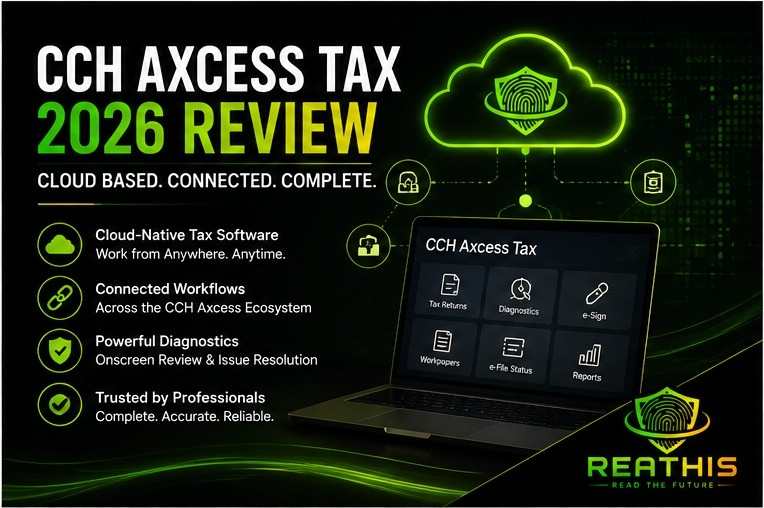
- CCH Axcess Tax is one of the strongest options for CPA firms that want complex professional tax preparation inside a cloud-based, connected tax and accounting ecosystem.
- Unlike traditional desktop tax applications that firms can place on hosted servers, Wolters Kluwer developed CCH Axcess Tax specifically for the cloud. It combines tax preparation with diagnostics, onscreen review, e-signatures, electronic filing status, and integrations across the wider CCH Axcess platform.
- Independent evidence shows an important tradeoff. In The Tax Adviser’s 2025 AICPA-member survey, 82% of CCH Axcess Tax users identified form comprehensiveness as a strength and 83.7% said the software contained all the forms they needed, while its 3.8/5 ease-of-use rating fell below the 4.2 average across the major products.
- CCH Axcess Tax is not limited to large accounting firms. Wolters Kluwer also offers CCH Axcess Tax Essentials with Pay-Per-Return and authorization-based packages designed to make the cloud platform accessible to smaller practices.
- ReaThis considers CCH Axcess Tax strongest when a firm wants both advanced tax capability and a broader cloud-platform strategy. Firms that only need remote access to tax software should compare the cost and disruption of adopting Axcess with simply hosting an existing desktop application.
Introduction
Cloud tax software can solve a deployment problem without necessarily solving a tax-workflow problem. A browser or remotely accessible environment may make software easier to reach, but firms still need a strong calculation engine, useful diagnostics, efficient review, reliable electronic filing, document workflows, and enough control to manage complicated engagements.
CCH Axcess Tax matters because Wolters Kluwer has tried to combine those requirements inside a broader cloud platform rather than simply place a traditional tax application on a remote desktop. The company currently positions Axcess Tax as cloud-based professional compliance software that connects preparation, review, e-filing, workflow, integration, and advisory capabilities across the CCH Axcess ecosystem.
That approach creates significant potential value, but it also creates a more complicated buying decision. A small firm may only need the tax engine and a few workflow capabilities, while a larger practice may want Axcess Tax to become one component of a much broader firm platform. The right evaluation therefore needs to separate the quality of CCH Axcess Tax itself from the value of adopting the wider CCH ecosystem.
Key Takeaways
- CCH Axcess Tax combines professional tax depth with a cloud-based architecture, which distinguishes it from traditional desktop products that firms merely host remotely.
- Independent AICPA survey data supports its form breadth: 82% of Axcess users named comprehensiveness as a top strength, and 83.7% said it contained all the forms they needed.
- Ease of use deserves scrutiny. The same survey gave CCH Axcess Tax a 3.8 ease-of-use score versus a 4.2 average.
- CCH Axcess Tax Essentials creates a small-firm route into the platform through Pay-Per-Return and fixed authorization packages rather than reserving Axcess exclusively for large accounting firms.
- The strongest buying case appears when firms value the wider CCH ecosystem, not merely cloud access.
How We Evaluated: ReaThis reviewed current Wolters Kluwer product documentation, 2026 package information, CCH Axcess Tax Essentials terms, independent AICPA tax-software survey results, and current third-party review and comparison pages. We did not run a controlled hands-on benchmark, so this review distinguishes vendor claims, independent user evidence, and ReaThis analysis.
What Is CCH Axcess Tax?
CCH Axcess Tax is Wolters Kluwer’s cloud-based professional tax compliance platform. It supports federal, state, and local tax preparation while integrating calculations, diagnostics, onscreen review, electronic filing, e-signatures, dashboards, and connections to the wider CCH Axcess environment.
The architecture differentiates Axcess from software such as Lacerte, ProSeries, and traditional Drake Tax. Those products primarily remain Windows desktop applications, although firms can host them remotely. Wolters Kluwer instead designed Axcess around a cloud platform that can connect tax with other cloud-based firm applications.
That difference matters most when several people need to work across locations and when firms want more of their tax process to move through one technology ecosystem. It matters less when a practice only wants a strong tax calculation engine and already has satisfactory workflow, document, portal, and practice-management systems.
CCH Axcess Tax Is More Than Remote Tax Preparation
Calling Axcess “cloud tax software” describes its deployment but not its real strategic advantage. Wolters Kluwer has built a wider platform around tax, document management, workflow, practice management, client collaboration, research, engagement products, and advisory tools.
For firms already committed to those products, the value can come from reducing handoffs between systems. Tax information can remain closer to document, workflow, client, research, and advisory processes rather than requiring numerous independent integrations.
However, firms should resist assuming that buying more products automatically creates better integration. Every additional module adds implementation, configuration, permission, training, and ongoing administration. The economic value comes only when the connected workflow removes enough duplicate work to justify that complexity.
What Independent CPA Survey Data Says
The Tax Adviser’s 2025 survey provides unusually useful evidence because it surveyed 2,011 AICPA members who prepared 2024 returns for a fee rather than relying entirely on vendor marketing or a small number of online reviews. CCH Axcess Tax accounted for 12.5% of respondents, making it one of the seven major products covered.
The results reveal a meaningful tradeoff. CCH Axcess Tax received a 3.8 rating for general ease of use, below the 4.2 average. However, 82% of its users selected number of forms/comprehensiveness as something they liked, and 83.7% said the product contained all the forms they needed.
The survey also showed how fundamentally cloud-oriented the product has become. While 71.5% of users across the major products said they ran their tax software from a hard drive or local network, 81.7% of CCH Axcess Tax users reported using it on the vendor’s server.
That combination helps explain Axcess clearly: strong breadth and cloud delivery do not automatically equal the easiest user experience.
CCH Axcess Tax Essentials Changes the Small-Firm Argument
CCH Axcess once carried a strong enterprise association, but Wolters Kluwer now offers CCH Axcess Tax Essentials specifically for smaller firms. The company sells Pay-Per-Return, 100-, 200-, and 400-authorization options, and its Essentials documentation includes setup assistance, self-guided training, free support, tax-planning tools, e-signatures, batch features, and cloud access.
One current eStore package lists CCH Axcess Tax Essentials 400 from $5,264, covering 400 authorizations, five states, and common return types including 1040, 1040-NR, 1065, 1120, 1120-S, and 990. Wolters Kluwer lists additional authorizations at $60.55 each on that specific package page. The offer applies to qualifying new customers, so firms should verify current eligibility and pricing directly rather than treating those numbers as a universal Axcess price.
There is also a detail firms should clarify before purchasing. Wolters Kluwer’s main Axcess page describes Essentials as an option for firms with four or fewer users, while its detailed Essentials FAQ says packages include up to nine full-time employees. Those statements may reflect different definitions of eligibility and included users, but a buyer should confirm the exact licensing rule rather than infer it.
That is precisely the kind of issue a purchasing conversation should resolve before the firm builds a migration plan.
Diagnostics, Review, and Filing Workflow
Wolters Kluwer emphasizes actionable diagnostics, onscreen review, collaborative notes, tick marks, filing-status visibility, and return dashboards. The company also integrates CCH eSign and an Electronic Filing Status System into the platform.
Those features matter because complex tax work rarely moves directly from preparation to filing. Reviewers need to understand what changed, identify unresolved questions, trace issues, communicate with preparers, verify filing status, and sometimes move between several returns for the same client group.
A firm evaluating Axcess should therefore test the entire review cycle. Give one return to a preparer, another to a reviewer, introduce missing information, generate diagnostics, resolve them, send required signatures, file the return, and monitor the filing status. That process will reveal more than a vendor demonstration centered on the dashboard.
Batch Processing Can Matter at Scale
CCH Axcess Tax Essentials includes tools for batch calculations, batch printing, and batch extension filing through CCH Axcess Tax Batch Manager.
A small firm may not care much about batch processing if it handles a modest number of returns manually. A larger or higher-volume practice may save substantial staff time when it can perform repetitive actions across many returns instead of opening each client separately.
This highlights a recurring theme in professional tax software: a feature only creates value when the firm’s volume reaches the point where manual work becomes expensive.
Integration Is Axcess’s Largest Strategic Advantage
Wolters Kluwer currently describes Axcess Tax as supporting both other CCH Axcess modules and third-party tools through its cloud platform. It also offers APIs and enterprise integration capabilities for larger firms.
That can make Axcess particularly attractive to firms already using CCH Document, Workflow, Practice, Engagement, AnswerConnect, Client Collaboration, or related Wolters Kluwer products. The more processes a firm wants to standardize inside the ecosystem, the stronger the platform argument becomes.
However, buyers should still inventory every application they currently use. A “connected ecosystem” creates less value if the firm intends to retain an entirely separate portal, practice-management system, document platform, research tool, billing application, and workflow system.
Where CCH Axcess Can Frustrate Firms
The independent ease-of-use score deserves attention. A 3.8 rating is not disastrous, but it sits below the 4.2 average in the AICPA survey and suggests that firms should not assume cloud architecture equals intuitive operation.
Implementation can create another source of friction. A firm adopting only Essentials may complete a relatively contained transition, while an organization replacing tax, document, workflow, portal, practice management, and research simultaneously faces a much larger transformation.
Cost also expands beyond the tax engine. Additional modules, states, authorizations, enterprise options, training, integrations, and implementation can affect total economics. Firms should model the complete intended CCH environment rather than compare one promotional package against a competitor’s annual tax license.
CCH Axcess vs. Lacerte, UltraTax CS, and Drake Tax
| Product | Strongest Fit | Main Advantage | Main Tradeoff |
|---|---|---|---|
| CCH Axcess Tax | Cloud-oriented firms seeking integrated workflows | Cloud platform + tax depth | Cost and adoption complexity |
| Lacerte | Complex Intuit-oriented firms | Diagnostics and complex-return workflow | Desktop architecture |
| UltraTax CS | Thomson Reuters-centered firms | Strong tax depth and CS Suite integration | Ecosystem/deployment considerations |
| Drake Tax | Cost-conscious small and midsize practices | Value and professional coverage | Less enterprise platform integration |
The Tax Adviser’s survey supports the idea that CCH Axcess serves more than giant firms. Nearly 20% of its surveyed users came from firms with six to 20 preparers, even though the platform also had substantial representation among larger firms.
Therefore, firm size alone should not determine the choice. Technology strategy, return complexity, integrations, and workflow carry more weight.
The ReaThis Axcess Fit Test
Start by asking whether the firm actually wants a cloud platform or simply remote tax access. If remote access represents the main goal, hosting an existing application may require less change. If the firm wants to modernize tax, workflow, documents, collaboration, and related systems together, Axcess becomes much more strategically interesting.
Next, evaluate complexity. Firms should test their difficult partnerships, trusts, multi-state businesses, consolidated structures, and high-value individual returns rather than letting a simple 1040 demonstration determine the purchase.
Finally, score implementation risk. Identify which applications will disappear, which will remain, which data will migrate, how staff will train, who owns administration, and what tax-season fallback exists if the rollout takes longer than expected.
The best cloud platform can still become the wrong decision when a firm attempts too much change at once.
Pros and Cons of CCH Axcess Tax
Advantages
CCH Axcess Tax combines broad professional tax capability with cloud delivery, strong form coverage, diagnostics, collaborative review, e-signatures, electronic filing visibility, and deep connections to the wider CCH platform. Independent survey results reinforce its strength in comprehensiveness, while Essentials gives smaller firms a more accessible entry path.
Limitations
The product may require more training and workflow adjustment than buyers expect from modern cloud software. Independent users scored its ease of use below the broader survey average, while total cost can rise as firms add authorizations, states, modules, integrations, and implementation services.
Frequently Asked Questions
Yes. Wolters Kluwer describes CCH Axcess Tax as a cloud-based professional tax platform, and its Essentials documentation says firms do not need an on-premise server to run the product.
No. Wolters Kluwer now offers CCH Axcess Tax Essentials specifically for smaller firms, while AICPA survey data also shows meaningful adoption among firms with six to 20 preparers.
Pricing varies by package and firm. One current new-customer CCH Axcess Tax Essentials 400 package starts at $5,264 and includes 400 authorizations and five states, but other packages and enterprise configurations differ. Firms should request pricing for their exact return mix, states, users, and modules.
The answer depends on the firm and workflow. In The Tax Adviser’s 2025 AICPA survey, CCH Axcess Tax scored 3.8 out of 5 for ease of use, below the 4.2 average, while users simultaneously rated its form comprehensiveness very highly. Firms should test real returns and reviewer workflows before committing.
Final Recommendation
CCH Axcess Tax makes the strongest case for firms that want professional tax depth and a broader cloud technology strategy at the same time. Its tax engine, form coverage, diagnostics, review features, e-filing workflow, and integrations can support demanding work, while the wider CCH ecosystem gives firms a path to connect tax with documents, workflow, collaboration, research, and other practice functions.
However, cloud architecture should not hide the implementation tradeoff. Firms need to test usability, calculate complete platform cost, plan migration carefully, and decide how many CCH modules they genuinely want to standardize around. CCH Axcess Tax becomes particularly compelling when a firm wants the surrounding platform—not merely when it wants to move tax software off an office server.