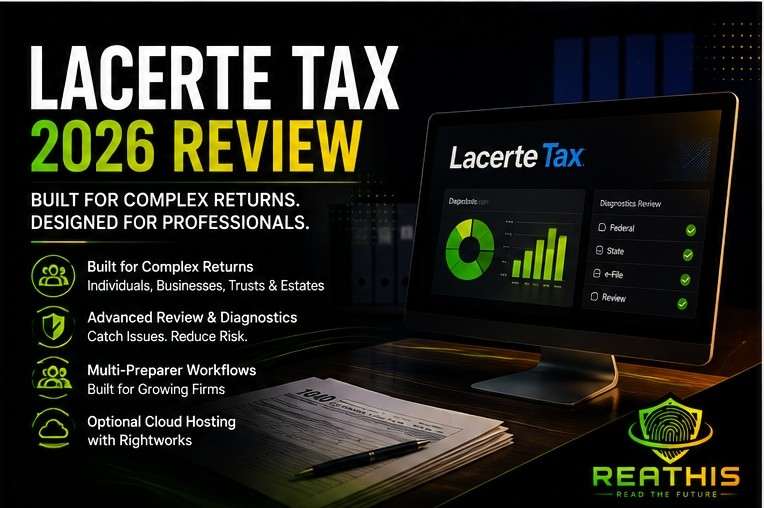
- Lacerte Tax is best suited to CPA and tax firms that regularly handle complex returns and need greater preparation and review depth than a simpler professional tax platform may provide.
- Intuit specifically positions Lacerte around complex returns and multiple preparers, with professional workflows designed for firms that need greater control when handling demanding individual and business tax work.
- Lacerte can create the most value when a firm’s workload includes substantial multi-state, partnership, S corporation, trust, estate, high-net-worth, or other review-intensive tax engagements. Firms dominated by straightforward returns may not gain enough additional efficiency to justify a premium platform.
- Lacerte remains desktop professional tax software, although Intuit offers optional Rightworks-powered hosting for firms that need remote access. Hosting changes where Lacerte runs; it does not turn the underlying application into browser-native software.
- ReaThis considers Lacerte strongest when complex-return efficiency and reviewer time justify the additional software cost. Firms focused mainly on straightforward individual and ordinary small-business returns should compare ProSeries and Drake before paying for capabilities they may rarely use.
Introduction
Professional tax software becomes harder to compare as a firm’s returns become more complicated. A simple comparison can count forms, electronic filing, diagnostics, portals, and e-signatures, but those features do not reveal how efficiently a reviewer can understand a complicated partnership, trace an unexpected calculation, manage multiple states, or identify an issue before a return reaches the client.
Lacerte has built its reputation around that deeper end of professional tax preparation. Intuit now explicitly differentiates the product from ProSeries by positioning Lacerte for complex, high-volume firms that need greater control and visibility, while it positions ProSeries around straightforward returns and streamlined workflows for small to midsize firms.
That distinction should shape the buying decision. A firm does not need Lacerte merely because it prepares taxes professionally, and a lower-cost platform does not automatically offer better value simply because the invoice is smaller. The real question is whether Lacerte saves enough preparation, review, correction, and planning time on the firm’s actual return portfolio to justify its higher operating cost.
Key Takeaways
- Lacerte makes its strongest case around complex professional tax work, particularly when firms handle substantial business, multi-state, trust, estate, and high-net-worth engagements.
- Intuit currently documents more than 25,000 diagnostics and more than 7,200 tax forms, giving Lacerte unusually broad calculation and review depth.
- Pricing requires more analysis than the advertised entry price. Intuit currently lists Pay-Per-Return starting at $599 per year, while bundled and unlimited configurations depend on the firm’s selected modules and quote.
- Lacerte remains a desktop tax application, although Intuit offers Rightworks-powered hosting as a separate monthly service.
- Firms dominated by straightforward returns may overbuy with Lacerte. Drake or ProSeries can deserve stronger consideration when complexity does not justify Lacerte’s additional cost.
How We Evaluated: ReaThis reviewed current Intuit Lacerte documentation, tax-year 2026 pricing information, product features, deployment options, current third-party reviews, and independent professional-user survey data. We did not conduct a controlled hands-on benchmark against competing tax applications, so this review separates documented capabilities, third-party user experience, and ReaThis analysis.
What Is Lacerte Tax?
Lacerte is Intuit’s professional desktop tax software for CPA firms that need to prepare and review complex individual and business returns. Intuit currently promotes the platform around complex calculations, multi-preparer workflows, automated diagnostics, document handling, client collaboration, and tax-planning capabilities rather than positioning it as its simplest entry-level professional product.
The program uses a professional input-oriented workflow rather than relying solely on direct entry into tax forms. That approach gives preparers structured places to enter underlying tax information while allowing reviewers to examine how values eventually flow to forms and schedules. For experienced tax professionals, the distinction can become particularly valuable when a return contains numerous entities, states, K-1s, adjustments, elections, or other interdependent calculations.
Lacerte also sits inside a broader Intuit professional ecosystem. Current product materials include Intuit Link for secure client document collection, automated document import, automated K-1 delivery, Intuit Sign, document management capabilities, and connections to Intuit Tax Advisor.
Why Complexity Is the Real Reason to Buy Lacerte
The strongest argument for Lacerte is not that it can prepare a 1040. Many professional products can do that well. Lacerte becomes more compelling when a firm’s clients create enough complexity that better diagnostics, review visibility, calculation depth, and information tracing can prevent expensive rework.
Intuit currently states that Lacerte includes more than 25,000 automated diagnostics and more than 7,200 tax forms. Those are vendor-reported figures rather than an independent benchmark, but they demonstrate where Intuit has positioned the product: breadth and complex-return control.
The distinction matters economically. If a senior reviewer spends twenty additional minutes understanding a complicated return because the firm’s cheaper software provides weaker diagnostics or less transparent calculations, the firm’s labor cost can quickly exceed the apparent license savings. Conversely, a practice preparing mostly straightforward returns may never extract enough value from those deeper capabilities to justify paying for them.
The right comparison therefore starts with return complexity, not software prestige.
Lacerte Pricing in 2026
Intuit currently offers a Pay-Per-Return option as well as customized bundled and unlimited configurations. Its live tax-year 2026 pricing page lists the annual Pay-Per-Return license at $599 per year during the current offer, down from a displayed $813 reference price, with individual and business federal and state returns purchased as needed. Intuit also offers bundles and unlimited individual or business return configurations through customized plans.
| Lacerte Option | General Fit | Current Buying Model |
|---|---|---|
| Pay-Per-Return | Lower-volume firms | Annual license + per-return charges |
| Return bundles | Firms with predictable volume | Individual and/or business return bundles |
| Unlimited configurations | Higher-volume firms | Unlimited selected return categories |
| Optional Hosting | Remote/multi-location firms | Separate monthly hosting service |
The current introductory promotion should not drive a long-term software decision. Intuit says the tax-year 2026 offer includes temporary discounts, while customized package pricing depends on the modules and return configuration the firm selects.
A serious comparison should therefore model at least three years of software cost. Include annual licensing, return authorizations, states or modules where applicable, additional users, hosting, tax-planning products, document systems, migration, training, and staff productivity during implementation.
The Diagnostics and Review Workflow Are More Important Than the Form Count
A form count sounds impressive in marketing copy, but reviewers rarely experience tax software by counting forms. They experience it when a return does something unexpected and they need to understand why.
Lacerte’s extensive diagnostics can help surface missing, inconsistent, or potentially problematic information before filing. Intuit currently reports more than 25,000 automated diagnostics, but the value of that number depends on how relevant and actionable those diagnostics are for the firm’s actual engagements.
This is where accounting firms evaluating Lacerte should conduct realistic testing. Instead of preparing one easy demonstration return, use several of the firm’s harder engagements. Include a multi-state partnership, an S corporation with complicated shareholder information, a high-net-worth individual receiving several K-1s, and a fiduciary return if those reflect normal production.
Then let both a preparer and reviewer work through them. The software should reduce review friction, not merely produce a technically complete return.
Document Collection and K-1 Workflows Add Practical Value
Intuit has expanded Lacerte beyond data entry and calculation. Intuit Link gives firms an encrypted client portal for collecting documents and responses, while Lacerte’s document-import functionality can extract information from W-2s, 1099s, K-1s, and other documents and map it into relevant fields.
Automated K-1 delivery addresses another common professional workflow. Intuit says firms can distribute secure links for partner K-1s in bulk rather than manually handling each document.
These features matter because tax preparation rarely fails at the calculation engine alone. Firms lose time collecting information, chasing clients, entering documents, distributing final materials, and resolving review notes. A tax platform that reduces those handoffs can create value even when the underlying tax calculation remains similar to competing software.
Lacerte and Tax Planning
Lacerte also deserves attention from firms trying to connect compliance work with advisory services. Intuit currently integrates Lacerte with Intuit Tax Advisor and markets the combination as a way to use return data to create client tax strategies.
However, firms should not buy Lacerte simply because the word “advisory” appears in the product ecosystem. Successful tax advisory requires staff expertise, a repeatable service model, clear client deliverables, pricing, review standards, and enough client demand to justify the process.
The software can reduce friction between compliance data and planning. It cannot create an advisory practice by itself.
What Current Users Say About Lacerte
Third-party review platforms generally support Lacerte’s reputation for handling professional and complex tax work. G2’s current review summary says users frequently praise its robust capabilities and ability to streamline complex returns, while Capterra reviews include positive feedback around multi-state preparation, reliability, and professional functionality.
The feedback is not uniformly positive. Current Capterra reviews also contain complaints involving support, cost, and particular return workflows. Capterra currently shows a relatively modest number of reviews for the product, which means individual comments should not be treated as statistically representative of Lacerte’s entire user base.
The broader AICPA survey provides stronger market context. Among 2,011 professional preparers surveyed in 2025, 15.8% used Lacerte, and the report described Lacerte as having notable adoption among midrange firms.
Taken together, the evidence suggests a mature product with meaningful professional adoption and strong complex-return positioning, but not a platform that every firm considers inexpensive or frictionless.
Lacerte Is Not Cloud-Native Software
Lacerte remains a Windows desktop tax application. Firms can install it on their own supported infrastructure or use Intuit’s Rightworks-powered hosting service to access the application remotely. Intuit describes that hosting as a separate monthly add-on rather than a conversion of Lacerte into browser-native SaaS.
That distinction matters to firms modernizing their technology stack. Hosting can centralize the application and improve remote access, but the underlying application architecture remains different from a platform such as CCH Axcess Tax or ProConnect Tax that centers its deployment around cloud delivery.
A firm that primarily wants Lacerte’s complex-return engine may accept that tradeoff easily. A firm whose strategic goal is to eliminate desktop applications should include architecture in the buying decision rather than assuming remote hosting solves the same problem as cloud-native software.
Where Lacerte Can Create Friction
The first issue is cost. Price complaints appear broadly across professional tax software, and Lacerte sits at the premium end of Intuit’s professional lineup. The more important question is whether a firm’s high-value work generates enough efficiency or risk reduction to justify that premium.
The second issue is training. Deep tax software rewards experience, but that can create onboarding friction when firms add junior or seasonal preparers. A partner who has used Lacerte for fifteen years should not serve as the only person who tests a proposed deployment.
Finally, firms should consider technology direction. Lacerte’s desktop architecture, even when hosted, may fit a firm differently from a cloud-native tax platform. That does not make it obsolete; it simply makes architecture another factor alongside tax depth.
Lacerte vs. ProSeries, Drake Tax, and CCH Axcess Tax
| Product | Strongest Fit | Main Advantage | Main Tradeoff |
|---|---|---|---|
| Lacerte | Complex, review-heavy firms | Diagnostics and complex-return depth | Premium economics and desktop architecture |
| ProSeries | Small to midsize firms | Forms-based workflow and accessibility | Less oriented toward the deepest complex work |
| Drake Tax | Value-focused practices | Cost and broad professional coverage | Less enterprise-oriented workflow |
| CCH Axcess Tax | Cloud-focused sophisticated firms | Cloud architecture and connected CCH ecosystem | Cost, implementation, and learning curve |
Intuit itself separates Lacerte and ProSeries along complexity lines, while Wolters Kluwer positions CCH Axcess Tax around a cloud-based integrated tax workflow.
No firm should use this table as a universal ranking. A 700-return practice with complex partnerships may choose very differently from a 700-return practice dominated by straightforward individual returns.
The ReaThis Lacerte Fit Test
Before purchasing Lacerte, determine how much of the firm’s revenue comes from engagements that genuinely benefit from deeper tax capability. Count complex partnerships, S corporations, trusts, estates, high-net-worth individual returns, multi-state engagements, and other work that consumes significant review time.
Next, examine staff structure. If experienced professionals prepare and review most returns, the firm may extract more value from Lacerte’s depth. If the practice trains large numbers of seasonal or junior preparers, learning time deserves greater weight.
Finally, model the cost of staying as well as the cost of switching. Firms often compare a new license against their current invoice but ignore training, conversion, process changes, document workflow, downtime, and first-season productivity. The best platform is the one that creates the strongest operating economics across the entire tax process.
Pros and Cons of Lacerte Tax
Advantages
Lacerte offers deep professional tax capability, extensive diagnostics, broad form coverage, strong complex-return positioning, integrated document collection, K-1 distribution, digital signatures, and access to Intuit’s tax-planning ecosystem. Its established position among professional firms also means buyers can find a substantial community of experienced users and support resources.
Limitations
The platform can become expensive relative to simpler professional tax products, particularly when a firm does not need its deeper capabilities. Its desktop architecture may also conflict with firms pursuing a fully browser-native technology strategy, while migration and staff training can materially increase the true cost of adoption.
Frequently Asked Questions
Yes. Intuit specifically positions Lacerte for complex and high-volume professional tax work, and the current product includes more than 25,000 diagnostics and more than 7,200 tax forms. Firms should still test their own complicated returns because feature counts cannot prove workflow quality for every tax situation.
Lacerte itself remains desktop tax software. Intuit offers separate Rightworks-powered hosting that allows firms to run Lacerte remotely, but hosted Lacerte does not become a browser-native application.
Intuit positions Lacerte for complex, high-volume firms that need greater control and visibility, while it positions ProSeries for small to midsize firms focused more heavily on straightforward returns, speed, and ease of use.
Intuit’s current page lists Lacerte Pay-Per-Return starting at $599 per year during its current offer. Bundled and unlimited configurations depend on the firm’s selected return types and modules, so firms should obtain a current quote and compare normal long-term pricing rather than relying only on promotional pricing.
Final Recommendation
Lacerte deserves strong consideration when complex tax work represents an important share of a firm’s revenue. Its diagnostics, form coverage, review depth, document workflows, K-1 handling, and Intuit ecosystem can create meaningful value when preparers regularly work through complicated entities, multi-state returns, trusts, estates, and high-net-worth engagements. In those environments, reducing review friction can matter far more than minimizing the annual software invoice.
However, a firm should not buy Lacerte because it wants the most powerful-sounding option. Practices dominated by straightforward individual and ordinary small-business returns may get better economics from ProSeries or Drake, while firms committed to a cloud-native technology model should compare CCH Axcess Tax and ProConnect Tax carefully. Lacerte becomes the strongest choice when its additional depth solves problems the firm actually has.